



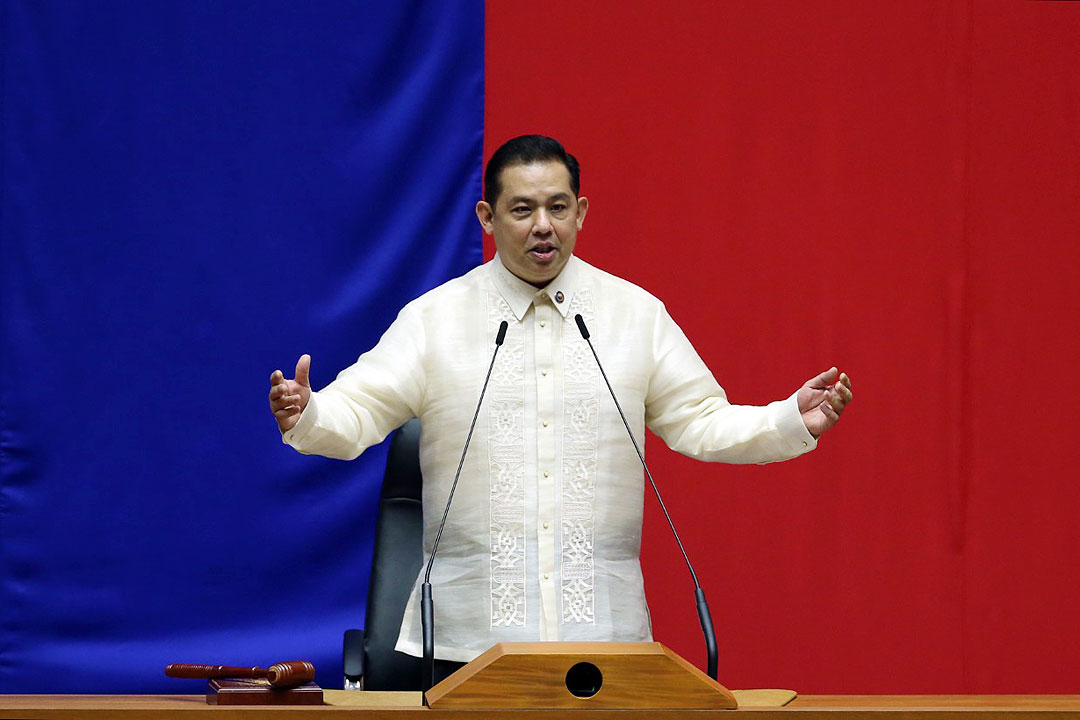

A party-list lawmaker has separately raised questions about a viral PGMN video that allegedly mismatched electric bill accounts, even as the camp of Leyte Rep. Martin Romualdez dismissed claims that the arrest of social media personality Franco Mabanta amounted to an attack on press freedom.

Bicol Saro Rep. Terry Ridon said he filed a resolution calling for an investigation into PGMN’s content after identifying what he described as a misrepresentation in one of the network’s widely shared videos. The clip, which went viral online, showed a person presenting electric bills that purportedly documented a dramatic rise in power costs — from roughly P700 to over P7,000 — across eight months.
Ridon said a review of the featured bills showed two different customer account numbers: CAN 2209188031 for an October 2025 bill showing P724.47, and CAN 0494824258 for a May 2026 bill totaling P7,009.64.
“PGMN and the person in the video should clarify why different Meralco account numbers were featured, and whether these CANs refer to the same household over the last several months. Without such clarification, this appears to be fake news and, worse, public disinformation,” Ridon said.
Ridon added that he backs House Speaker Faustino “Bojie” Dy III’s call to curb disinformation, saying that even legitimate concerns — like rising electricity costs — are undermined when built on false premises.
The statement came as Romualdez’s spokesperson, lawyer Elaine Atienza, pushed back against PGMN’s framing of Mabanta’s arrest as an attempt to muzzle the press.
“PGMN is twisting the narrative. The issue here is not about freedom of the press. It is not even about trampling the right of anyone to call out government officials. The true question is: did anyone ask for money in exchange for silence?” Atienza said.
NBI Director Melvin Matibag confirmed to Inquirer.net that agents from the bureau’s Organized and Transnational Crime Division arrested Mabanta and four others on the evening of May 5 at Valle Verde Country Club in Pasig City on charges of robbery and extortion in connection with the Cybercrime Prevention Act of 2012. The four others identified were Finance Officer Ericson James Pacaba, Incorporator John Alexander Vasquez Gomez, and employees Jardine Christian Requio Serrano and Franco Jose Gallardo.
According to the NBI, Mabanta had already attempted to extort Romualdez since last year, threatening to release a supposed exposé video linking the congressman to corruption in the House of Representatives. The scheme reportedly resumed two weeks ago when Mabanta allegedly sent a teaser of the video to Romualdez’s camp and raised his demand, initially to P350 million, before settling on P300 million to be paid in four tranches of P75 million each.

Undercover NBI agents posed as Romualdez’s representatives and met Mabanta at the Manila Peninsula Hotel in Makati, where he allegedly directed them to deliver the money in Pasig to a contact identified as “Jimmy,” later identified as Serrano. Agents then tracked the marked cash and arrested Mabanta and his companions at Valle Verde.
Mabanta denied the charges. In a statement released through PGMN’s Facebook page, he said the network had spent the past five months conducting research on Romualdez’s alleged corruption while he was House speaker, and that a 90-minute documentary had already been filmed, edited, and was ready for release.
“There was no extortion. There were zero threats from us. That’s all bullshit. The ‘evidence’ provided showed one side of the story. We committed no crime, and we can prove it. Romualdez did this to silence us,” PGMN wrote.
Atienza rejected that framing, saying any person who holds damaging information about a public official has a clear and lawful path forward.
“Whatever materials or exposés they claim to possess are irrelevant to the criminal allegations of extortion now under investigation. If anyone believes he has evidence of wrongdoing by public officials, the proper course is simple: release it, submit it to the authorities, and let the proper institutions act on it — not use it as leverage in exchange for money,” she said.
“That is what PGMN did: They purportedly produced a video that was allegedly ready to run several weeks ago and yet chose not to release it. That is not journalism, that is extortion … Such conduct undermines legitimate journalism and damages public trust in genuine media institutions,” Atienza added.
On Thursday, Matibag said additional government officials had approached the NBI to raise concerns about possible blackmail. “No one directly said they were blackmailed, but from the looks of it, that seems to be the direction they want to go,” he told reporters in an ambush interview at the NBI headquarters.
Atienza said the outcome of the case would rest on the courts, not on competing social media accounts. “This is simple: In a democracy, people are free to criticize. But our laws are clear: extortion is a crime,” she said.
