



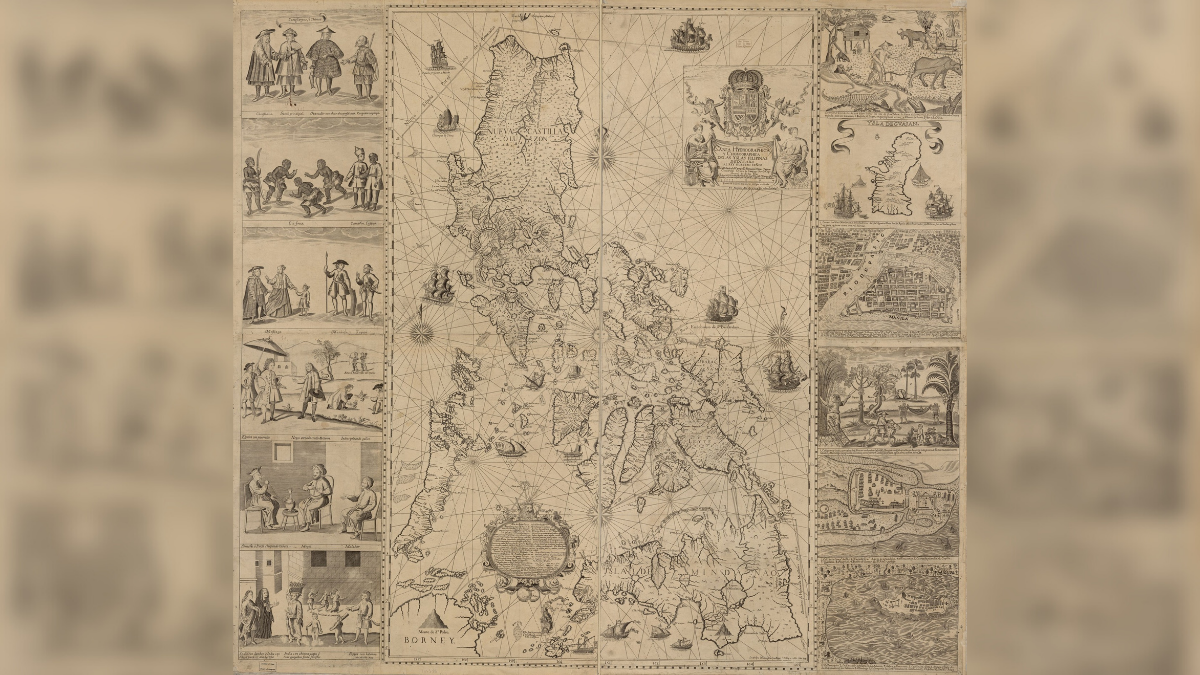

A colonial-era map that has largely disappeared from public consciousness may hold some of the strongest evidence yet in the Philippines’ long-running territorial dispute with China — and a former Supreme Court justice wants Filipinos to pay attention to it again.

Antonio Carpio, who served as Senior Associate Justice of the Supreme Court, donated Thursday a copy of the 1875 Carta General del Archipielago Filipino to the National Library of the Philippines, calling it the most complete cartographic record of the Philippine archipelago predating the 1898 Treaty of Paris.
The significance of the map lies in what it includes: both Bajo de Masinloc — better known internationally as Scarborough Shoal, or Panatag — and Pag-asa (Thitu) Island in the Spratlys, both plotted within Philippine territory. These are two of the most contested features in the country’s ongoing dispute with Beijing.
“This is an old map that we have to be reacquainted with again because we have forgotten this map,” Carpio said at the turnover ceremony.
He sourced the copy from a map dealer, and described it as likely the only one currently in the country.
Carpio traced the roots of the confusion to a drafting flaw in the Treaty of Paris itself. The coordinates written into that treaty, he explained, drew lines that left out several islands — including Scarborough, the Spratlys, Cagayan de Sulu, and Sibutu — even though Spain’s actual territorial holdings included them.
“The text of the treaty did not match with the map attached to the treaty, and that was the problem. Because after signing the Treaty of Paris of 1898, the Americans came here and the Spanish garrison in Cagayan de Sulu and Sibutu refused to vacate.”
“And so there was a dispute,” he added, which pushed the Americans to return to Spain and negotiate a correction — producing the 1900 Treaty of Washington.

That subsequent treaty, Carpio argued, was specifically designed to fix what the Paris agreement got wrong, and it extended American sovereignty — and by succession, Philippine sovereignty — over islands that fell outside the original treaty lines.
Yet the Treaty of Washington has been almost entirely absent from public and academic discourse. Carpio said it was never taught in law school, which he believes contributed to a widespread but mistaken belief that the Philippines’ national territory is limited to islands within the Paris treaty boundaries.
“There is this misconception that what was ceded by Spain to the US were only the islands within the treaty lines. Everybody forgot about the Treaty of Washington,” Carpio said. He pointed out that this gap in awareness had unintended consequences: “It even misled the Chinese because they kept echoing what our public intellectuals had been saying — that the Scarborough and Spratlys were not ceded in a treaty by Spain.”
He said legal scholars and researchers had been “remiss” in correcting this, and named three prominent figures whose statements had reinforced the flawed framing — the late former Solicitor General Estelito Mendoza, the late former Senate President Juan Ponce Enrile, and the late Ateneo law school dean Joaquin Bernas.
Between 1899 and 1902, the US War Department produced four versions of the 1875 Carta General, adopting it as the reference map both before and after the Treaty of Washington was signed.
As for why no Philippine government after independence had retained a copy, Carpio said a historian pointed to the Japanese occupation as the likely explanation. Japan, which had claimed the Spratlys in 1939, is believed to have destroyed a large volume of historical records during the war — maps likely among them.
The donation came days after the Chinese Embassy in Manila publicized a 1990 letter written by then Philippine Ambassador to Germany Benvenido Tan Jr., in which he stated that Scarborough Shoal “does not fall within territorial sovereignty of the Philippines” and described it as lying ten miles outside the Treaty of Paris lines, though within the country’s 200-mile exclusive economic zone.
Carpio dismissed the letter’s legal weight outright: “The rule in international law is that only the head of state or the foreign minister can issue a statement or a letter binding the state. He may be an ambassador or undersecretary but his statement is not binding on the state.”
