



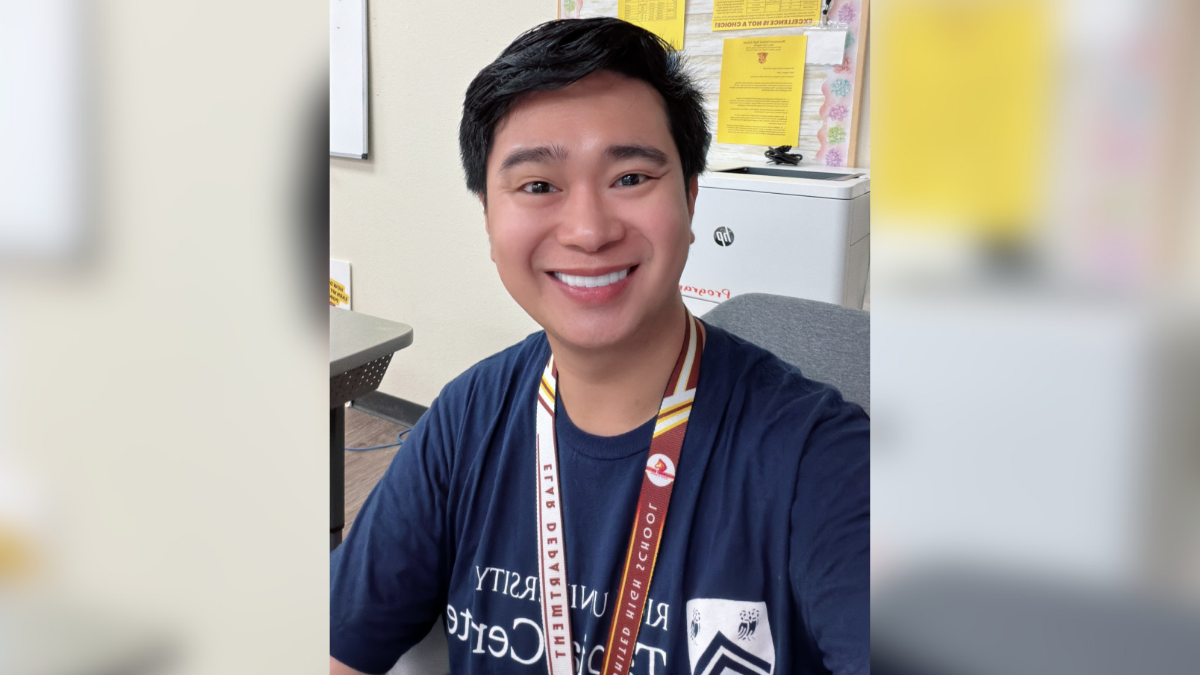

Every international teacher who signs up for a J-1 exchange knows the unspoken arithmetic: the career growth on one side of the ledger, the missed birthdays and funerals and ordinary Tuesdays back home on the other. For Dr. Eman A. Lachica, a Filipino educator at Beaumont United High School in Texas, that arithmetic became a little easier to justify the day an email landed in his inbox announcing he had won a Silver Star in a nationwide civic education competition.

His first instinct was disbelief. “At first, I honestly thought there had been some mistake because I knew this was a countrywide competition involving many talented educators across the United States,” he shares with TGFM. When it sank in that the Bill of Rights Institute and iCivics had indeed selected him among their Silver Star Award winners, disbelief gave way to something quieter. “My immediate reaction was to thank God.”
From Philippine classrooms to a Texas high school
Before Texas, there was a long apprenticeship. Dr. Eman had worked his way through nearly every rung of the Philippine education system — classroom teacher, Master Teacher, Education Program Specialist, college instructor. The throughline was a conviction he states plainly: education is, in his words, “one of the most powerful tools for transforming lives and communities.”
That conviction carried him to the United States in 2023 through the J-1 Exchange Visitor Program, which places international educators in American schools to share their expertise and absorb new practices in return. He joined Beaumont Independent School District to teach Emergent Bilingual students — young people learning academic content and a new language at the same time. The assignment could have been just a posting. Instead, the Filipino teacher describes it as something closer to a home. Beaumont United, he says, “has become more than just my workplace, it has become a community where I have grown professionally and personally.”
Making civics matter to students still learning the language
The challenge in the civic education project was not abstract. Teaching rights, responsibilities, and participation is hard enough; teaching it to students still building fluency in English raises the degree of difficulty considerably. Dr. Eman’s answer was to refuse the lecture.

“One of my goals as an educator is to make learning relevant to students’ lives,” he explains. Rather than hand down definitions, he anchored concepts like natural rights and civic responsibility in things his students could touch — current events, literature, debates, reflective writing. He worked deliberately to keep the material within reach for Emergent Bilingual learners, tying every idea back to their families and neighborhoods. The shift was visible. As they connected the lessons to their own lives, the former Master Teacher says, “students became more engaged and began to see themselves as individuals who could contribute positively to society.”
He is insistent that the recognition is not his alone. The students sit at the center of it. “Their willingness to participate, think critically, and engage in meaningful civic discussions made the learning experiences possible.” He credits his ESL aide, Miss Karla Cadenas, for steady encouragement and reinforcement, and his administrators — principal Ms. Tamara Long and assistant principal Dr. Chaison — for building a school where, as he puts it, “creativity and student-centered learning can thrive.”
The cost behind the recognition
What the award does not show is the distance. “One of the biggest challenges of being an international teacher is being away from family and loved ones,” he says. Important life events, celebrations, hard moments — all of them experienced from thousands of miles away, on top of the work of adjusting to an unfamiliar system and culture.
This is where moments like the Silver Star do their real work. They affirm that the trade was worth making. But Dr. Eman is careful to rank his rewards honestly: the award is wonderful, yet “seeing students grow and succeed remains my greatest reward.”
The win carries a $2,000 grant for his school, which he hopes to channel into instructional resources and civic engagement projects that let students practice participation rather than just study it. His ambition for them runs past the classroom. Whether they end up as teachers, nurses, business leaders, or public servants, he wants them carrying one idea out the door with them — that their voices matter, and that, in his words, “positive change begins with informed, engaged individuals.”
