



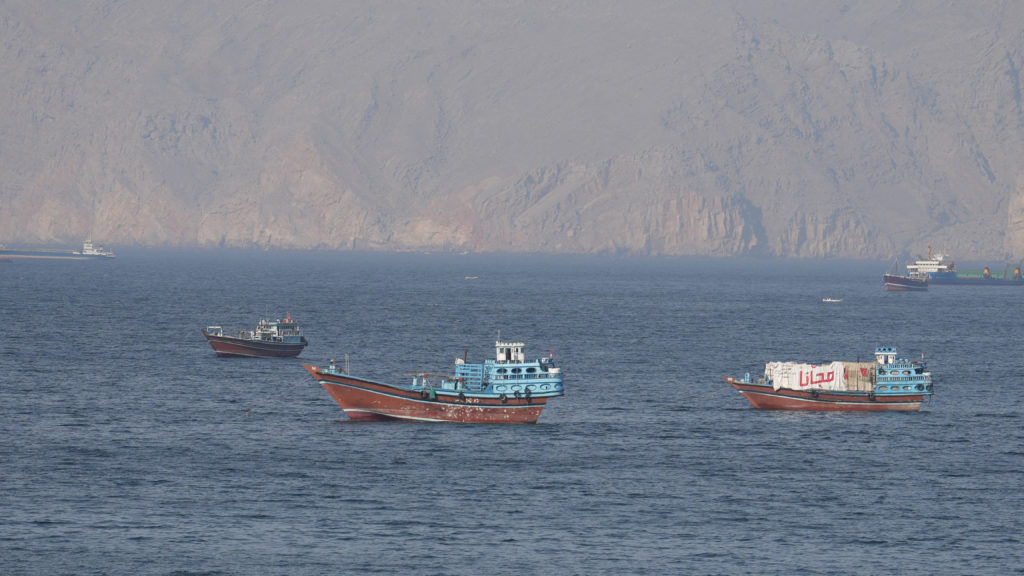

Iran’s armed forces reimposed control over the Strait of Hormuz on Saturday, reversing a brief reopening and throwing fresh uncertainty over ceasefire negotiations with the United States and Israel that have just four days left to produce a deal.

Iranian state television cited a statement from military central command saying the waterway had “returned to its previous status” and was under “strict management and control of the armed forces” — a move Tehran directly linked to Washington’s refusal to lift its naval blockade of Iranian ports.
The reversal came just hours after ships had begun moving through the strait again. Maritime tracking data showed several vessels completing transits in both directions by 0900 GMT, some hugging Iranian territorial waters and broadcasting Indian or Chinese identities in apparent signals of neutrality. At least two tankers that had departed UAE ports and were heading east toward India appeared to have aborted their journeys mid-route.
The strait normally carries roughly a fifth of the world’s oil and liquefied natural gas supply.
Uranium the harder fight
Even before the strait’s status flip, a sharper dispute had emerged over Iran’s stockpile of near-weapons-grade enriched uranium — and the two sides appeared to be describing entirely different negotiations.
Speaking at an event in Arizona on Friday, US President Donald Trump said Iran had agreed to hand over approximately 440 kilograms of uranium enriched to 60 percent, close to weapons-grade. “We’re going to get it by going in with Iran, with lots of excavators,” Trump said.
Iranian foreign ministry spokesman Esmaeil Baqaei flatly contradicted that account on state television. “Iran’s enriched uranium is not going to be transferred anywhere,” he said. “Transfer of Iran’s enriched uranium to the US has never been raised in negotiations.”

The stockpile is believed to be buried deep underground following US bombing during a 12-day military campaign last June.
Mediation push continues
Pakistan’s military chief, Field Marshal Asim Munir, wrapped up a three-day visit to Tehran on Saturday, where he met Iran’s top leadership as part of ongoing mediation efforts. Simultaneously, Pakistani Prime Minister Shehbaz Sharif traveled to Saudi Arabia, Qatar, and Turkey to advance the peace process.
Islamabad has taken on a central role as lead broker in the conflict, which began on February 28 when the US and Israel launched a coordinated wave of surprise strikes on Iran — an operation that killed Supreme Leader Ali Khamenei and numerous other senior officials despite ongoing diplomatic contacts between Washington and Tehran at the time. The war quickly expanded, with Iran targeting American interests across the Gulf and Hezbollah drawing Lebanon into the fighting through rocket attacks on Israel.
A second round of direct talks is expected in the Pakistani capital this week. The first round, hosted in Islamabad last weekend, was attended by US Vice President JD Vance.
Trump on Friday called the day “GREAT AND BRILLIANT” in social media posts that repeatedly praised Pakistan’s mediation role, and told AFP by phone that the two sides were “very close to having a deal” with “no sticking points at all.”
Iran’s civil aviation authority opened the country’s airspace to international transit flights on Saturday, describing a route through the country’s eastern corridor — a signal that the two-week ceasefire, despite the strait dispute, remained broadly intact.
Iranian citizens, however, entered their 50th consecutive day cut off from the international internet, with the blackout that began at the war’s outset still in force as of Saturday, according to network monitoring group Netblocks.
