





The Philippine nursing license was already in his pocket, earned and passed, when Montreal told him it was worth nothing. Not for practicing, anyway. So he took a menial job and waited — a trained nurse doing blue-collar work in a new country, watching the clock on a credential evaluation that would decide when he could be a nurse again.

That waiting room belongs to Neri Torrato Camina Jr., a Filipino-Canadian clinical registered nurse now working progressive care at a Florida hospital. He is 48, close to sixteen years into the profession, and the man who once had to start his career over from scratch has since turned an appetite for education into a defining trait.
“I cannot practice my profession right away,” he recalls of those first months, “so I have to work a menial job while waiting for the right time to study and work as a nurse.”
The degree he couldn’t afford
Science was the pull from the beginning. It was his favorite subject in high school, and it carried him into a biology degree with medicine as the goal. Then the money ran the numbers for him. Medical school was out of reach, so he made the decision that would shape the next decade and a half: stay in the medical field, but come at it through nursing.
“I first took a BS Biology course,” the former biology major says, “but after graduation, due to financial constraints, I did not pursue my medical degree; instead I studied nursing to still be in a medical field.”
It’s a compromise plenty of Filipinos in scrubs would recognize — the plan that bends around what a family can pay. What’s less common is how far he ran with the alternative. After passing his Philippine licensure exam, he started as a volunteer nurse in Parañaque, moved into private duty work in Manila, took a brief private-duty stint in Singapore, then came home to work as a government nurse with the Department of Health while he waited for a Canadian immigrant visa.
Trained as a nurse, twice
The visa came through, and with it the hard lesson that a license earned in one country doesn’t cross borders. In Montreal, his Philippine credentials wouldn’t let him work as a nurse — hence the menial job, and the waiting.
Then he did something most people wouldn’t. He went back to school and trained as a nurse a second time, earning his Canadian license through a full pass at the education he’d already completed at home. He lived and worked in Montreal from 2017 to 2024 before moving to Florida in early 2025, where he now works clinical staff on an intermediate care unit — the step just below intensive care, where patients are sicker and the margin thinner.
He refuses to write off the detour as lost time. He frames the blue-collar stretch as one of the more useful lessons he’s had.
“Despite the sacrifices and adversity, I am still grateful to God,” the Filipino-Canadian nurse says. “We should always have gratitude and kindness in our hearts.”
The work, and the distance behind it
The job itself is as multifaceted as nursing anywhere. He assesses patients and takes vital signs, gives medications, runs lab work, performs procedures, and coordinates constantly — with the broader healthcare team and with physicians on each patient’s plan through to recovery. On a progressive care floor, that coordination isn’t paperwork; it’s the difference between catching a decline early and catching it late.

He describes the pull of it plainly. “I like to save lives and comfort patients for their recuperation,” he says. “Being a nurse is a hard job, but nothing is hard as long as you love the job and put your sincere heart into it.”
What the job description leaves out is the cost of doing it an ocean from home. The hardest part of settling abroad, he says, wasn’t the workload — it was the distance, the ordinary grief of living alone, away from the people the work is meant to support. Video calls and messaging shrank the gap. Prayer covered the nights they didn’t.
“When I feel sad, depressed or lonely, I pray a lot and put my strong faith and belief in God,” he says.
The certificate habit
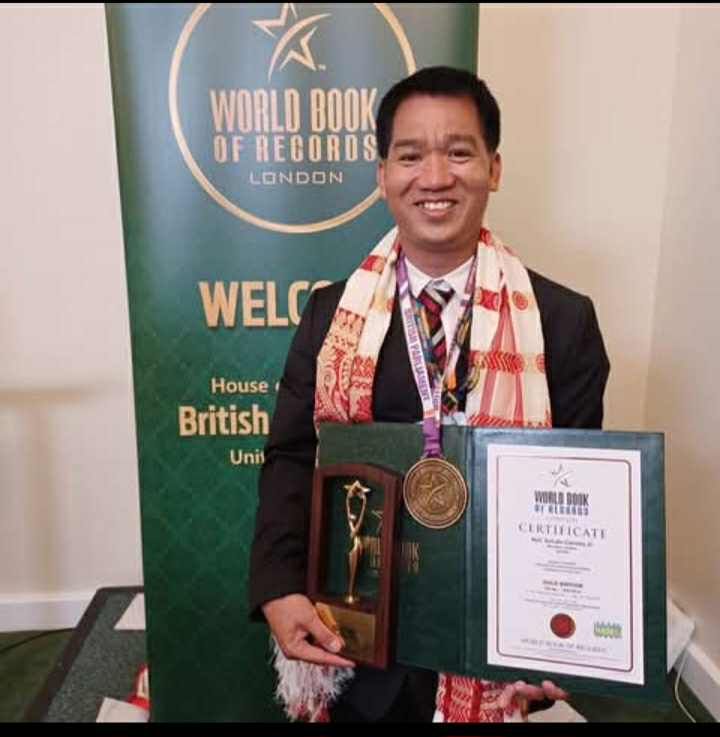
Somewhere in there, his appetite for continuing education turned into something bigger. He has pursued online certifications at a volume that has drawn a string of recognitions — a set of healthcare “world record” citations for the sheer number of certificates completed, along with “top nurse” honors from several US-based recognition companies. He counts himself, by his own tally, as the first Filipino to hold more than one such world-record award, and says he was nominated for the Excellence in Direct Patient Care Award by the Florida Nurses Association and an icon award from a nursing magazine in Orlando.
He’s candid that the honors trace back to one habit rather than any single dramatic feat. “I like continuing education online a lot,” he says, “and that is why I got world record awards.”
But it’s clear the certificates aren’t really the point for him. They’re a means to an argument he wants younger Filipinos to absorb — that learning is the one asset nobody can take.
“Education is the strong way to uplift status in life and be successful,” he says. His continuing education, he adds, “could really benefit other people, especially the younger generation, to never stop learning and studying because it is a precious jewel or treasure that nobody could be robbed or taken of.”
What comes next
The classroom isn’t done with him yet. He recently completed a master’s in nursing and is set to begin a doctoral degree in nursing in 2026 — the next rung in a plan that reaches toward healthcare administration and, eventually, an executive role before retirement. After that, he wants to come home.
His longer aspiration is less about title than payback. If he ever has the means, he says, he wants to build an educational foundation for children who can’t afford school, distributing supplies to the kids most likely to be counted out — the version of himself who once couldn’t afford the degree he wanted.
For the kababayan grinding it out overseas, his advice comes without polish. “Never give up,” he says. “You started and decided to leave the country and your loved ones, so you have to stand it and be strong. Fight, but do not forget to stay healthy and happy.”
Then, the line that sounds like his whole résumé compressed into a sentence: “Always proud to be Filipino with a good heart.”
