



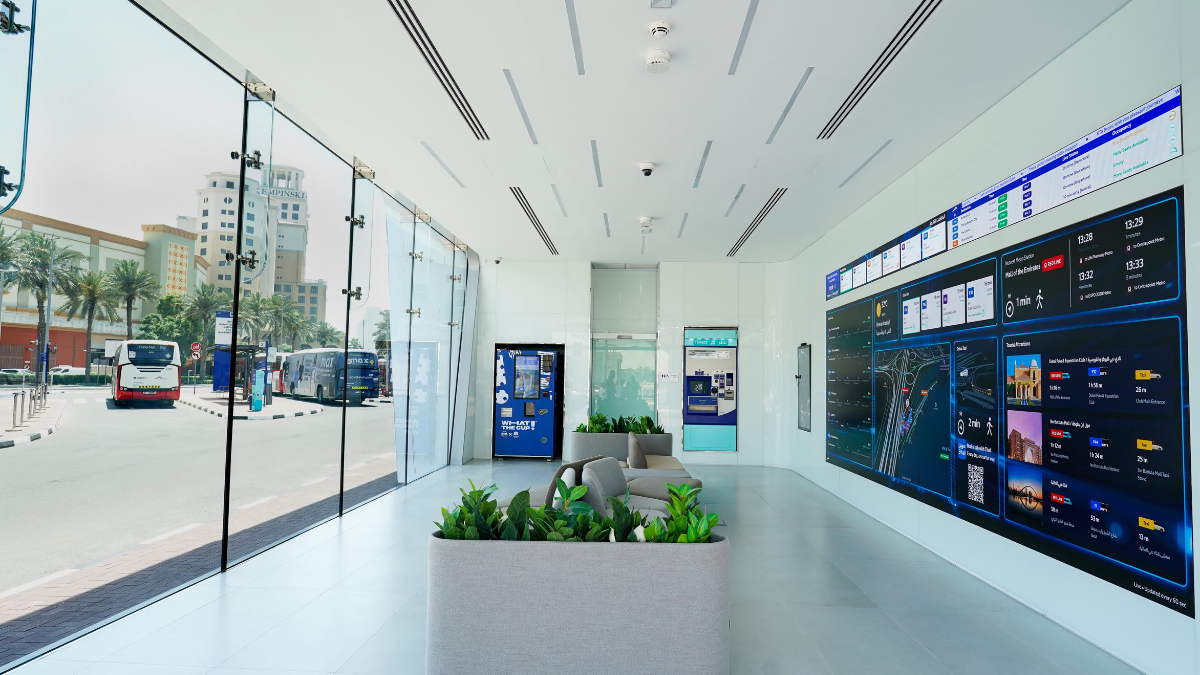

Solar panels power the facility. AI cameras watch the crowds. And passengers checking bus schedules can see live Metro arrival times on the same screen.

That is the reality inside Dubai’s newly opened smart bus station at Mall of the Emirates — what the Roads and Transport Authority (RTA) is calling the world’s first fully integrated smart bus terminal — a compact but technology-dense facility that redefines what a public transport hub can look like.
At just 147 square metres, the station is deliberately modest in footprint but ambitious in function. It accommodates up to 20 commuters at any given time and includes a designated rest area for bus drivers — a detail that signals the facility was designed with operational sustainability in mind, not just passenger experience.
Eleven bus routes pass through the hub, covering Metro feeder services, internal city routes and two seasonal connections. Commuters travelling to Al Barsha, Al Quoz, Umm Suqeim, Jumeirah Village Circle, The Greens, Arabian Ranches, Dubai Science Park and Dubai Studio City are among those served, along with visitors heading to Dubai Miracle Garden and Global Village.
RTA Director General Mattar Al Tayer positioned the launch within the authority’s broader digital transformation agenda.
“The opening of the first smart bus station marks a major advance under RTA’s strategy to create a modern, integrated and attractive environment for public transport users,” Al Tayer said. “We are committed to enhancing customer service by deploying the latest digital technologies and smart solutions to deliver the highest levels of comfort and efficiency to users, while strengthening the appeal of the public transport network.”
The station’s architecture follows RTA’s corporate visual identity and is directly connected to Mall of the Emirates Metro Station, making it a genuine interchange point rather than a standalone stop. Passengers inside can view real-time bus and Metro arrival data on large displays, check taxi stand availability, and access maps and directions to nearby landmarks — all from the same integrated system.

A smart kiosk with a virtual assistant handles trip planning queries, Lost and Found requests and direct connections to the RTA Call Centre. Digital ticket sales and nol card top-ups are also available on-site, alongside a vending machine linked to a loyalty rewards programme.
Among the station’s more operationally significant features is its crowd density monitoring system. Displays indicating how full approaching buses are allow commuters to make more informed boarding decisions — a practical tool for managing passenger flow without requiring staff intervention.
Al Tayer highlighted the safety and compliance dimensions of the station’s technology stack: “The station also incorporates advanced systems for crowd management and violation detection through AI-powered cameras, further enhancing safety and ensuring a smoother user experience.”
On the environmental side, the facility runs on solar power and uses smart air-quality sensors to continuously track conditions inside and around the station.
“The station’s design balances operational efficiency and user comfort while delivering an integrated service that combines flexibility and innovation,” Al Tayer added.
RTA has framed the station as part of Dubai’s long-term urban mobility goals — an effort to make public transit a more competitive alternative to private vehicles by removing friction points at every stage of the commute.
