



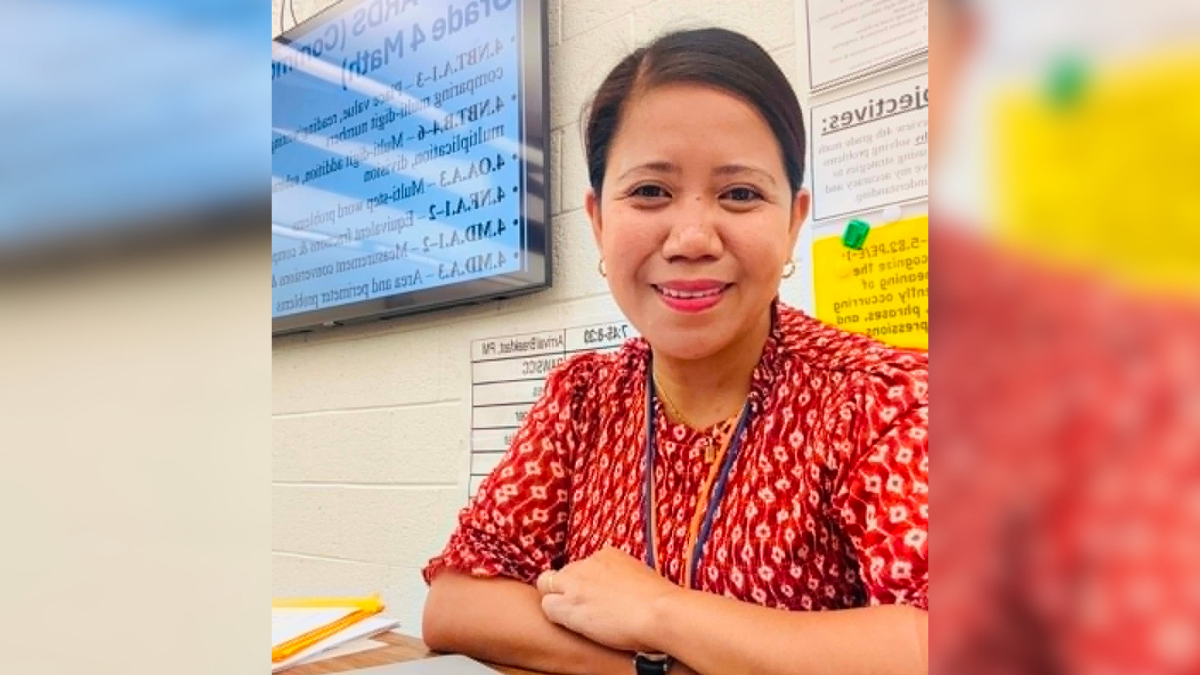

Ask any Filipino teacher why they stay in a profession that asks so much and pays so little in recognition, and you’ll often hear some version of the same answer: the students. The breakthroughs. The quiet proof that the work matters. Dr. Ma. Neiz Ewican Amper built an entire life around that conviction — then carried it eleven thousand kilometers to a fourth-grade classroom in Arizona to see if it would hold.

It did. Three years into teaching mathematics in the Coolidge Unified School District, the 40-year-old educator has taken on leadership roles — serving as Grade Level Team Lead for 5th grade in school year 2024–2025, and currently as Math Department Lead for Grades 4–5 in school year 2025–2026, collaborating with American colleagues on instruction, student performance, and academic growth across grade levels. But the title she values most isn’t on any org chart. “I carried with me the belief that excellence has no nationality,” she says. Her years abroad have been one long argument in its favor.
The decision that divided a room
The move was never impulsive. Neiz describes it as a decision “shaped by faith, responsibility, and a long-term vision” — the kind of choice a person turns over for months before committing. She wanted growth that her comfort zone couldn’t offer: a different education system, new teaching strategies, an understanding of how global classrooms actually work. She also wanted something harder to quantify. “I wanted to prove to myself that Filipino teachers are globally competitive, capable, and resilient.”
Not everyone shared the vision. Before she left, some people close to the family questioned whether the plan would work; others quietly pulled away, treating the opportunity as too uncertain to believe in. The former public-school teacher is candid about what stung most. “What hurt most was not the difficulty itself, but the silence and judgment from people we expected to understand and support us.”
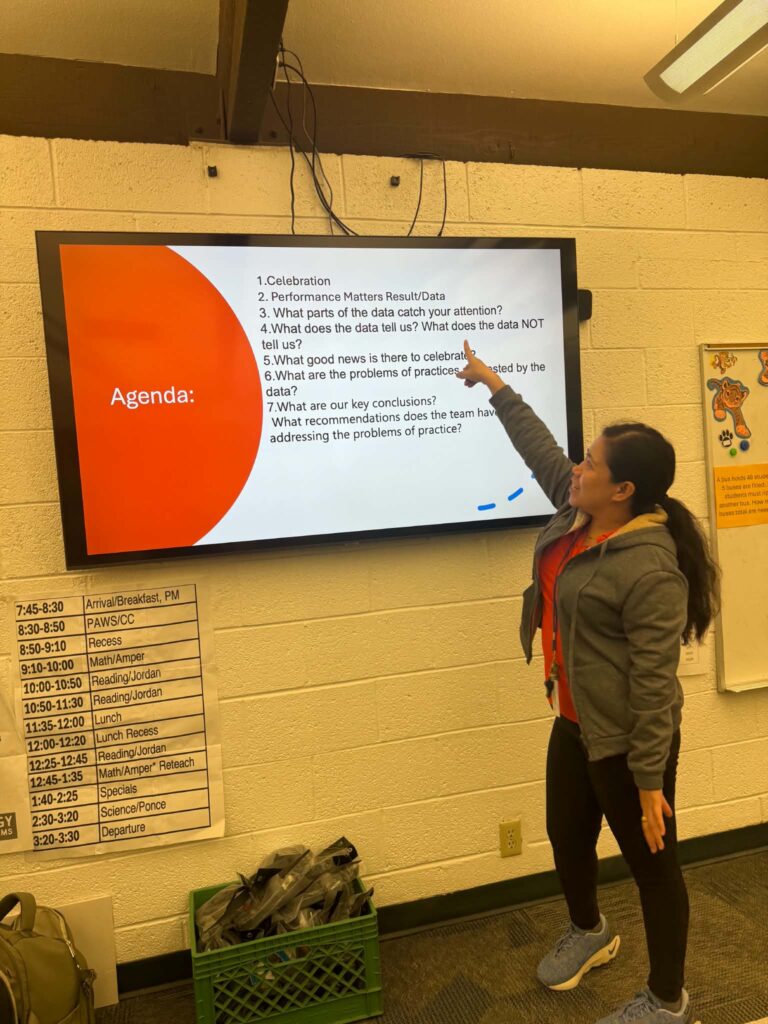
She went anyway. In July 2023, through the J-1 Teacher Exchange Program, she stepped into an elementary mathematics classroom in Arizona — and into a teaching culture that bore little resemblance to the one she’d spent seven years mastering back home.
Unlearning, then relearning
Seven years in Philippine public schools had given her a working philosophy: make mathematics meaningful and accessible, especially for the kids who arrive convinced they can’t do it. What Arizona demanded was that she keep the philosophy while rebuilding the method around it. “I had to unlearn familiar practices, relearn new systems, and continuously adapt to a different learning environment,” she recalls — all while holding on to the core values that shaped her as an educator in the first place.

The adjustment wasn’t only professional. She arrived alone. Her husband and children didn’t join her until November 2023, which meant the hardest months of acclimating to a new job also meant rebuilding a household from scratch in a foreign country. There was homesickness, pressure, emotional exhaustion. She names what got her through it plainly: prayer, family unity, perseverance, and a network of fellow Filipino educators who understood exactly what being far from home costs.

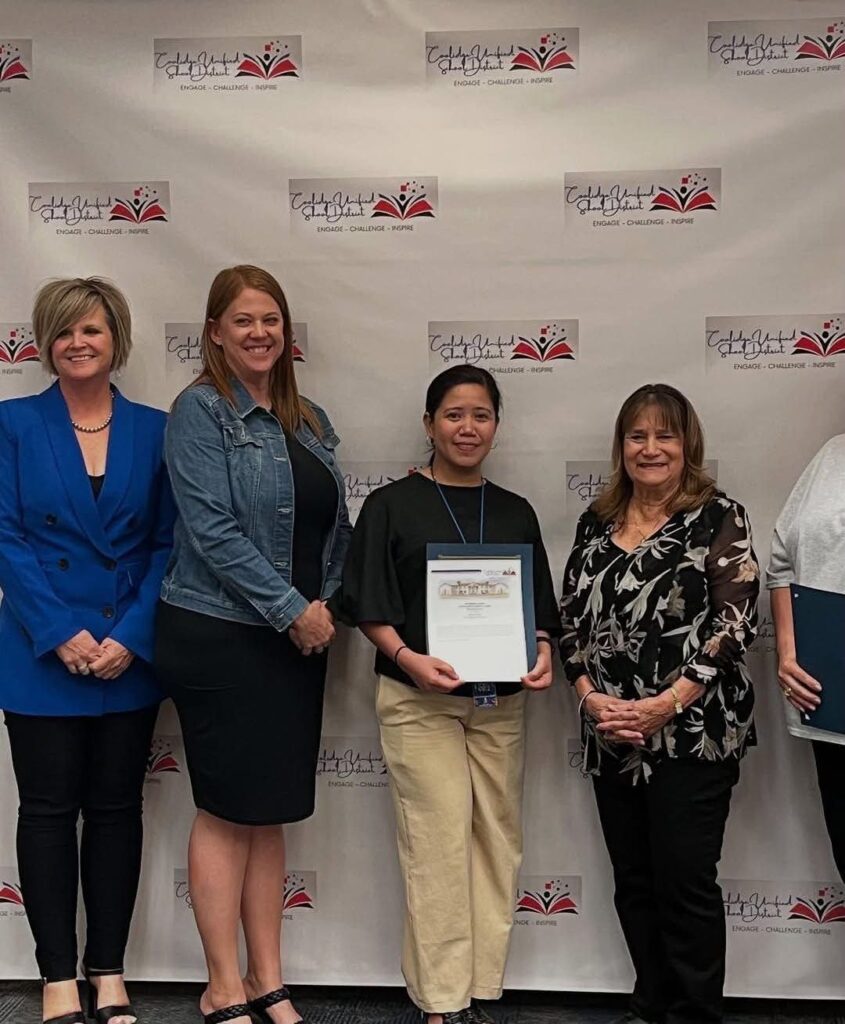
And she did all of it while finishing a doctorate. Completing her Doctorate in Development Education during the transition abroad — and now pursuing a Master of Arts in Education major in Special Education — is the accomplishment she returns to when asked what resilience actually means. “Resilience is not about never falling,” she says. “It is about continuing despite uncertainty.” In April 2025, the district recognized that consistency with an Outstanding Service Award, a moment she frames less as a trophy than as confirmation that quiet effort registers, even when no one seems to be watching.
The hand that finally goes up
For all the talk of leadership roles and graduate degrees, the part of the job she loves is smaller and more immediate. It happens at the level of a single child deciding they’re not hopeless after all.
“Teaching for me is not simply about delivering lessons,” she says. “It is about building confidence, breaking fear, and helping students see their own potential.” Every day in the classroom runs through the same cycle — struggle, patience, laughter, breakthrough — but for her, one moment never loses its charge. It’s the student who used to avoid mathematics entirely finally raising a hand and saying, “I get it now.”
Those four words are her real metric. Test scores measure something; confidence measures more. “Teaching is not measured only by test scores,” she says, “but by the confidence we help build in each learner.”
That conviction is already shaping what comes next. She plans to keep working in instructional leadership and special education, strengthening mathematics instruction and pushing for inclusive classrooms that serve learners of every kind. She also wants to mentor Filipino teachers eyeing international careers — honestly, including the parts the recruitment brochures leave out.
Her advice to kababayans abroad carries the weight of someone who earned it the hard way. “Your journey is valid even when others do not understand it,” she says. “Not everyone will celebrate your growth, and not everyone will understand your sacrifices.” Protect your peace, she urges. Be intentional about who you let close. Remember why you started.
She’s still living the proof of her own thesis — a Filipino educator in an American classroom, teaching arithmetic and something larger than arithmetic at the same time. “Wherever this journey continues,” she says, “I will remain committed to teaching with purpose, serving with integrity, and living with gratitude for every step that brought me here.”
