



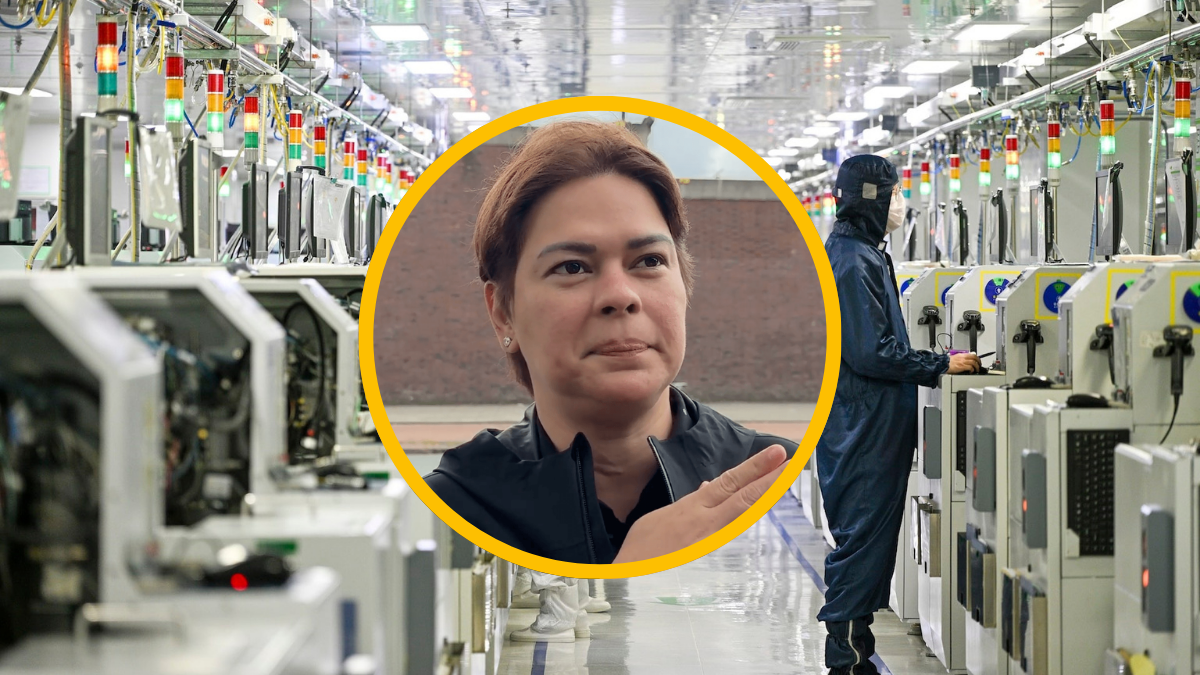

Vice President Sara Duterte’s brief exchange with a supporter in The Hague spread quickly online this week, less for what she said than for what she did not. Pressed to weigh in on Pax Silica, a project the government wants to build on more than 1,600 hectares in Tarlac, she first appeared to mishear the name before ending the matter in six words.

The moment was captured in a video uploaded by Duterte supporter Alvin Sarzate to his YouTube channel, filmed during the vice president’s July 28, 2026 appearance in The Hague, Netherlands. A woman asked, “Any thought po about sa Pax Silica na balak pong itayo sa Pilipinas?” Duterte responded, “Ano? Ano? Fox Sili… Fox Silic?” Sarzate corrected her: “Hindi, Ma’am. Pax Silica. Do you know anything about that?” Her reply: “Wala ako–I cannot comment on that.”
The clip landed at a pointed moment. A day earlier, President Ferdinand Marcos Jr. had held up Pax Silica during his State of the Nation Address, saying it “will bring quality jobs to our people, accelerate our industrial competitiveness, and revitalize our economy.” For anyone hearing the name for the first time through Duterte’s puzzled reaction, here is what the project actually involves.
Pax Silica is not a single building or company. It was launched in Washington, D.C., on December 12, 2025, as a coalition led by the United States, built to strengthen and diversify global supply chains for semiconductors, critical minerals, and advanced technologies. The unstated target is China’s dominance in advanced manufacturing; the stated aim is to secure supply chains and reduce reliance on Beijing. Washington assembled partner countries around that goal, and the Philippines signed on in April as the initiative’s 13th member.
What the country committed is a specific piece of land. The government has offered about 4,000 acres, roughly 1,620 hectares, in New Clark City in Capas, Tarlac, a footprint that sits within the larger 9,450-hectare New Clark City. The site would become an “Economic Security Zone” on land administered by the Bases Conversion and Development Authority, with the US Embassy describing an arrangement in which both governments share responsibility for governing the zone.

Officials have offered competing numbers on what it could deliver. BCDA President and Chief Executive Officer Joshua Bingcang told a Palace briefing the project could attract between US$40 billion and US$70 billion in investments once fully developed and generate more than 130,000 high-quality jobs. Philippine Ambassador to the United States Jose Manuel Romualdez, speaking on radio, put the figure higher, saying it could create up to 300,000 jobs and begin generating businesses as early as 2027 if the project moves this year. The gap between those two estimates has itself become part of the debate.
The timeline remains loose. The BCDA says site development is projected to begin within the first two years of a signing expected this year, with studies on earthquake and flood stability planned for next year over roughly a 12-month period. As of late April 2026, neither government had disclosed anchor tenants or firm investment commitments, and Defense Secretary Gilberto Teodoro Jr. acknowledged that “there are no firm documents yet.”
Opposition has hardened alongside the promotion. Critics have cast the deal as a neocolonial arrangement that would deepen foreign control over the economy and pull the country further into tensions with China. Advocacy groups estimate as many as 20,000 residents and 15,000 farmers could be displaced, and opponents warn the demand for critical minerals could accelerate large-scale mining in provinces such as Zambales, Palawan, and Nueva Vizcaya. The scientists’ group Agham said the BCDA presented an incomplete picture of the project’s potential impacts, while the agency maintains that all components comply with Philippine and international law.
Whether the vice president’s non-answer reflected genuine unfamiliarity or a deliberate refusal to be drawn in, she is one of many Filipinos still forming a view on a project whose scale, cost, and consequences remain only partly defined. The land is real, the coalition is signed, and the questions surrounding both are still open.
