



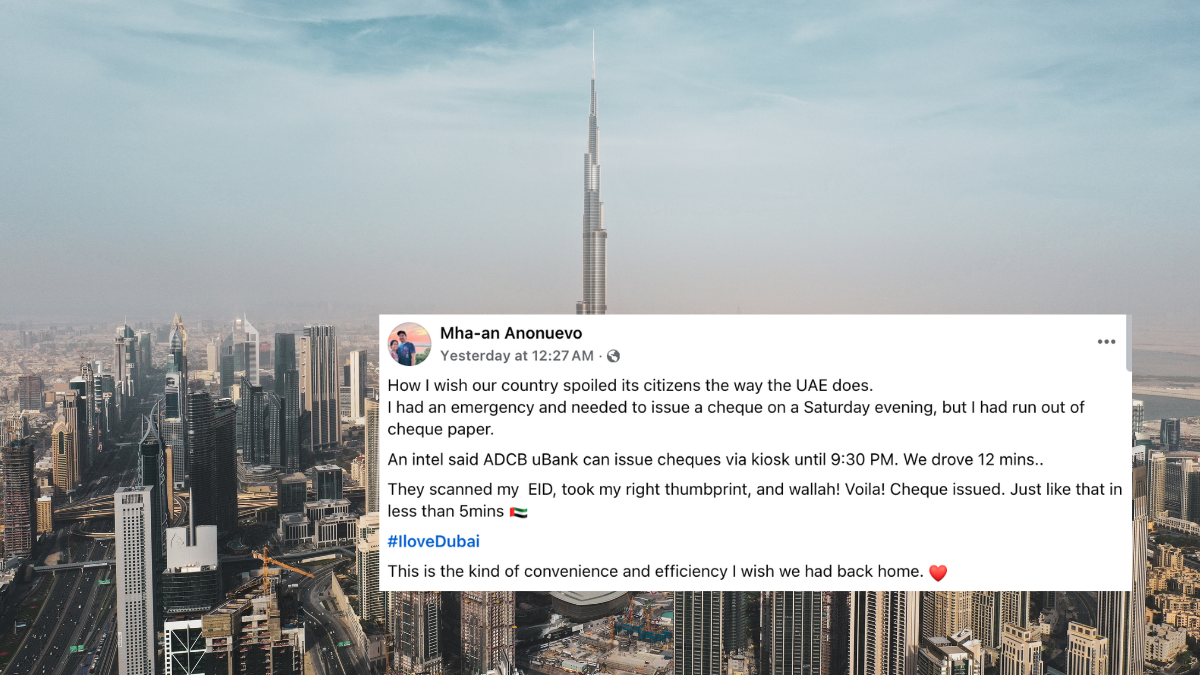

The post itself was small. Filipino expatriate Mha-an Anonuevo had an emergency, needed to issue a cheque on a Saturday evening, and had run out of cheque paper. A tip led her to an ADCB uBank kiosk a 12-minute drive away that stays open late. “They scanned my EID, took my right thumbprint, and wallah! Voila! Cheque issued. Just like that in less than 5 mins,” she wrote, closing with a wish that traveled further than the errand ever could: “This is the kind of convenience and efficiency I wish we had back home.”

It was not viral in the explosive sense. But it made the rounds among Filipinos abroad—because the cheque was never really the point. The point was the feeling underneath it: that in the UAE, the systems of daily life tend to just work, and that back home they often do not.
A city built around ease
Anonuevo’s instinct is backed by data. In the 2026 InterNations Expat Insider survey, one of the most closely watched global rankings of life abroad, Dubai placed among the world’s top-tier expat cities, and the UAE ranked the fourth-best country overall for expats to live and work. The country took the number one spot globally for career prospects and scored at the top for what the survey calls “expat essentials”—the visas, digital services, and administrative basics that determine whether ordinary life feels smooth or exhausting. It also ranked third worldwide for quality of life, with strong marks for safety, healthcare, and political stability.
That is the texture of the convenience Anonuevo was describing: banking after hours in minutes, but also efficient government services, dependable infrastructure, and the sense—as one expat quoted in the survey put it—of a lifestyle that feels safer, more comfortable, and, increasingly, more affordable than its luxury reputation suggests.
The contrast that stung
For many who read the post, the comparison wrote itself. The daily inconveniences expats most often cite about the Philippines are precisely the ones the UAE has engineered away: the punishing traffic of Metro Manila, patchy internet once you leave the big cities, and above all the unpredictability of government bureaucracy—slow processing, redundant requirements, and the sense of hours lost to paperwork.
The comments turned into a catalog of that frustration. “If you really want to experience better public and private services, step outside the Philippines,” wrote Ter Zamora. “That’s when you truly see the difference in how people are valued and treated.” Arlene C. Cordero traced the contrast from the moment travelers land—airport Wi-Fi and transport she felt lagged well behind Hong Kong and Singapore. Dong Merk compressed the whole grievance into a line: “30 minutes process in UAE is equal to 30 days process in Philippines.”

Andrew Reyes captured the particular absurdity of Philippine bureaucracy with a joke that landed because it felt true: “Simple things that government cant provide like applying ID with requirements of valid ID.”
Not just grievance
The thread was not a pile-on, though. Woven through it was a more reflective strain—people wrestling with why the gap exists and whether it can close.
Marl Binh urged perspective, noting that even many developed countries lack this level of service and that the Philippines reaching it will realistically take time. Rio Sun redirected the conversation from complaint to accountability, arguing that progress at home is possible if Filipinos vote for competent leaders with clean records rather than on the strength of a family name. Others simply added texture: that cheques are mostly an adult obligation tied to large payments like months of rent, and a reminder that convenience always comes with responsibility.
The ache the diaspora keeps returning to
What makes a post like Anonuevo’s resonate is not envy of a bank. It is the accumulation of small conveniences—each minor on its own—into a way of life that quietly tells residents their time is valued. For the millions of Filipinos who left to build careers overseas, that is the bittersweet core of the diaspora experience: gratitude for the ease they found abroad, tangled up with a wish that they had never needed to leave to find it.
“Wishing for this in the Philippines is understandable,” Marl Binh wrote, “but realistically, matagal pa bago maabot ang ganitong level of service.”
For now, the convenience lives 12 minutes away in Dubai—and the longing for it lives back home.
