



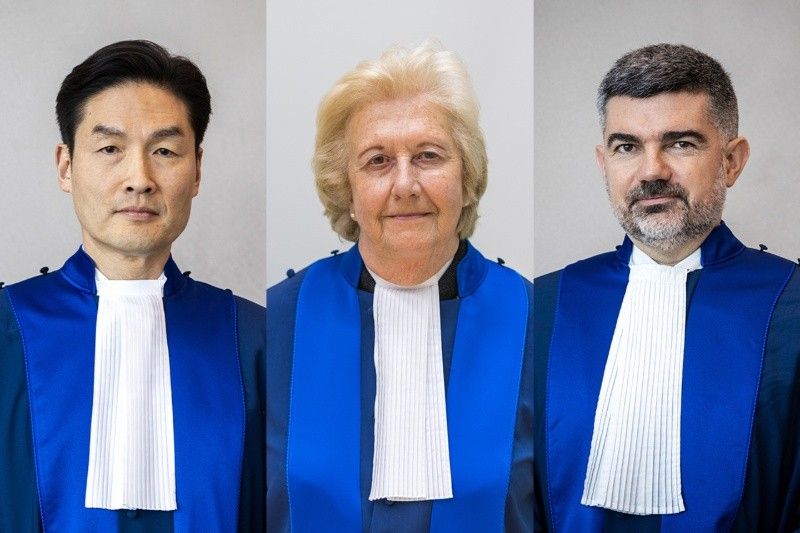

A French judge who once issued an arrest warrant for a Kosovo Liberation Army commander, a South Korean legal scholar who helped draft his country’s ratification of the ICC’s founding treaty, and a British barrister with four decades of war crimes prosecutions behind her — these are the three members of the panel that will try former Philippine President Rodrigo Duterte for crimes against humanity.

The International Criminal Court announced on Tuesday, April 28, that ICC President Tomoko Akane has constituted Trial Chamber III and assigned the Duterte case to it. The bench is composed of Judge Nicolas Guillou of France, Judge Keebong Paek of South Korea, and Judge Joanna Korner of the United Kingdom.
The three were selected from outside the pre-trial chamber that confirmed the charges on April 23 — a requirement under ICC rules that mandates a fresh panel for the full trial. The pre-trial chamber had unanimously upheld all three counts of crimes against humanity against Duterte.
Korner, 74, brings the longest track record of the three. A barrister and judge with more than 45 years in criminal law, she spent eight years as a senior prosecutor at the International Criminal Tribunal for the former Yugoslavia, where she led cases against Bosnian Serb leaders accused of ethnic cleansing. She later served on the Crown Court of England and Wales before joining the ICC in 2021. Most recently, she chaired the trial chamber that convicted Sudanese militia leader Ali Kushayb, sentencing him to 20 years in prison for war crimes and crimes against humanity in the Darfur region.

Paek’s path to The Hague began in 1992 as a public prosecutor in South Korea. He later moved to the country’s Ministry of Justice, where he drafted legislation for South Korea’s ratification of the Rome Statute and represented Seoul at ICC preparatory sessions. He also served at the United Nations Office on Drugs and Crime, helping member states implement the UN Convention against Transnational Organized Crime. His doctoral dissertation at Hanyang University examined the law of evidence in ICC proceedings specifically.
Guillou began his legal career as an investigating judge in France before serving as Chef de Cabinet to the President of the Special Tribunal for Lebanon and later as a liaison prosecutor at the United States Department of Justice. At the Kosovo Specialist Chambers, where he served as a Pre-Trial Judge for four years, he issued the arrest warrant for Salih Mustafa — a KLA commander who was subsequently convicted of war crimes. Both Guillou and Paek were sworn into the ICC on March 8, 2024, and are in their first nine-year terms.
Trial Chamber III will now take possession of the full case record — which includes evidence, transcripts, and the 50-page charge confirmation decision — and begin scheduling status conferences with the prosecution, defense, and victim representatives. Under standard ICC procedure, trials typically begin between six months and a year and a half after charges are confirmed.
The charges against Duterte cover murder and attempted murder as crimes against humanity, carried out as part of a widespread and systematic attack on civilians in the Philippines from November 1, 2011 to March 16, 2019 — a period spanning his tenure as Davao City mayor through his presidency. More than 500 relatives of those killed in his anti-drug campaign have already been granted permission to participate in the proceedings.
