



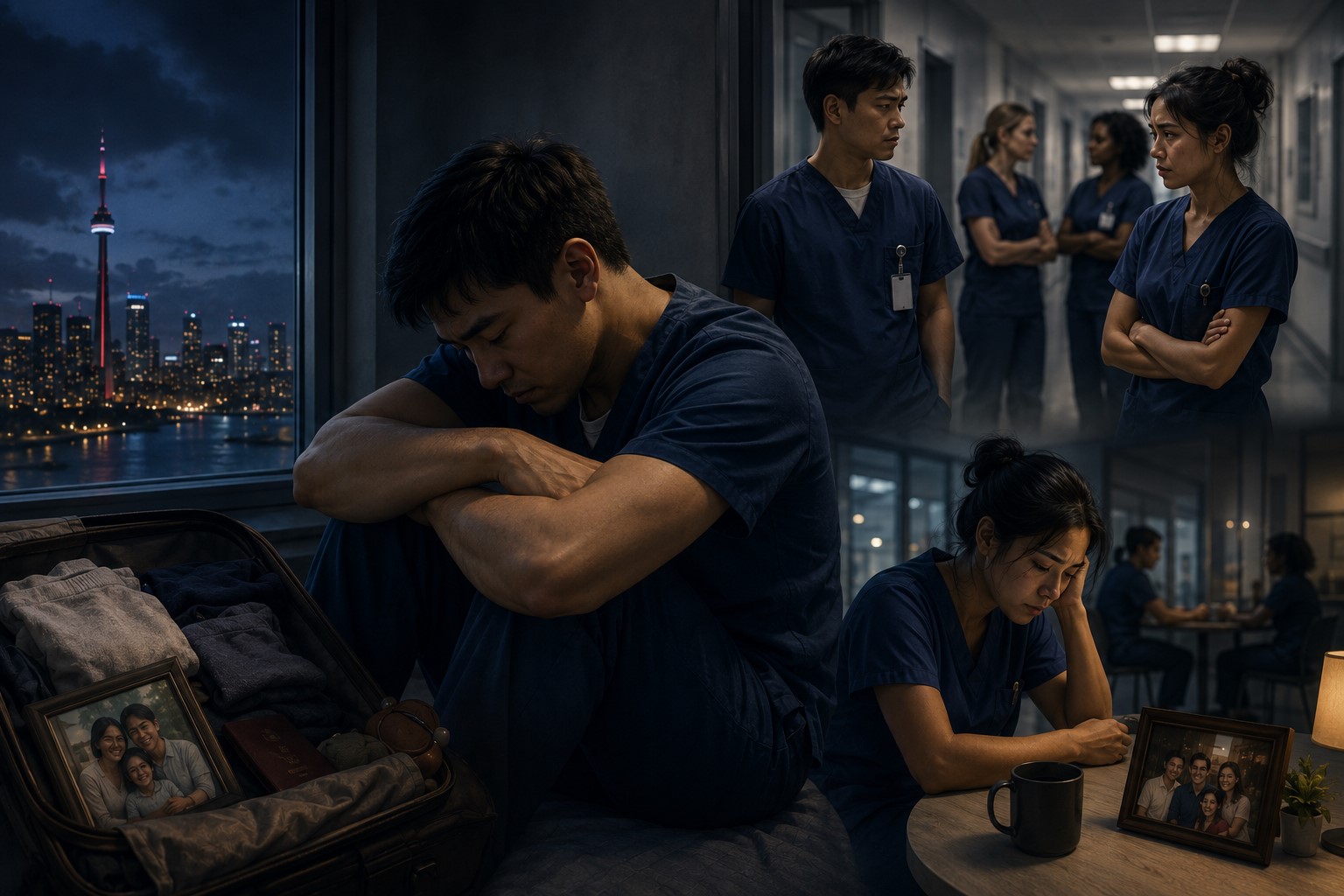

There is a peculiar kind of loneliness that comes with leaving home-not the dramatic loneliness often portrayed in films, but a quieter, heavier version that settles in the spaces between long hospital shifts, unfamiliar accents, and celebrations missed from afar. For thousands of Filipino nurses working overseas, migration is often framed as a success story-one of sacrifice rewarded by opportunity, financial security, and professional advancement. Yet beneath this admired narrative lies another truth seldom spoken about openly: many Filipino foreign-trained nurses quietly navigate loneliness, discrimination, and homesickness while trying to build lives in countries far from home.

For many Filipino nurses, leaving the Philippines begins with hope. It is the hope of providing a better future for one’s family, supporting aging parents, sending siblings to school, or creating opportunities unavailable back home. Yet migration is never simply geographical. It is profoundly emotional. One leaves not only a country, but also a support system, identity, language, familiar routines, and a sense of belonging (Lorenzo et al., 2007).
The emotional realities of overseas migration among Filipino nurses are neither imagined nor isolated. Research examining the experiences of migrant Filipino nurses highlights that adapting to foreign healthcare systems often involves emotional distress, cultural adjustment, and identity reconstruction (Valdez, 2026). What appears from afar as a life of success may, in reality, involve moments of silent struggle.
Imagine arriving in a foreign country for the first time. You step into a hospital where the clinical environment feels unfamiliar, communication styles differ, and workplace expectations are unlike anything you have known before. You smile professionally, but internally, uncertainty lingers. Did I understand the instructions correctly? Am I performing well enough? Will I ever feel accepted here?
Migration scholars describe this as acculturative stress, the psychological strain experienced when adjusting to a new cultural environment (Berry, 2005). For Filipino nurses, this adjustment extends beyond workplace adaptation. It touches language, food, social norms, religious expression, and even humor. Something as simple as not understanding a joke in the staff room can become a reminder that one is far from home.
In many cases, loneliness becomes the quiet companion of migration.
Homesickness among overseas Filipino nurses is rarely dramatic. Instead, it emerges in ordinary moments. It is hearing a familiar Filipino song after a twelve-hour shift and suddenly feeling tears form unexpectedly. It is seeing family photos online while eating dinner alone in shared accommodation. It is attending Christmas duty while imagining loved ones gathered around noche buena back home.
Research among internationally recruited nurses in Oman found that migrant nurses often experienced profound emotional struggles related to separation from family, social isolation, and the emotional burden of adapting to unfamiliar environments (Valdez, 2021). For many, homesickness is not simply missing home; it is mourning the everyday life one can no longer participate in.
A nurse working in Riyadh may quietly watch her child’s birthday celebration through a phone screen because annual leave is impossible. Another in London may receive news of a parent’s hospitalization but cannot immediately fly home. A Filipino intensive care nurse in Canada may spend New Year’s Eve caring for strangers while family celebrates twelve time zones away. The grief of migration is often invisible because nurses continue functioning. They show up to work. They smile. They care for patients. Yet inside, many wrestle with emotional exhaustion that few people see.
Equally painful, though less openly discussed, is discrimination.
For some Filipino nurses abroad, discrimination is not always explicit. It arrives subtly—in hesitant trust, unequal opportunities, or assumptions about competence. A nurse with years of clinical expertise may repeatedly feel the need to prove themselves. Others report being mistaken for junior staff despite advanced qualifications or being overlooked for leadership roles despite demonstrated competence (Jose et al., 2014).
At times, stereotypes become disguised as compliments.
“You Filipinos are naturally caring.”
Although seemingly positive, such statements can unintentionally confine Filipino nurses to narrow expectations-celebrated for compassion yet overlooked for leadership, policy, research, or specialized expertise (Alexis & Vydelingum, 2007). In some settings, migrant nurses encounter implicit workplace hierarchies where foreign-trained professionals must continually prove their credibility.
Scholarship examining Filipino nurses in diaspora settings similarly highlights the challenges of workforce diversity, cultural adaptation, and negotiating professional identity in multicultural healthcare systems (Valdez, 2016). For many migrant nurses, competence alone does not guarantee acceptance. Instead, acceptance is often earned slowly through persistence.
And yet, despite loneliness, homesickness, and occasional discrimination, Filipino nurses continue to endure. Perhaps this endurance comes from a deeply rooted cultural strength shaped by sacrifice, faith, and family-centered values. Studies exploring the cultural transition experiences of migrant Filipino nurses reveal that many develop remarkable adaptability, drawing emotional resilience from spirituality, social connectedness, and a strong sense of professional duty (Valdez, 2026).
Faith often becomes a lifeline. Across hospitals in the Middle East, Europe, and North America, Filipino nurses gather in prayer groups, attend church services, or hold tightly to spiritual rituals reminding them of home. Community also becomes healing. Filipino potluck dinners after duty shifts, karaoke nights, or simply hearing one’s own dialect spoken in hospital hallways become acts of emotional survival. Technology has softened distance but never erased it. Video calls help ease separation, but they cannot replace presence. A mother still misses her child’s graduation. A son still grieves for not attending a father’s funeral. The ache of absence remains.
Yet resilience should never be romanticized.

Too often, the world praises Filipino nurses for being resilient while ignoring the emotional cost of survival. Resilience is not the absence of pain. It is continuing despite pain.
Healthcare systems benefiting from internationally recruited nurses must recognize that adaptation is not solely the responsibility of migrant workers. Institutions must create genuinely inclusive environments-through mentorship programs, anti-discrimination initiatives, psychological support services, culturally responsive leadership, and equitable professional opportunities (Covell et al., 2017).
Nurse leaders also have an obligation to ensure foreign-trained nurses feel respected rather than merely tolerated. Inclusion begins with listening, acknowledging invisible struggles, and valuing diversity not as charity but as strength. The story of Filipino nurses abroad is often told through heroism and sacrifice. While these narratives are true, they remain incomplete. Behind every smiling nurse is a person who has likely missed birthdays, mourned losses from afar, questioned their worth in unfamiliar spaces, and silently longed for home.
And still-they continue.
They comfort strangers while carrying personal loneliness. They heal others while quietly healing themselves. They navigate systems that sometimes misunderstand them while remaining steadfast in compassion. Perhaps this is what makes the Filipino nursing diaspora extraordinary-not because suffering defines them, but because despite loneliness, discrimination, and homesickness, they continue to care. Still, one truth remains difficult to ignore: no nurse should ever have to trade belonging for opportunity. The world owes Filipino foreign-trained nurses more than gratitude. It owes them dignity, inclusion, understanding, and workplaces where they no longer feel like outsiders carrying the silent weight of leaving home.
References
Adhikari, R., Melia, K. M., Tyler, D., & Regmi, P. R. (2011). The experience of migrant workers in the health sector: A qualitative systematic review. International Journal of Nursing Studies, 48(6), 740–754. https://doi.org/10.1016/j.ijnurstu.2011.01.002
Alexis, O., & Vydelingum, V. (2007). The lived experience of overseas black and minority ethnic nurses in the NHS in the south of England. Diversity in Health and Social Care, 4(1), 13–20.
Berry, J. W. (2005). Acculturation: Living successfully in two cultures. International Journal of Intercultural Relations, 29(6), 697–712. https://doi.org/10.1016/j.ijintrel.2005.07.013
Covell, C. L., Primeau, M. D., Kilpatrick, K., & St-Pierre, I. (2017). Internationally educated nurses in Canada: Predictors of workforce integration. Human Resources for Health, 15(1), 26. https://doi.org/10.1186/s12960-017-0201-8
Jose, M. M., Ryan, J., & Pryjmachuk, S. (2014). Exploring the experiences of internationally recruited nurses in the UK. Journal of Clinical Nursing, 23(15–16), 2180–2187. https://doi.org/10.1111/jocn.12481
Lorenzo, F. M. E., Galvez-Tan, J., Icamina, K., & Javier, L. (2007). Nurse migration from a source country perspective: Philippine country case study. Health Services Research, 42(3 Pt 2), 1406–1418. https://doi.org/10.1111/j.1475-6773.2007.00716.x
Valdez, G. F. D. (2016). Filipino nurses in the diaspora: Contextualizing workforce diversity and cultural adaptability: A Middle Eastern perspective. Journal of Nursing Care 5:4(Suppl):http://dx.doi.org/10.4172/2167-1168.C1.019
Valdez, G. F. D. (2021). The lived experience of internationally recruited nurses in Oman: A phenomenological study. https://doi.org/10.21203/rs.3.rs-322435/v3
Valdez, G. F. D. (2024). Transcending cultural barriers in nursing education.https://nursingcentered.sigmanursing.org/topics/career/stories/view/transcending-cultural-barriers-in-nursing-education
Valdez, G. F. D. (2026). Navigating change: The educational and cultural transition experiences of migrant Filipino nurses. Frontiers of Nursing, 13(1), 69–82.DOI: https://doi.org/10.2478/FON-2026-0009
Xu, Y. (2007). Strangers in strange lands: A metasynthesis of lived experiences of immigrant Asian nurses working in western countries. Advances in Nursing Science, 30(3), 246–265. https://doi.org/10.1097/01.ANS.0000286623.84763.3e
