



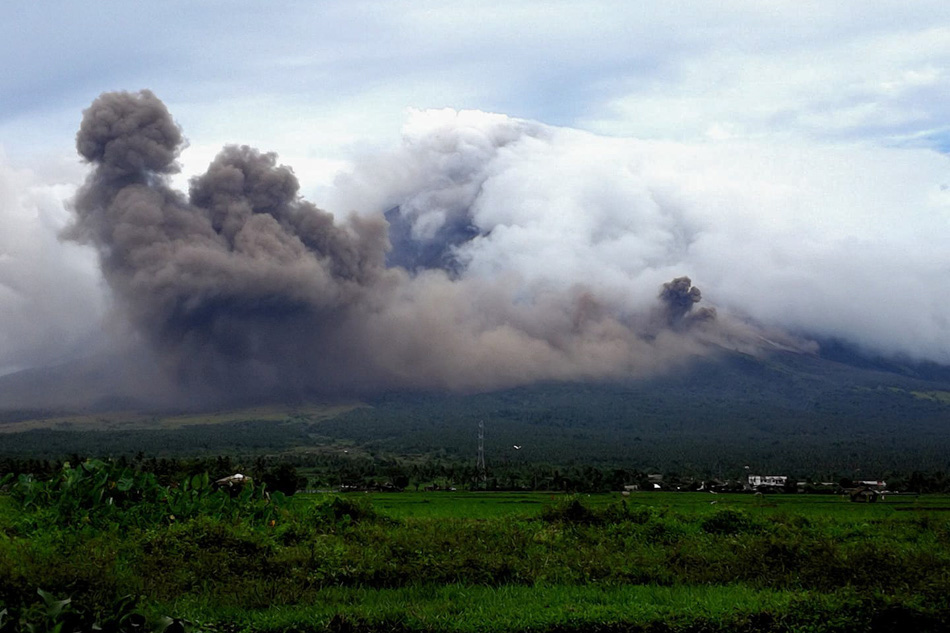

To the casual traveler, Mayon Volcano is a geological masterpiece—a flawless, emerald-draped cone that defies the jagged chaos of nature. But to those who live in its long, sweeping shadow, this “Perfect Cone” is not merely a mountain; it is a monument to a love so fierce the earth itself rose to protect it. For centuries, the story of Daragang Magayon (The Beautiful Maiden) has been whispered through ash and clouds, transforming a volatile force of nature into a timeless epic of romance and tragedy. This is the story of how a maiden’s heart gave birth to a landmark—and why the world still watches in awe as her legend continues to breathe fire and beauty into the Philippine sky.

The legend of Daragang Magayon is one of the most romantic and tragic epics in Philippine folklore. It transforms the volcano from a mere geological wonder into a monument of eternal love. Here are the key pillars of the myth and the enduring folklore surrounding it.
The beautiful Magayon and the suitor Pagtuga
The story begins with Magayon, the exceptionally beautiful daughter of Chieftain Makusog. Despite many powerful suitors vying for her hand, her heart was eventually won by Panganoron, a brave warrior from the Tagalog region, after he saved her from drowning in the Yawa River. But a jealous suitor named Pagtuga—a rich and arrogant hunter—kidnapped Magayon’s father to force her into marriage.
The tragic battle
A fierce battle erupted between Panganoron’s tribe and Pagtuga’s forces. Panganoron succeeded in killing Pagtuga, but the victory was short-lived. As Magayon rushed toward her lover’s arms, a poisoned arrow struck her down. While Panganoron knelt over her, a spear thrown by one of Pagtuga’s soldiers found its mark. Both lovers died on the battlefield.
The birth of the volcano
The grieving Chieftain Makusog buried the lovers together. In the days that followed, the land above their graves began to rise—higher and higher—until it formed the volcano we know today. The locals named it Mayon, a shortened form of Magayon.
The clouds and the “hug”
The undying myth lives on in how Bicolanos read the weather:
- The clouds: When mist shrouds the peak, it is said that Panganoron is kissing Magayon.
- The rain: When it rains, it is believed to be Panganoron weeping for his lost bride.
- The eruptions: Folklore holds that eruptions are the spirit of Pagtuga stirring beneath the earth—either trying to reclaim Magayon, or Magayon herself, enraged at being disturbed.
The perfect cone: a symbol of purity
Mayon Volcano holds the Guinness World Record for being the most conical volcano on Earth—a recognition of its nearly perfect symmetrical shape, a geological rarity that volcanologists call the “Perfect Cone.” Beyond this record, Mayon has earned several prestigious accolades.
Global heritage and natural recognitions
UNESCO World Heritage Tentative List
The “Mayon Volcano Cultural Landscape” is officially on UNESCO’s Tentative List for World Heritage Site nomination, recognized for its outstanding universal value and the unique relationship between the active volcano and the communities that have grown around it.
UNESCO Biosphere Reserve
In 2016, UNESCO designated Albay province—with Mayon as its centerpiece—as the Albay Biosphere Reserve.

Celebrated as the world’s most perfect cone
Mayon is widely regarded in global rankings as the most perfectly formed volcano on Earth, often cited alongside—and said to surpass—other famous peaks such as Japan’s Mt. Fuji, Costa Rica’s Mt. Arenal, and New Zealand’s Mt. Taranaki.
National honors in the Philippines
First national park in the Philippines
On July 20, 1938, Mayon and its surrounding landscape were declared the country’s first national park. It was later reclassified as the Mayon Volcano Natural Park in 2000.
Icon on Philippine currency
Mayon’s iconic silhouette has appeared on Philippine currency since as early as 1903, featuring on minted coins and various banknote denominations across the decades.
Historical accounts: the reality of Mayon’s power
The symmetry of the Perfect Cone is spiritually linked to Magayon’s legendary beauty and the purity of her love for Panganoron—which is why the volcano is seen not merely as a landmark, but as a living entity with a soul. Yet Mayon is also the most active volcano in the Philippines, with more than 50 recorded eruptions since 1616. The contrast between the beauty of the myth and the destruction of its reality is nowhere more apparent than in its major historical events.
The 1814 cataclysm: the deadliest eruption
On February 1, 1814, Mayon unleashed its most violent eruption—a Plinian blast that killed an estimated 1,200 to 2,000 people. The eruption buried the town of Cagsawa under 10 to 12 meters of volcanic debris. Today, only the Cagsawa Ruins belfry remains, a solitary sentinel rising above a buried town. Folklore frames this fury as the spirit of Pagtuga challenging Panganoron’s claim over Magayon.
The 1897 eruption: seven days of destruction
This prolonged eruption lasted seven days, burying villages under 15 meters of lava and killing more than 400 people. It reinforced the image of Mayon as a force that perpetually destroys and rebuilds itself—a volcano that reshapes its own perfect cone.
The 1993 and 2018 unrest
In 1993, sudden pyroclastic flows killed 77 farmers, a sobering reminder that the volcano’s beauty remains lethal even in the modern era. During the 2018 eruption, ash clouds rose in formations that some observers described as the silhouettes of Magayon and Panganoron embracing in the sky.
“In writing this, my hope is that when you next look upon the majestic silhouette of Mayon, you see more than just a volcano. I want you to see the resilience of a culture that finds poetry in the midst of peril. The story of Daragang Magayon teaches us that beauty is often born from sacrifice, and that even the most destructive forces of nature can be seen through the lens of an undying spirit. Mayon stands as a reminder to the global community that while the earth may shift and the fires may rage, the stories we tell—of love, of courage, and of home—are the only things that truly remain immortal. From the heart of Bicol to the eyes of the universe, Magayon remains, forever beautiful and forever free.”
