



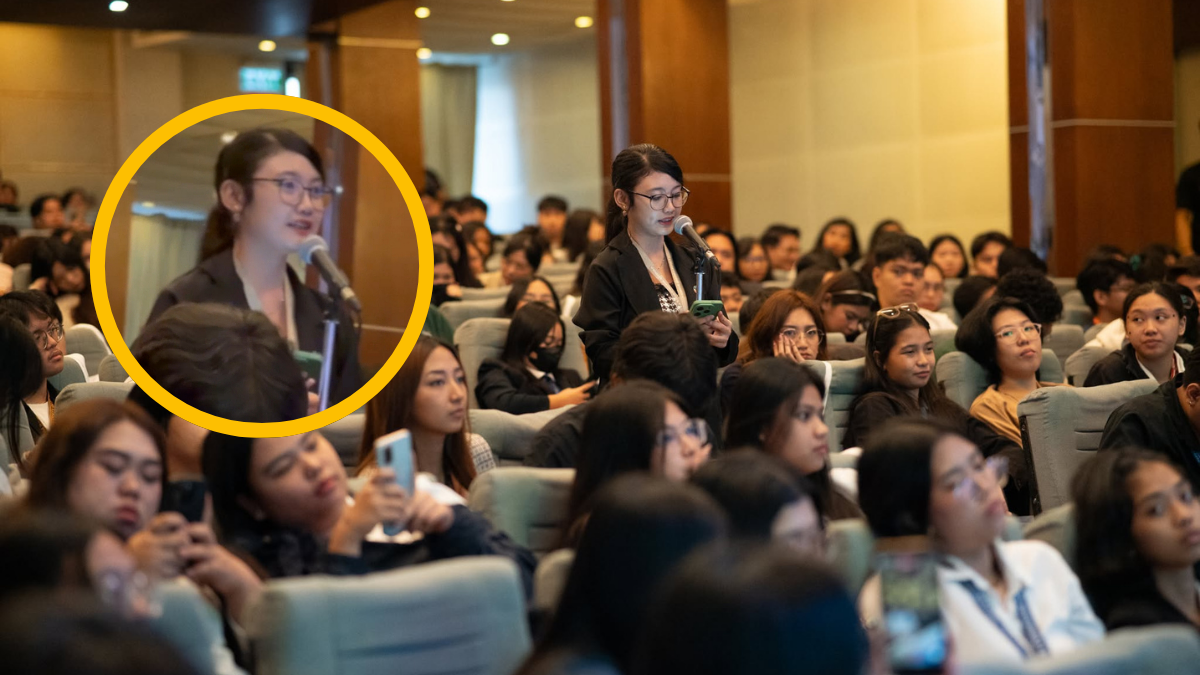

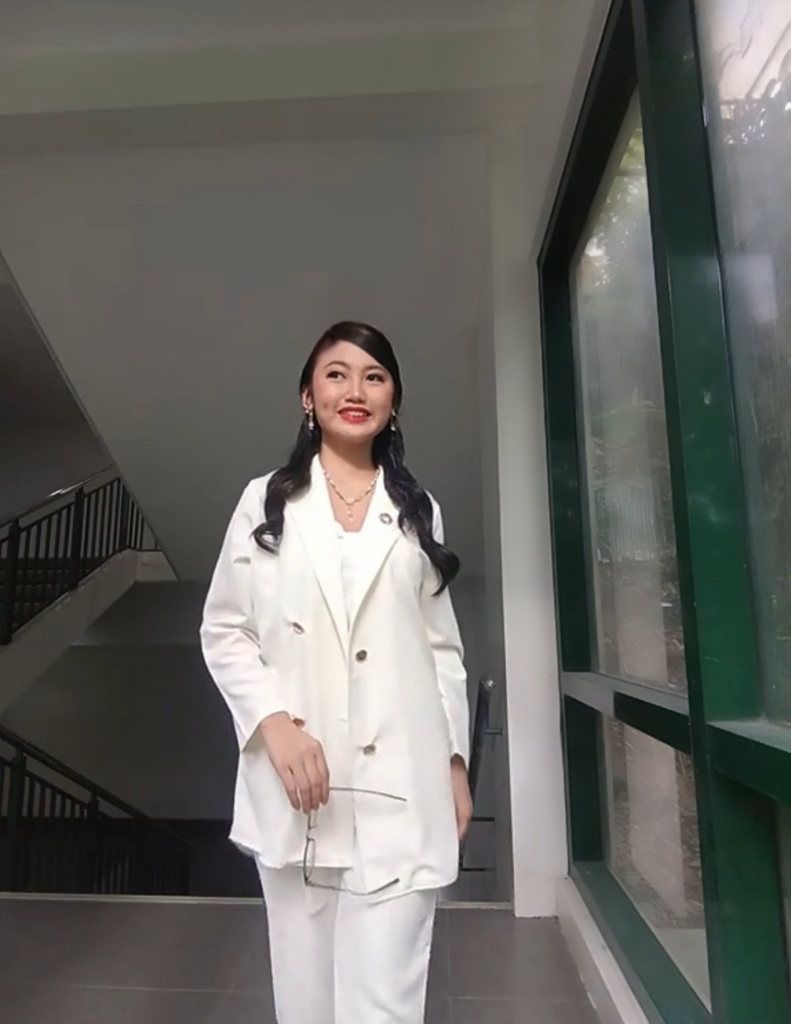
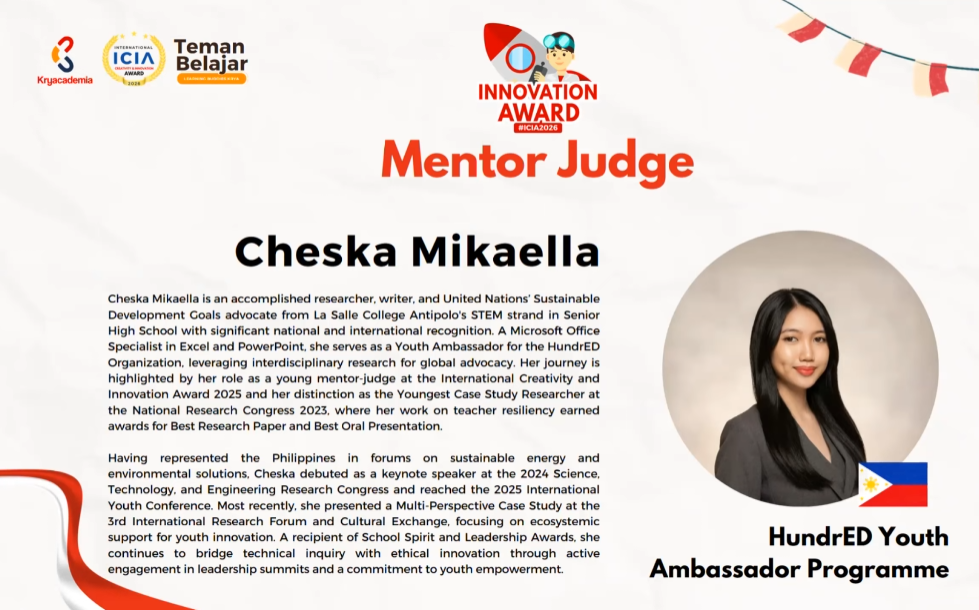
There is a moment most people know — when the body refuses to cooperate, and the world keeps moving anyway. For Cheska Mikaella N. Supangan, that moment did not arrive once. It came in waves, each one a reminder that the air she needed to breathe was never guaranteed. And yet, here she is: 18 years old, a sitting Mentor-Judge at two international innovation events, a HundrED Youth Ambassador, and a published researcher — all while managing a chronic condition that, by others’ reckoning, should have slowed her down.

Asthma has followed Cheska since infancy. Diagnosed in her earliest years, the condition settled into what felt like a quiet truce for much of her childhood. She was active, curious, energetic — a girl who, at five years old, was already tilting her head toward the sky and asking questions about the stars. For a time, she believed she had simply outrun it.
She had not.
When the air became the enemy
Junior high school changed everything. The academic pressure mounted, and alongside it came a diagnosed mental health condition — a combination that, as Cheska describes it, created a “perfect storm.” The stress did not stay in her head. It moved into her chest.
“Suddenly, I wasn’t just fighting for grades,” she recalled. “I was fighting for air.”
What stung most was not the nebulizer or the respiratory flares. It was the shift in how people began to see her. Potential, she says, curdled into pity. Belief gave way to skepticism. Teachers and peers who once cheered her on began to treat her condition as a ceiling — a quiet, unspoken verdict on how far she could realistically go.
“That doubt is contagious,” she said. “I started to wonder if they were right.”
So she did what many young people in her position do: she went silent. She hid the panic attacks. She concealed the gasping breath. She convinced herself that showing weakness would only confirm what the doubters already believed. She chose, as she puts it, to “suffer in silence” — striving alone, carrying the weight without asking anyone to share it.
The breaking point, when it came, was total. There was a moment — chest heaving, tears falling, everything collapsing at once — when she simply could not hold it together anymore. Her family, it turned out, had known all along. They had been giving her space, waiting. When she finally broke, they did not judge her. They caught her.
But it was a smaller voice that cracked her open the most. Her younger brother, watching his sister at her most vulnerable, did not see a sick girl. He wiped her tears and told her he was still looking up to her — that she was still, in his eyes, his number one inspiration.
“Their kindness was what I call my torch in the dark,” she said. “I realized that my vulnerabilities weren’t flaws to be hidden — they were the very things that allowed me to connect with and inspire the youth I advocate for.”
Building the resume breath by breath
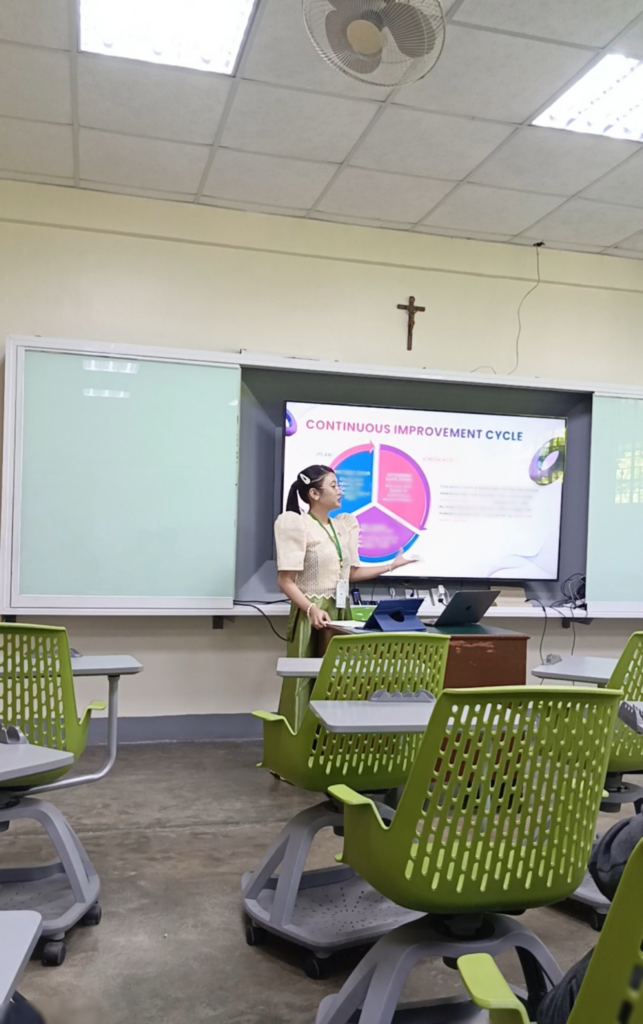
Long before the international forums and the Mentor-Judge panels, Cheska was already doing the work. At 13, she began her first solo research. At 14, she completed a case study on cancer resiliency among Filipino teachers — a project she presented at the National Research Congress, standing alongside degree holders and professionals while still in Grade 9. She walked away with honors for Best Oral Research Presenter and Best Research Paper, and the distinction of being the youngest case study investigator at the event.
What most people do not see is what it costs her to show up to those rooms. Preparing for an international event like the March 2026 Festival Karya — where she served as Mentor-Judge for the second time — is not simply a matter of reviewing rubrics. It is a logistical negotiation with her own body. Managing fatigue. Monitoring her breathing. Pacing herself across hours of engagement with youth delegates and fellow mentors from around the world.
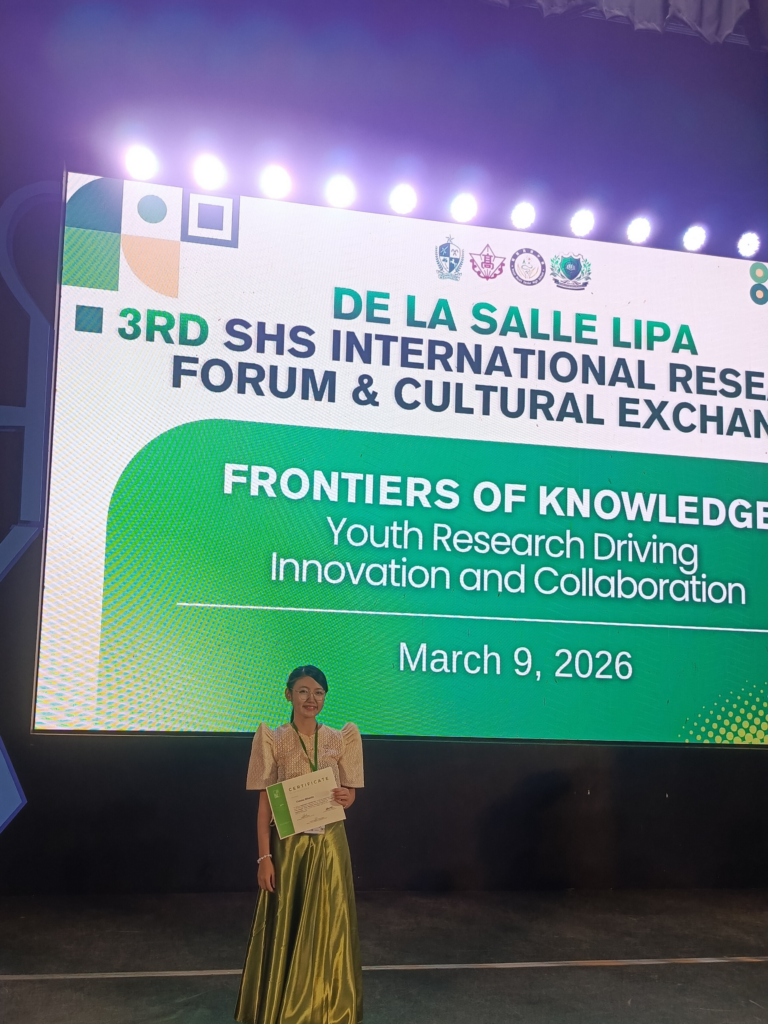
One event reshaped how she thinks about all of it. At the 3rd Senior High School International Research Forum and Cultural Exchange held at De La Salle Lipa, she was still under recovery when she almost decided not to push through. Her research mentor, Mr. John Daza, asked her a simple question: why would she be standing there, and what was the purpose of sharing her work?
She went. And for the first time, she competed for nothing. There were no awards, no trophies — only ideas and people. Riding home that evening, she felt something she had not quite felt before.

“I realized the profound fulfillment of not striving for a prize, but seeing the impact my research had on the audience,” she said. “This shift — from seeking recognition to seeking connection — has redefined how I view success in the international arena.”
From student to steward
This year, Cheska stepped into a new role — one that puts her at the intersection of personal advocacy and global education reform. As a HundrED Youth Ambassador, she now represents a worldwide movement for education innovation, debuting the title at the same De La Salle Lipa forum. It is a role she takes seriously, and one she reads through the lens of everything her health has taught her.
“My health journey has become the primary lens through which I view global education,” she said. “It reminds me that every young person carries an invisible weight, and innovation is only truly innovative if it creates space for those whose circumstances — whether physical, social, or economic — make the traditional path more difficult to walk.”
Her research has expanded from health and resilience into the broader architecture of the United Nations Sustainable Development Goals — particularly SDG 4 (Quality Education), SDG 9 (Innovation and Infrastructure), and SDG 17 (Partnerships for the Goals). But SDG 3, Good Health and Well-being, remains the heartbeat of it all. Living with asthma, she says, has fundamentally changed how she relates to time.
“When you live with the constant awareness of your own physical fragility, you stop viewing time as an infinite resource,” she explained. “You begin to see it as a precious currency that must be spent with absolute intention.”
That sense of urgency drives her mentorship as much as her research. Working under Mr. John Daza, a Grand Winner of the ICIA 2025, and guided by Dr. Wida Sari, a PhD holder in Education and international research expert, Cheska has sharpened her qualitative research skills and learned to translate lived experience into evidence-based frameworks. When she stands on an international stage, she is not just sharing a personal story. She is presenting an argument — that fragility, when properly understood, is not a liability. It is a form of expertise.
What she wants other students to hear
Cheska does not pretend the hard days are easy. There are days when the air feels thin and the spirit feels tired. On those days, she leans on faith, on family, on a deliberately built circle of mentors and peers who see her potential rather than her prognosis. She also, perhaps surprisingly, leans on the people who doubted her.
“Their doubt became the very nutrients I needed to grow stronger,” she said. “I realized that my success is the best response to degradation.”
To Filipino students who feel their health is holding them back, her message is direct: the struggle is not a detour. It is part of the road.
“Your health condition is not a barrier to your purpose — it is the very forge that tempers your resilience,” she said. “We don’t need more leaders who only know how to run. We need leaders who know how to rise after they’ve been grounded.”
Her inhaler goes with her everywhere now — not as a symbol of sickness, but as what she calls a tool of her paninindigan, her firm resolve. She has stopped hiding the condition and started managing it with the same precision she applies to her research. The nebulizer, the breathing techniques, the careful pacing of her energy — these are not concessions. They are strategy.
Cheska Mikaella Supangan is still in Senior High School. She is still, in the most literal sense, growing up. But the trajectory she has built — through research, mentorship, international advocacy, and the unglamorous daily work of managing a chronic condition — is not waiting for adulthood to mean something.
“My breath might falter,” she said. “But my vision doesn’t have to.”
For a girl who once believed she had outrun her asthma — and then had to learn, the hard way, that she hadn’t — that might be the most honest thing she has ever said.
