



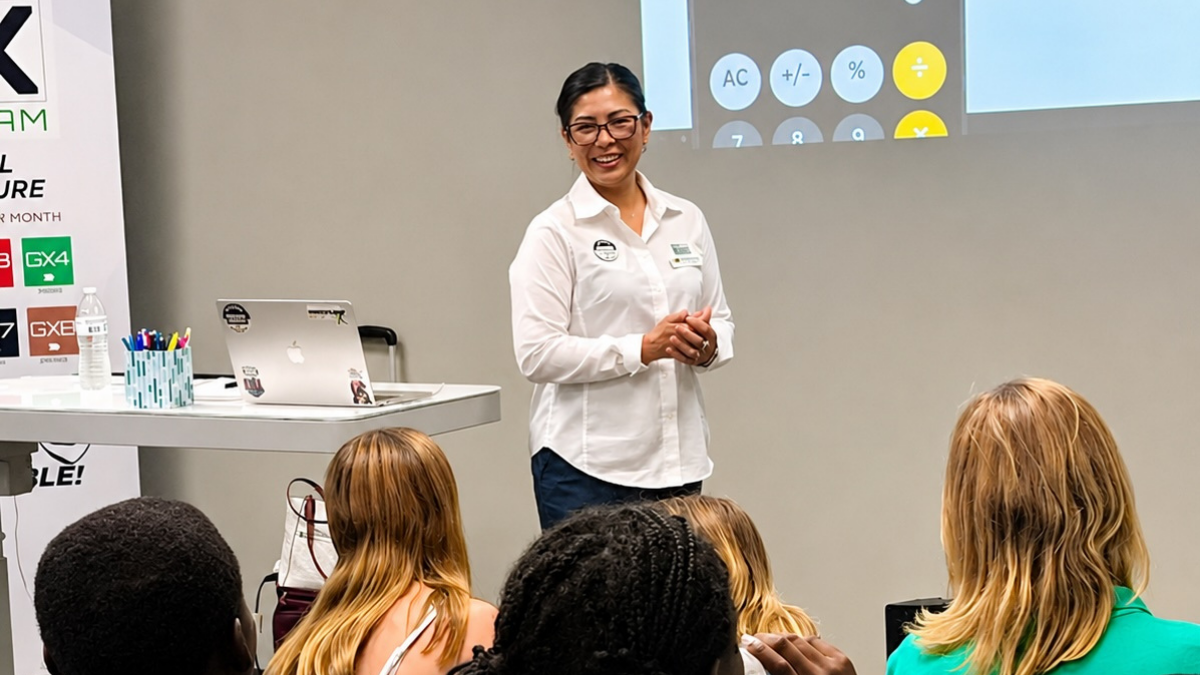

Every dollar she earned in Texas came with a dollar she owed. The paychecks were real, the American address was real, the four sons enrolled in American schools were real — and yet the mortgage was always late, the car payment always behind, the credit cards always climbing. From the outside, the family looked like it had made it. Elisa Dijamco Belderol knew better.

For years, she lived that contradiction: a working professional in the wealthiest country she’d ever set foot in, quietly drowning. The woman who would eventually retire early to teach families how money works spent more than a decade unable to make her own money work at all.
The dream that didn’t pay for itself
She grew up in Tarlac City, one of eight daughters in a family that had little except conviction. Her father repaired watches; her mother stayed home. What they lacked in money they made up for in stubbornness about education, sending every daughter through private school and college on a watch technician’s income.

Elisa graduated with a degree in architecture from Tarlac State University and spent nine years teaching architectural drafting at Don Bosco Technical Institute. Then, in 2002, a bigger idea took hold. She applied for a teaching job in Texas — not for herself, but for her sons. “I wanted my kids to have better opportunities abroad,” she shares with TGFM. She was hired as a math lab teacher in Zapata and left her husband Danny and their four boys behind in Tarlac for six months.
In 2003 she went home to bring them over. The family sold everything. Danny resigned from his corporate job to join her. “We were all very happy and thought that all our dreams will come true,” she recalls. “But this is not what happened.”
The math was brutal in a way no lab could fix. A teacher’s salary and a computer technician’s wages, split across a family of six, plus regular remittances to her parents back home — it never stretched far enough. “Yes, we were earning US dollars,” she says, “but our bills are also in US dollars.”
Living rich, sinking fast
What followed was a scramble that many overseas Filipinos will recognize. She catered events. The family band played gigs. She taught herself to DJ. She launched a T-shirt business. Every side hustle brought in a little; none of it closed the gap. And underneath the hustle ran a quieter problem — the family looked prosperous. “We were living like rich people,” she admits, “going to the mall and spending money using credit cards.”
Determined to earn her way out, she pursued a master’s in educational administration and became an assistant principal, certain the higher salary would finally settle things. It didn’t. The raise disappeared into the same hole. That was the moment the truth landed: they could work like this forever and still retire with nothing. No savings. No investments. Just debt, indefinitely.

With nowhere else to turn, she and Danny prayed — plainly, desperately — for someone to help.
The answer came in an unlikely place. At a monthly Filipino gathering after Mass, she noticed a man she’d known in the community for years wearing a small pin: “National Financial Literacy Campaign.” An admitted introvert who dislikes approaching people in public, she nudged her husband instead. “I told my husband to talk to him and asked him about what he do.”
The next day, the man and his wife came to the house. They laid out the idea of financial literacy, then invited the family to workshops at their office. Elisa brought everyone. And somewhere in those first sessions, something shifted. “I was blown away with the information that I felt a big weight being lifted from me,” she says. “I saw a light at the end of the tunnel. I suddenly realized that God had answered our prayer.”
From paycheck to purpose
She and Danny got licensed in the financial industry and started building the business part-time through World System Builder and World Financial Group. She studied the workshops, then began teaching them. The education did something the extra jobs never had — it changed behavior. “The education started teaching us how money works,” she says. “We became more disciplined.”
They started helping other families across multiple states build the kind of foundation they’d once lacked. After eight years of doing it on the side, the part-time income outgrew her assistant principal’s salary. In December 2025, she retired from a career in education she genuinely loved — and left in part because it had stopped loving her back. “I loved what I did,” she says, “but I was not feeling 100 percent happy anymore during my last year as an assistant principal. I was looking for something else.”
Now she and Danny work the business full-time. What surprises her most isn’t the income — it’s the passport stamps. Portugal and Spain, Turkey, South Korea, and Poland this year — travel that was flatly impossible on two education salaries. “This is what I have been waiting for,” she says. “Freedom, Lifestyle, Flexibility and Purpose.”
Her conviction now runs deeper than her own balance sheet. As a Senior Marketing Director, she’s tied to a mission to educate 30 million families by 2030, and she frames it in absolute terms: she won’t stop helping families become financially free “until the day I die.” What she learned the hard way, she offers as a warning to every kababayan chasing a dollar abroad — budget, live simply, save 10 to 15 percent, stay off credit cards. “If you cannot afford it, don’t buy it.” And, above all, protect the family with proper coverage and a plan for the worst.
It’s the advice she wishes someone had pinned to their chest twenty years ago — back when she was earning in dollars and losing in dollars, waiting for a light she couldn’t yet see.
