



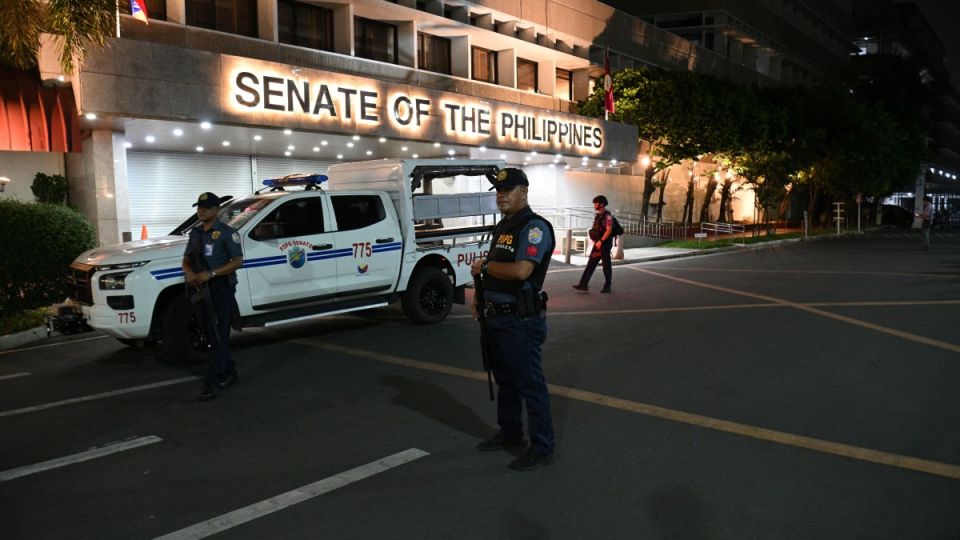

The Philippine National Police has a blanket prohibition on warning shots — no exceptions, no circumstances — a senior official clarified days after the May 13 gunfire incident at the Senate compound rattled the country’s political landscape.

Police Brig. Gen. Alan Manibog, deputy director of the PNP Directorate for Operations, said the ban is explicitly written into the force’s operational procedures.
“As to warning shots, it is strictly written in the provisions of the [PNP Operational Procedures] that the use of warning shots is not allowed in any instance or circumstance. So we do not use warning shots,” Manibog said in a Radyo Pilipinas interview Saturday, May 16.
The alternative, he said, is always verbal de-escalation. “It is because delikado iyon. It can create more danger,” Manibog said. “So we would rather use another approach, like megaphones or verbal commands.”
NBI Director Melvin Matibag had raised similar doubts a day earlier, on May 15, during a “Facts First” interview — though his objections went beyond procedure. Matibag argued that even on the terms cited by the man who fired first, the act was unjustified.
That man was acting Senate Sergeant-at-Arms Roberto “Mao” Aplasca, a retired police general, who admitted discharging his firearm first after NBI operatives were spotted near the Senate’s rented premises on May 13. The incident unfolded during a Senate lockdown declared after Sen. Ronald “Bato” dela Rosa claimed an arrest was imminent. Dela Rosa eventually slipped out before dawn amid the confusion. No one was reported hurt.

Matibag pushed back on the standard Aplasca invoked. “He said, you are only entitled to warning shots if you are outnumbered and the force you’re facing is overwhelming,” the NBI chief said in Filipino, recounting Aplasca’s own reasoning. “Second, firing a warning shot does not apply to him because he is not law enforcement. He is security personnel, as Sergeant-at-Arms.”
Matibag also challenged whether the shooting was a measured response at all. “What he did was act all based on assumptions,” he said. “He felt they would be assaulted, there was drilling.” In his view, Aplasca’s team had a simpler option available: pick up the phone.
PNP spokesperson Police Brig. Gen. Randulf Tuaño said individuals who discharge firearms outside of protocol could face complaints for indiscriminate firing or alarm and scandal.
Manibog, speaking strictly within the bounds of PNP rules, declined to assess whether those rules applied directly to Aplasca’s situation — noting that Aplasca, as Senate security, operates under a different framework. But he was unambiguous on when any firearm use is legally defensible.
“The use of firearms can be made only when there is an imminent threat upon oneself, or in self-defense, or in defense of a stranger,” Manibog said. The threat, he added, must be concrete — not anticipated. “If there’s an imminent threat, kung klaro na sa atin na may delikado sa buhay mo, puwede kang mamatay, puwede kang masaktan, o puwedeng masaktan ang kasama mo, then we can use our firearms,” he said.
