



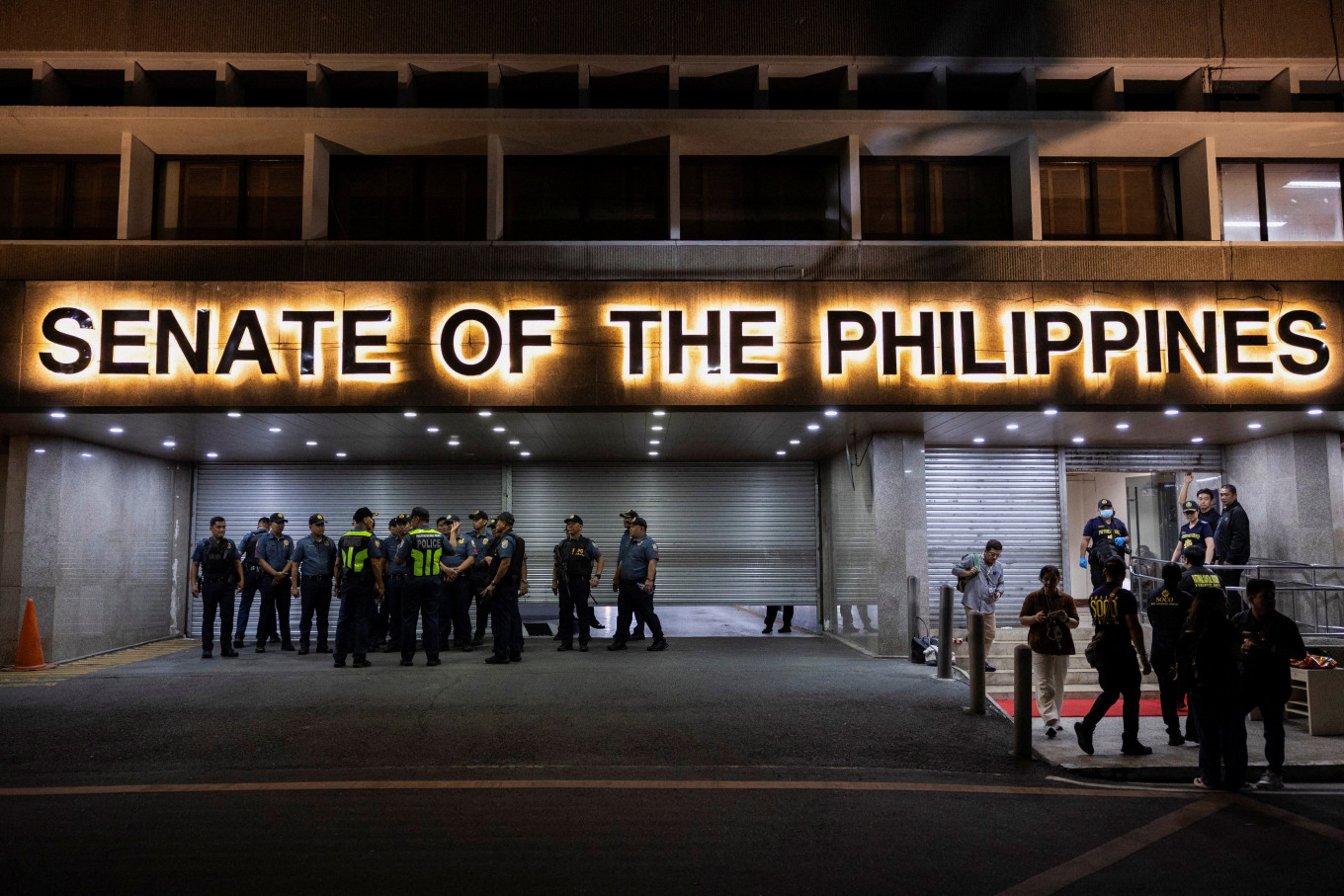

All bullet holes found at the Senate following the May 13 shooting incident originated from inside the building — a finding that forms the centerpiece of the joint investigation by the Philippine National Police and the Department of Interior and Local Government.

The two agencies presented CCTV footage of the incident at a Palace briefing on Tuesday, offering the clearest official account yet of how the gunfire unfolded in the upper chamber.
PNP Chief Jose Melencio Nartatez Jr. confirmed the nature of the incident without ambiguity. “This is a gun-related incident, meaning there is a discharge of firearm in the premises of the Senate building last May 13,” he said.
Investigators determined that 44 shots were fired in total, traced to only four firearms — pointing to four individuals who discharged their weapons during the incident. Senate Sergeant-at-Arms Mao Aplasca, who has since been placed under preventive suspension, fired the first three shots. Two other members of his staff also fired, with the shooting occurring as Aplasca refused to relinquish his firearm.
NBI Senior Agent Darwin Nicomedes Francisco, captured on CCTV retreating at the time, accounted for five of the shots, which investigators classified as cover fire.

DILG Secretary Jonvic Remulla described the sequence leading to Francisco’s shots. “The agent identified himself as NBI. Shortly thereafter, Aplasca fired three shots toward—shot three shots into the–not exactly the direction, but three shots towards the vicinity of the NBI agent. And you can see the muzzle fire there, the blast, one, two, three firearms, then the agent withdrew behind the air conditioning dock units,” he said. “And because he was being fired upon, he discharged a cover fire. Take note that the cover fire was because he was under the impression that he was under attack,” Remulla added.
Physical evidence backed up the CCTV analysis. Nartatez said bullet impacts were found on a door and a window, with trajectories pointing outward. “May nakita tayong bullet hole on the door, in the window, and the direction of the bullet that hold that door in the window is coming from inside, going outside. So, anim doon sa pinto, through and through, and one was stuck on the door jam and several bullet holes dun sa window,” he said. No bullet holes were found on the exterior walls suggesting fire directed into the building, he added.
The briefing also shed light on security arrangements made the day before the incident. Senate security and GSIS security held a coordination meeting on May 12, during which GSIS sought NBI assistance to protect the building, citing its collection of high-value artworks. Door reinforcement work was also coordinated with Senate security ahead of the shooting.
Remulla explained the rationale behind GSIS’s security posture. “GM found it better to secure the entrances going in the GSIS because Senator Bato had called for a people power movement and had there been anarchy in the building the GSIS contains billions of pesos of worth of artworks that are displayed in their walls,” he said. “Had there been an overflow of people going to GSIS, the losses would have been incredible. So, he found it better for them to secure the doors so that there would be no commotion going inside to the GSIS building,” he added.
Remulla was careful to draw a firm boundary around the investigation’s conclusions. “The only conclusion is that there was no attack to the Senate,” he said, stressing that the agencies are not ruling the incident a staged event.
