



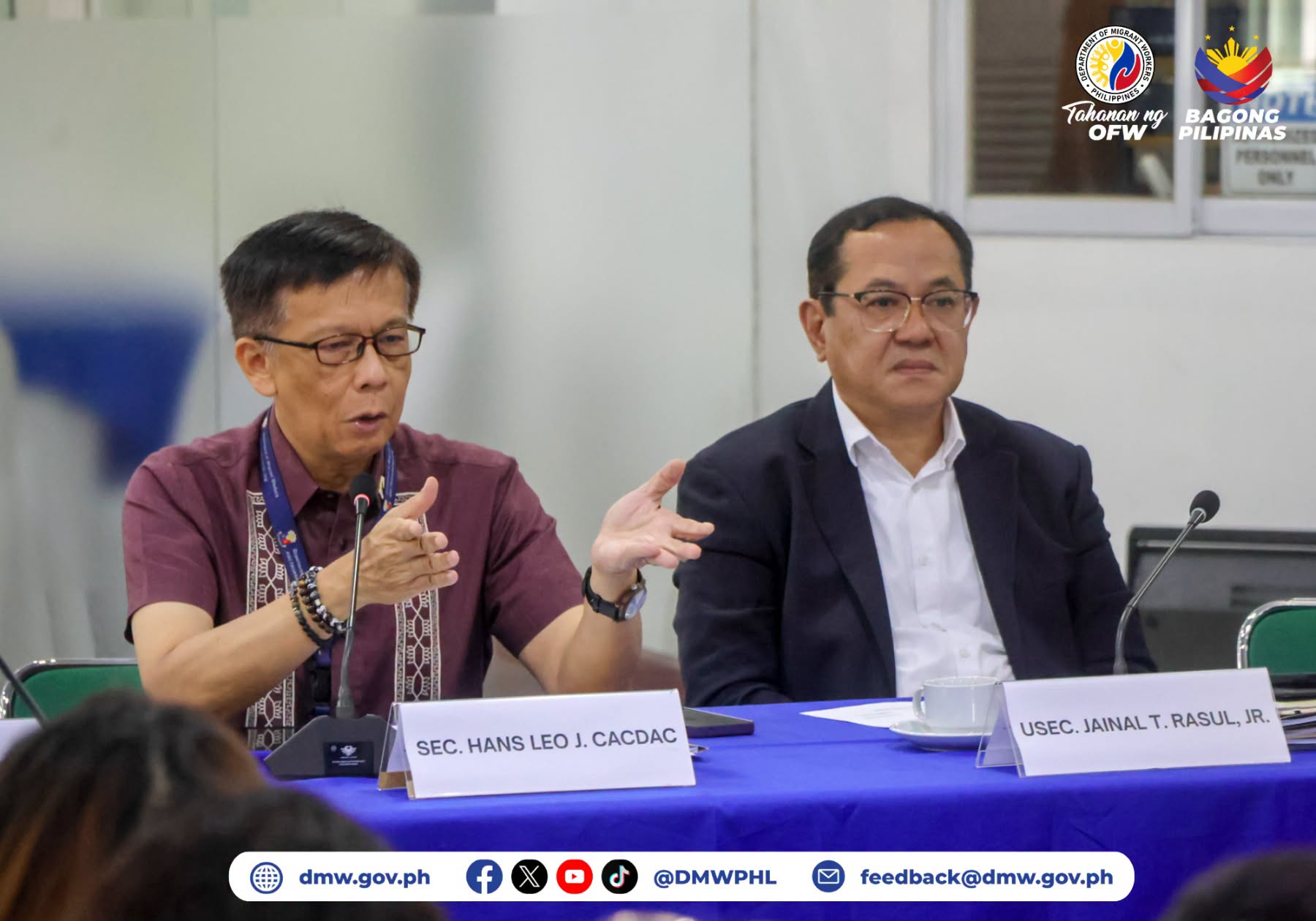

Domestic workers must have a clear place in the Philippines’ agenda when it leads the Abu Dhabi Dialogue, Migrant Workers Secretary Hans Leo J. Cacdac told stakeholders during a September 1 meeting called to map out the country’s approach to the regional forum.

The gathering brought together the Overseas Landbased Tripartite Consultative Committee (OLTCC), whose ranks include recruitment industry figures, partner government agencies, and non-government organizations working on labor migration. The committee met to weigh the thematic priorities and groundwork tied to the Abu Dhabi Dialogue (ADD), which the Philippines will chair from 2026 through 2028.
Four subject areas anchor the ninth ADD cycle: digital transformation aimed at inclusive and responsible labor mobility; remittances alongside financial inclusion and social protection; recruitment and mobility governance built on fairness and ethics; and pathways covering skills development, upskilling, and the shift from education to employment.
Cacdac pointed to social protection as an area ripe for exchange, noting the differences between the Philippine system and those of its Gulf counterparts. “Our social protection framework is more visible and systematized, including structured pension and benefits coverage. But it would be interesting to know about the social protection systems in the Gulf, which are relatively younger than ours. So it’s good to see the social insurance programs in the receiving countries and to have a comparison and sharing of best practices in how these countries provide social protection,” he said.
On the question of safeguarding household service workers, the secretary gave assurances that the matter would be raised at the dialogue. “We need to firm up our position and we need to be united. Dapat lang lumabas ang kasambahay sa usapin,” he said.

The ADD functions as a consultative channel linking countries that send workers with those that receive them, giving both sides a setting to trade policy ideas and workable practices in migration management. Its membership pairs nine origin countries, the Philippines among them, with seven destination states: Bahrain, Kuwait, Malaysia, Oman, Qatar, Saudi Arabia, and the United Arab Emirates. An estimated 2.5M OFWs live and work across the Gulf, one of the world’s heaviest migration corridors.
Undersecretary Jainal T. Rasul Jr. walked the committee through the dialogue’s background and urged members to file their comments and pool proposals that could steer policies toward the welfare and protection of migrant workers. Participants observed that earlier ADD cycles have carried thematic discussions from national experiments and policy prototypes toward regional alignment and, in some cases, domestic law, touching on wage protection, technology-based recruitment and dispute resolution, and the verification of skills.
Separately, the committee took up the planned renewal of the bilateral labor arrangement with the Kingdom of Saudi Arabia and the Memorandum of Cooperation with Japan. Assistant Secretary Levinson Alcantara, Director Jerome Yanson, and Cleobelle Romero laid out the specifics of the two proposed agreements, in a session run by Assistant Secretary Venacio Legazpi and Director Francisco Jun Aguilar.
The road to the ADD conferences is set to run through technical-level talks and rounds of consultation across the various stakeholders.
