



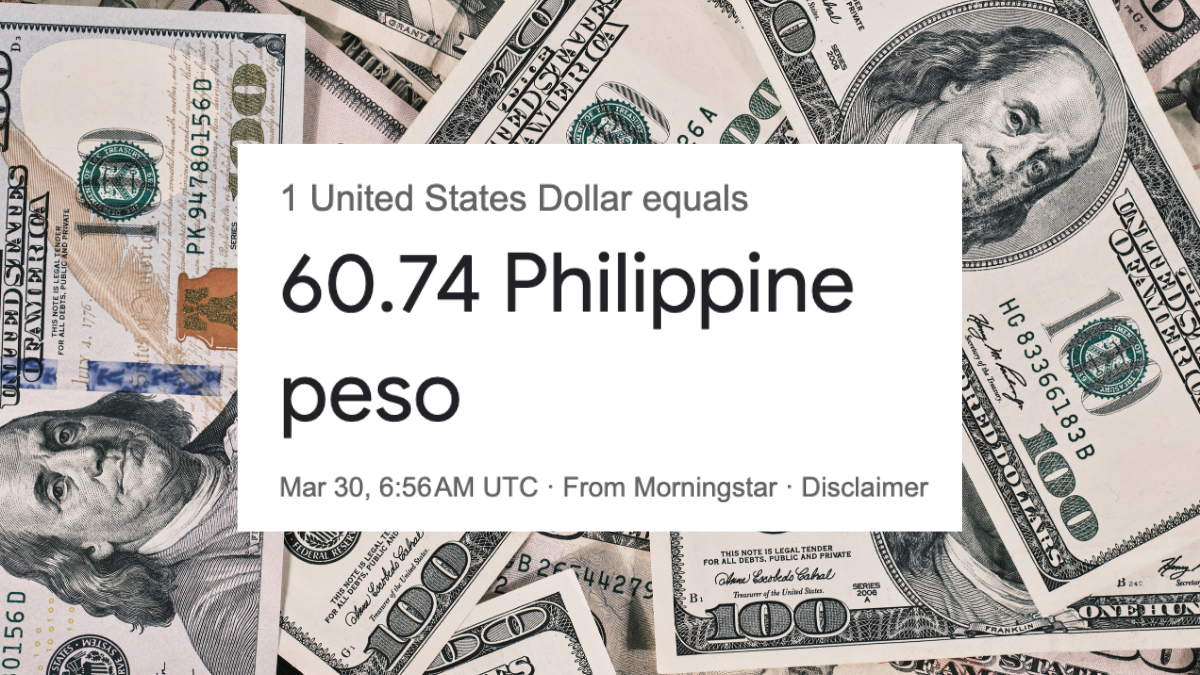

The Philippine peso edged closer to the ₱61 threshold against the US dollar on Monday, touching 60.74 by mid-afternoon — a record low that compounds the country’s challenge of securing oil and gas supplies from a war-torn Middle East.

The currency’s slide reflects a broader regional pattern. East Asian economies have struggled to hold their ground since the United States and Israel launched strikes on Iran on February 28, triggering a conflict that has sent global crude prices higher and raised concerns about shipping disruptions in key supply routes.
The Bangko Sentral ng Pilipinas is grappling with a currency that has lost 4.87 percent of its value against the dollar over the past four weeks. President Ferdinand Marcos Jr. has already declared a national energy emergency, citing the Philippines’ near-total dependence on Middle Eastern crude and a supply buffer of only 45 days as of late March.
Unlike most of its neighbors, the peso’s current weakness is not merely a cyclical dip — it is an all-time low. The distinction matters for the cost of importing dollar-denominated commodities, particularly fuel.
Thailand’s baht has fallen harder in relative terms since the war began, dropping 5.10 percent to 32.49 per dollar, though that level does not represent a historic nadir for the Kingdom. South Korea’s won has shed 4.54 percent, sliding to 1,508.56 per dollar — a level not seen in 17 years.

Other currencies in the region are under strain but faring comparatively better. The Taiwan dollar has weakened 2.07 percent to 32.04 per dollar, while the Japanese yen has eased 1.71 percent to 160.29. Indonesia’s rupiah and Vietnam’s dong have each depreciated 1.12 percent, settling at 16,990.8 and 26,337 to the dollar, respectively.
China’s yuan has been the most insulated, slipping just 0.78 percent to 6.91 per dollar — a resilience attributed to the size of the Chinese economy and the scale of its foreign currency holdings.
Analysts point to a combination of factors that make countries like the Philippines and Thailand more exposed than their neighbors: chronic trade deficits, persistent inflation, and capital flowing out in search of safer havens. These structural vulnerabilities amplify currency shocks that others can absorb more easily.
Warnings from Yemen’s Houthi militants that they intend to disrupt Red Sea shipping lanes if hostilities against Iran persist have added to the unease among oil-importing nations in the region, raising the prospect of further price pressure on economies already struggling to keep the lights on.
