




Overseas Filipino workers coming home to Central Visayas will no longer need to knock on each government agency’s door for reintegration help. A single digital form now routes their request to whichever office handles their case, according to the Philippine News Agency.

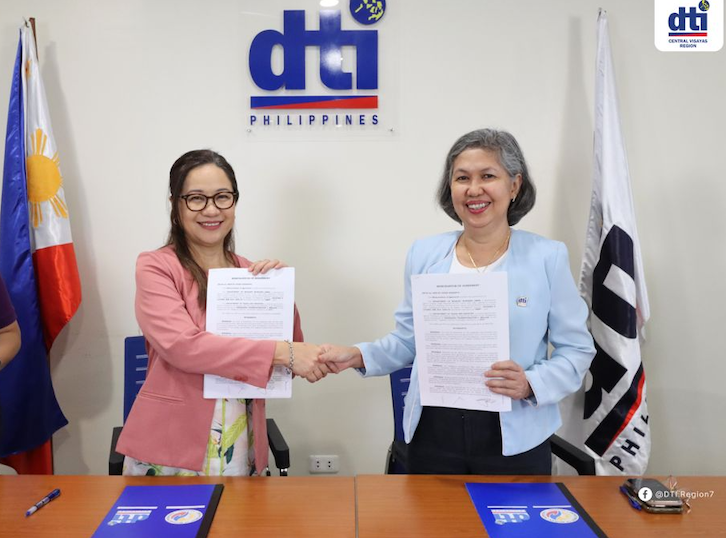
The change follows a memorandum of agreement signed Aug. 12 at the Department of Trade and Industry (DTI) Region 7 office in Cebu, bringing the DTI into the One Window Bayanihan Assistance Program (OWBAP) Referral and Tracking System. A returning worker enters personal details and uploads documents only once. The system then passes the application to the appropriate office and logs every update, letting the worker and the assigned case officer track its progress in real time.
DTI-7 Acting Regional Director Esperanza T. L. Melgar and DMW-7 Regional Director Jhoaden G. Lucero put their names to the agreement. Joining them were DTI-7 Small and Medium Enterprise Development Division Chief Ma. Theresa Sederiosa and DMW-7 Assistant Regional Director Rex A. Tadena.
Melgar cast the tie-up as a way to reach workers rebuilding their lives at home. “This partnership brings our services closer to our OFWs and their families, particularly those who are returning home and looking for opportunities to rebuild their livelihoods,” she said. Pairing DTI resources with DMW’s reach, she added, would connect returnees to business guidance, financing and information that turns overseas earnings and skills into homegrown enterprises.
Both agencies have 30 days from the signing to convene a technical working group, which will draft, finalize and monitor the OWBAP work plan for Region 7.
Workers referred through the platform will be steered toward DTI’s Negosyo Centers for business advice and enrollment in government entrepreneurship tracks, among them the Kapatid Mentor ME program. Capital comes from the P2-billion OFW Negosyo Fund, which DTI opened on March 11 and runs through its lending arm, the Small Business Corporation (SBCorp). Loans stretch from P30,000 to P20 million, carry repayment terms of up to five years, and waive collateral below P5 million, with a grace period on principal and interest for qualifying products. Applications move through the SBCorp Money app, app.sbcorp.ph or the SBCorp website, and any of the 1,431 Negosyo Centers nationwide can guide a borrower through it. Women running their own ventures may also tap a separate P2-billion Women Enterprise Fund.

“Access to capital is often the biggest barrier during these uncertain transitions,” DTI Secretary Cristina Roque said when the fund launched. The agency has tied the fund to a directive from President Ferdinand R. Marcos Jr. to broaden help for returning workers.
DTI is stepping into a referral network DMW-7 assembled earlier in the year. On March 31 in Cebu City, the migrant workers’ agency signed agreements covering both OWBAP and the Anti-Illegal Recruitment and Trafficking in Persons campaign, drawing in the provincial governments of Cebu, Bohol and Siquijor; the cities of Cebu, Mandaue and Lapu-Lapu; the Region 7 offices of OWWA, the Department of Social Welfare and Development, the Department of Labor and Employment, the Technical Education and Skills Development Authority and the Department of Health; and the Legal Alternatives for Women Center Inc. Cebu Technological University is building the platform, with faculty and students from its College of Computer, Information and Communications Technology supplying the technical work under a separate agreement.
At that March ceremony, DMW Undersecretary for Licensing and Adjudication Services Bernard P. Olalia described the network as a way to widen the options open to returnees. “Overseas is not a matter of necessity, it should be a matter of choice,” he said in his keynote.
The DTI’s new role also folds it into migrant worker protection. Anti-illegal recruitment, anti-trafficking and safe migration messaging will be built into the business forums, consumer network sessions and Negosyo Center briefings the agency already conducts. To keep referrals accurate, DMW will hand partner agencies data on returning and returned workers, with the exchange governed by Republic Act 10173, the Data Privacy Act of 2012, and its implementing rules.
The regional setup sits within a national reintegration push launched after conflict in the Middle East began displacing Filipino workers. Marcos signed Executive Order 110 on March 24, declaring a state of national energy emergency and adopting the Unified Package for Livelihoods, Industry, Food and Transport as the government’s coordinated answer. Under that banner, 25 government agencies, local governments and private partners convened in Quezon City on April 6 for a national reintegration network fair, where returnees could reach livelihood, employment, health, education and financial services under one roof.
DMW Secretary Hans Leo Cacdac told that gathering the drive honors the President’s standing order that no Filipino be left behind. “You are not stranded in your own homeland. We are here to serve you so you can start again,” he said. As of March 29, DMW counted more than 3,800 OFWs repatriated from the Middle East; in Central Visayas, OWWA-7 reported helping 225 returning workers with airport and transportation support by April 27.
