



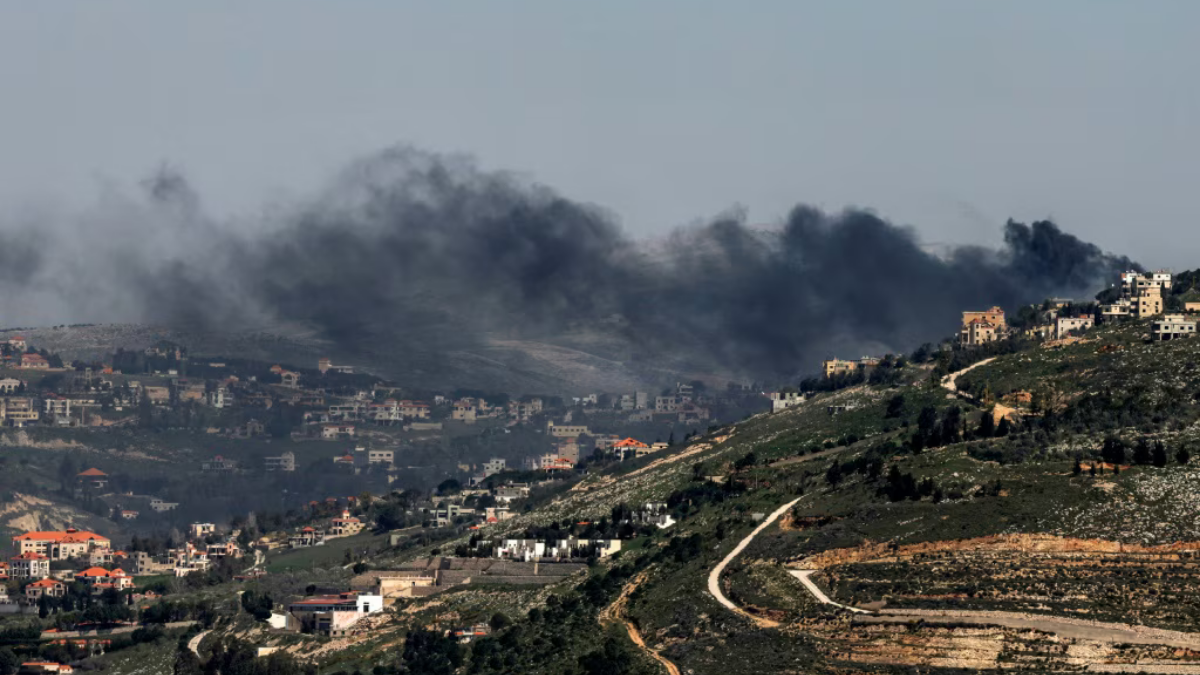

Nearly four weeks into a conflict with no clear exit strategy, the war ignited by US-Israeli strikes on Iran has expanded well beyond its original theater — drawing in shipping lanes, offshore gas facilities, and military installations thousands of kilometers apart.

Crude oil prices have climbed more than 50 percent over the past month, with North Sea Brent trading comfortably above $105 a barrel. Iran’s de facto blockade of the Strait of Hormuz, which normally carries 20 percent of the world’s oil and gas, has driven much of that surge — compounded by a string of strikes on energy infrastructure across the Gulf.
On Thursday, Qatar’s Ras Laffan natural gas facility took a direct hit. A day later, Kuwait’s Mina Al-Ahmadi refinery was struck by drones. Iran, for its part, is vowing retaliation after an Israeli strike Wednesday damaged South Pars, the gas field tapping the world’s largest known reserve and a cornerstone of Iranian domestic supply.
The geographic reach of the war has widened sharply. Israel says its aircraft struck Iranian naval vessels in the Caspian Sea on both Thursday and Friday, as well as targets in Iran’s Noor coastal region. On Friday, a UK official confirmed Iran attempted — and failed — to hit a joint British-American base in the Indian Ocean, following a Wall Street Journal report that Tehran had fired two ballistic missiles at the facility.
Washington’s war aims remain a moving target. President Donald Trump has at various points cited regime change among US objectives, but on Friday he described a narrower set of goals: preventing Iran from acquiring nuclear weapons, protecting Gulf allies, and dismantling Tehran’s missile arsenal, naval forces, air force, and industrial base. He added that he was considering “winding down” military operations. The White House press secretary said the Pentagon was working within a four-to-six-week window to complete its mission — though Trump had previously rejected any ceasefire, saying the US and Israel were “literally obliterating” Iran.
The campaign against Iranian leadership has continued in parallel. Supreme leader Ayatollah Ali Khamenei was killed in the opening hour of the war. National security chief Ali Larijani was killed Wednesday in what analysts consider the most significant loss to the Islamic Republic since then. The spokesman for Iran’s Revolutionary Guards, Ali Mohammad Naini, was killed at dawn Friday — hours after he publicly rejected Israeli Prime Minister Benjamin Netanyahu’s claim that Iran had lost the ability to manufacture ballistic missiles. Naini had said production was continuing “even under wartime conditions.”

Whether Iranian capabilities are genuinely degraded remains contested. The volume of Iranian strikes on Gulf states has fallen — the UAE reported intercepting 26 drones and four ballistic missiles on Friday, compared with 117 drones and 17 missiles on March 8. But analyst Kelly Grieco of the Stimson Center cautioned against reading that as a sign of exhaustion. Writing Monday on War on the Rocks, she said Tehran may have simply shifted to a lower, sustained launch rate to maintain pressure on Gulf states while preserving stockpiles for a conflict that could stretch for months.
The question of reopening the Strait of Hormuz presents its own military complications. Martin Sampson, executive director of IISS–Middle East, noted that any operation to clear the chokepoint would require concentrating US forces in a confined space — precisely the kind of environment Iran could exploit. Analyst Pierre Razoux pointed out that four islands at the Gulf’s entrance — Siri, Greater Tunb, Lesser Tunb, and Abu Moussa — have been converted by Iran into fortified positions equipped with anti-ship missiles.
US media reported the Pentagon has sent the amphibious assault ship USS Tripoli and around 2,500 Marines to the region. The Wall Street Journal on Friday added that forces from the California-based USS Boxer Amphibious Ready Group and the 11th Marine Expeditionary Unit — between 2,200 and 2,500 personnel — are also being deployed. Razoux said these assets could be used to seize the contested islands. Daniel Schneiderman of Penn Washington said planners were likely also weighing a landing on Kharg Island, through which 90 percent of Iran’s oil exports pass, or establishing a coastal beachhead to restore navigation through Hormuz. He added that any of these options would “almost certainly come at significant costs in terms of troops killed and equipment lost.”
Trump on Friday called on US allies to share the burden of securing the strait, noting that American vessels do not rely on it.
One front that has yet to open is Yemen. The Iran-backed Houthi movement, which controls the capital Sanaa, has not entered the war. Betul Dogan Akkas of Ankara University described the group as the conflict’s most unpredictable actor, given its demonstrated ability to disrupt shipping and strike Gulf energy targets.
