



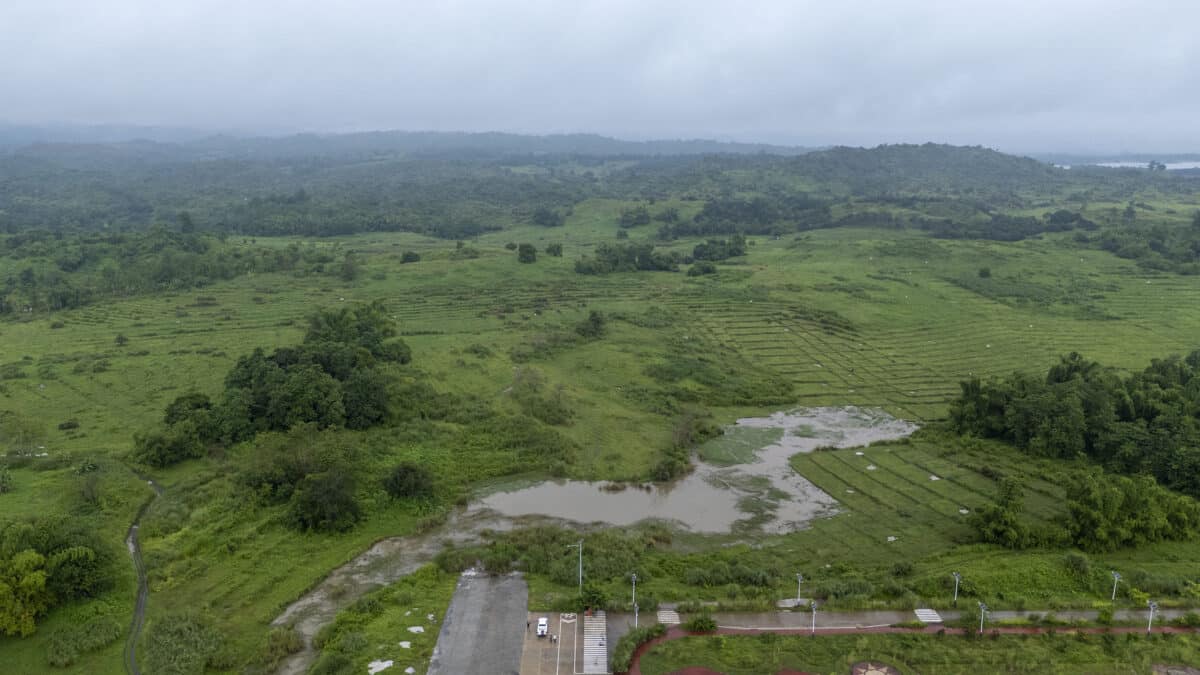

Dozens of families who have long tilled farmland in Barangay O’Donnell, Capas, Tarlac now face pressure to give up their plots, drawing a village official into a widening controversy over one of the country’s largest planned technology projects.

Barangay Captain Wendelle Mercado said roughly 92 farmers in his village received word to vacate land they cultivate, clearing the way for development pursued by the Bases Conversion and Development Authority. Notices have reached the affected households, he said, yet residents keep coming to the barangay hall unsure of where they will end up.
“Pumupunta po sila sa barangay at nangangamba sa kanilang kabuhayan. Sinukat na ang lupa pero hindi pa malinaw kung saan sila pupunta,” Mercado said in an interview with CLTV36.
The plots in question, according to the barangay captain, are productive agricultural land. He argued that any push toward industrialization framed as a benefit to rural areas must also account for the people whose livelihoods sit in its path.
The land falls within New Clark City, the sprawling BCDA-run development that has been tapped as the site of the Pax Silica Initiative — a US-led partnership the Philippines joined in 2026 to strengthen global supply chains for semiconductors, artificial intelligence, and critical minerals. Government projections put the proposed 1,619-hectare hub’s potential investment as high as $70 billion, with BCDA estimating it could generate more than 130,000 jobs.

The BCDA has rejected claims that farmers or Indigenous communities will be uprooted. President and CEO Joshua Bingcang has said the construction footprint sits inside zones designated as buildable under the New Clark City master plan years before the current dispute, and the agency maintains the covered land is titled and government-owned. In a statement this week, the BCDA said it has set aside a 50-hectare agricultural zone, a 10-hectare Ayta Ethnobotanical Center, and additional relocation areas within New Clark City to cushion the impact on affected households, framing the project as a source of expanded livelihoods rather than displacement.
Those assurances have not settled the matter. Senator Imee Marcos filed a Senate resolution on August 3, 2026, urging lawmakers to examine the initiative’s demands on the region’s water and power supply along with its environmental footprint, after citing reports that around 1,600 hectares and some 92 farmers and Aeta community members could be affected without prior consultation. She has also pressed for a look into complaints that some farmers were told to stop planting and faced intimidation, saying land conversion should not be rushed at the expense of those who work the soil.
The scientist advocacy group AGHAM has separately disputed the government’s position, arguing that BCDA presented an incomplete account of the project’s reach. The group pointed to an initial roster of project-affected persons covering residents of O’Donnell, Aranguren, and Santa Lucia, and cited Capas municipal data indicating that more than 30 percent of the town’s land is classified as productive agricultural land.
Marcos has grounded part of her objection in existing regulation, noting that under a 2002 Department of Agrarian Reform order, any conversion of land use must follow the requirements set by law.
