



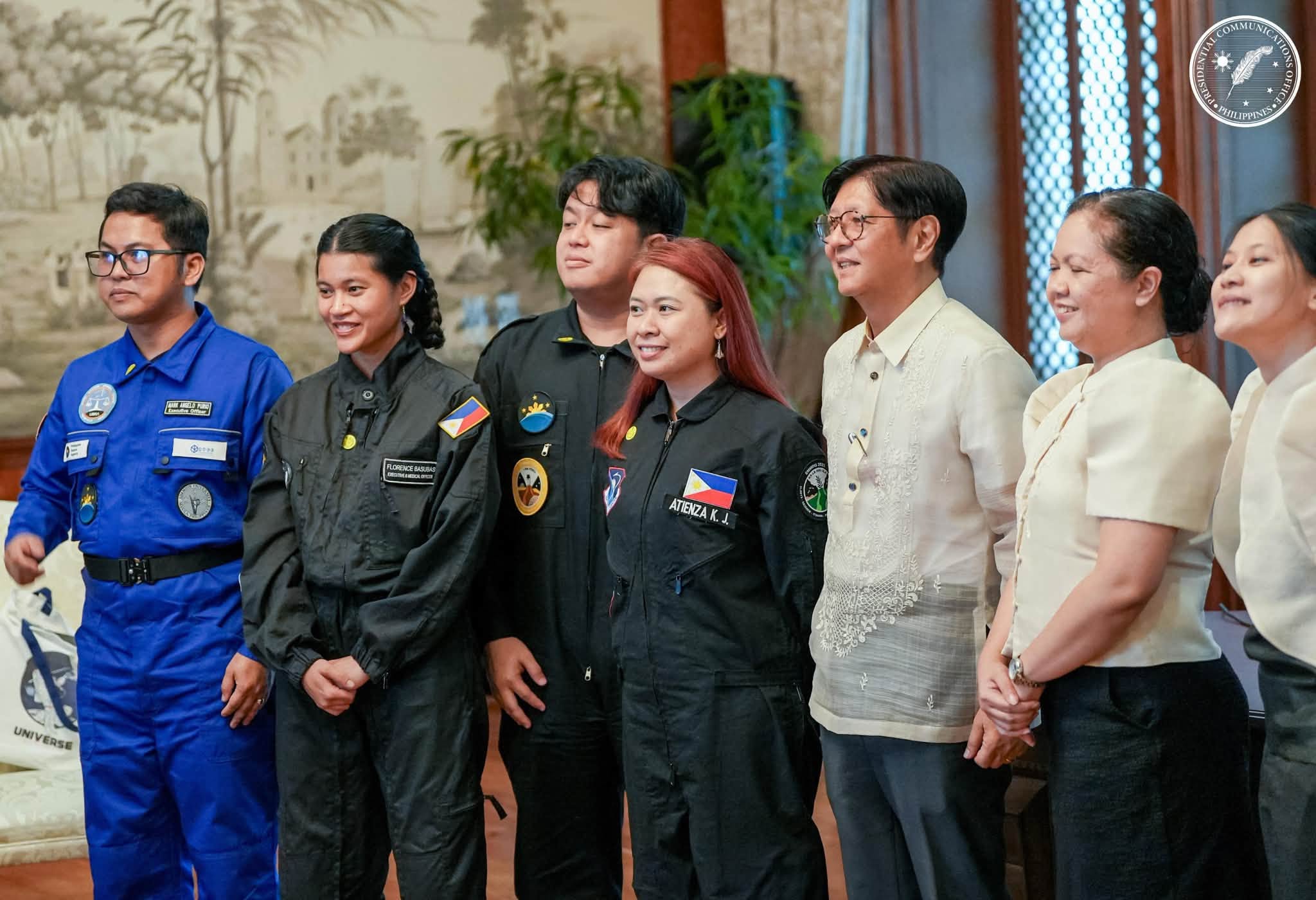

Four Filipinos who have lived through simulated Moon and Mars missions abroad brought their stories to Malacañang on Thursday, drawing a pledge of support from President Ferdinand Marcos Jr. for the country’s space program.

Analog astronauts train under conditions built to replicate life on the Moon, on Mars, or in orbit. Crews face isolation, delayed communication, scarce supplies, and a range of physical, operational, and psychological pressures. The exercises are meant to prepare them for real microgravity, whether aboard a spacecraft or the International Space Station.
The visitors each came to the courtesy call with international mission experience. Kristine Jane Atienza, a nutrition specialist from Bataan, joined the Hawaii Space Exploration Analog and Simulation program in 2023 and earned suborbital spaceflight certification from the National Aerospace Training and Research Center in Pennsylvania. Dr. Marvic Jon Alcantara, a medical specialist from Cavite, is the first Filipino physician to become an analog astronaut, with missions completed in Hawaii and Australia.
Florence Pauline Basubas, a space biologist from Cebu, held the posts of executive and medical officer for the Monsaraz Mars Analog Mission in Portugal. Dr. Mark Angelo Purio, a space engineer from Oriental Mindoro, became the country’s first engineer analog astronaut through the LunAres Mission M4.26 in Poland. He also had a hand in building Maya-2, a Philippine cube satellite.
The Presidential Communications Office said Marcos “eagerly listened” as the group described what they had learned. He urged them to keep sharing their experiences so more young Filipinos would consider careers in space science and technology.
“Congratulations. Keep it going. I am so glad that we have a presence in all these space sciences. It has become so much easier now … much safer than it used to be,” Marcos told them.
Writing on his official Facebook page afterward, Marcos thanked the group and noted that “it is not every day that I get to talk about space in Malacañang.”

“Our Filipino analog astronauts are already testing here on Earth what it takes to live and work beyond it. I look forward to the day when a Filipino takes that science all the way to space,” he wrote.
Philippine Space Agency (PhilSA) Director General Gay Jane Perez used the meeting to walk Marcos through the agency’s plans to expand local analog missions and position Filipinos for eventual human spaceflight.
PhilSA is separately building launch know-how. A 10-member agency team has been in South Korea since August, learning to develop, assemble, and test a liquid-fueled rocket alongside Perigee Aerospace Inc., a private launch company regarded as one of Asia’s leading players. The program, which runs until October, falls under PhilSA’s “SIKLAB: Building Industrial Space Launch Systems Project.” Once the training ends, the rocket the team puts together will be shipped home for additional tests before a planned 2027 launch in Cagayan.
The agency said the effort is meant to give the country more capacity to send up satellites and scientific payloads that deliver services on the ground.
“Progressively developing our domestic launch capabilities will allow greater flexibility and independence in sending satellites into space, which serves the country’s key sectors such as security, telecommunications, and agriculture,” Perez said in a statement released Saturday.
Marcos has spoken openly about his own fascination with the field. As a presidential candidate in April 2022, he told CNN Philippines that he might have become an astronaut or a rock star had he not gone into politics. He has also called himself a “frustrated scientist.”
