



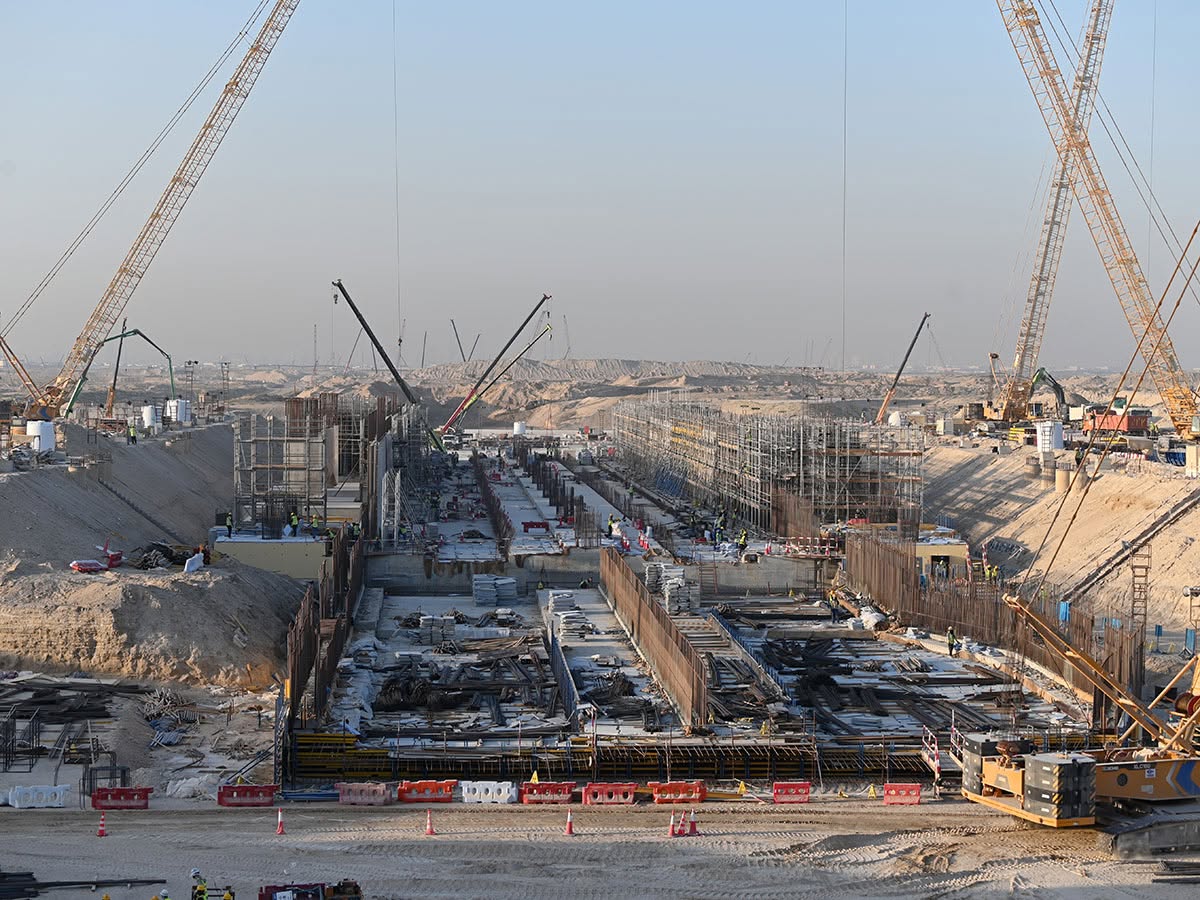

Roughly 9,000 workers are currently on site at Al Maktoum International Airport, a figure Dubai expects to swell to around 120,000 once the build hits peak capacity. That workforce projection, disclosed by Dubai Aviation Engineering Projects, captures the scale of what the emirate is calling its new global airport — a project the government says is tracking to its approved 2032 opening.

Engineer Suzanne Al Anani, chief executive of Dubai Aviation Engineering Projects, said contracts worth more than AED13 billion are currently being executed. The active scope includes more than 17,000 concrete piles, excavation topping 45 million cubic metres, and a core infrastructure package involving roughly 4.5 million cubic metres of concrete. A second runway has been finished to allow the existing one to be rehabilitated. Crews have logged over 10 million work hours across the past 15 months.
Sheikh Ahmed bin Saeed Al Maktoum, chairman of Dubai Airports, framed the build as one of the projects shaping the city’s economic trajectory. “Al Maktoum International Airport is one of the most significant strategic projects shaping Dubai’s economic future. It embodies our leadership’s long-term vision of investing in world-class infrastructure capable of accommodating the rapid growth in travel, trade, and logistics. The project’s transition into a large-scale construction phase, with contracts valued at AED13 billion currently under execution and preparations underway to award strategic projects worth more than AED55 billion during the next phase, reflects the substantial progress achieved and the strong momentum driving the development,” he said.
That next wave of contracts — together exceeding AED55 billion — is slated for award by year-end. Al Anani said the packages cover substructure works for the Western Passenger Terminal, a fourth concourse, the Automated People Mover, and the Baggage Handling System, alongside superstructure work on the Western Passenger Terminal and the first three concourses. Long-span structural frameworks spanning around 1.5 million square metres, southern airfield infrastructure, and power and district cooling plants are also in the pipeline, with façade and roofing packages expected to follow this year.
Sheikh Hamdan bin Mohammed bin Rashid Al Maktoum, Crown Prince of Dubai, tied the airport directly to the Dubai Economic Agenda. “A key enabler of the objectives of the Dubai Economic Agenda, D33, the Al Maktoum International Airport project will expand the aviation sector’s capacity and enhance the efficiency of the emirate’s transport and logistics ecosystem. This will attract high-value investments, broaden business activity, and create sustainable economic opportunities that will support Dubai’s development journey for decades to come,” he said. He credited the delivery team working under Sheikh Ahmed’s oversight.

From a fiscal standpoint, Abdulrahman Saleh Al Saleh, director-general of Dubai Finance, positioned the airport as a sovereign asset built to draw long-term investment. He said the work reflects a commitment to governance and financial discipline that balances development ambitions against efficient use of resources, which in turn shores up the confidence of investors and international partners in the durability of Dubai’s economy.
Khalifa Al Zaffin, executive chairman of Dubai Aviation City Corporation, said attention is also on engineering a clean handover of operations from Dubai International. “At the same time, we are working to ensure a smooth and carefully managed transition of operations from Dubai International Airport to the new airport, safeguarding the world-class service standards for which Dubai is renowned, while enhancing our capacity to accommodate sustained growth with exceptional efficiency, agility, and resilience,” he said. He described the facility as an integrated platform designed around automation, operational intelligence, and connectivity across airport and transport systems rather than a conventional infrastructure expansion.
Once its final phase is complete, the airport is designed to handle upward of 260 million passengers and 12 million tonnes of cargo a year, running five independent parallel runways, two terminals, and seven concourses linked to more than 430 aircraft stands, with air, rail, and road links woven into a single network.
Running parallel to the new build is a separate modernisation programme across Dubai International and Dubai World Central, carrying a budget of AED16 billion, of which more than AED7.5 billion in contracts has already been awarded. At Dubai World Central, terminal and boarding upgrades are geared toward flydubai’s fleet growth, including its incoming wide-body Boeing 787s. At Dubai International, work spans the Terminal 3 access bridge, road and access-route upgrades serving Terminals 1 and 3, airfield improvements, and expanded remote boarding and baggage systems.
