



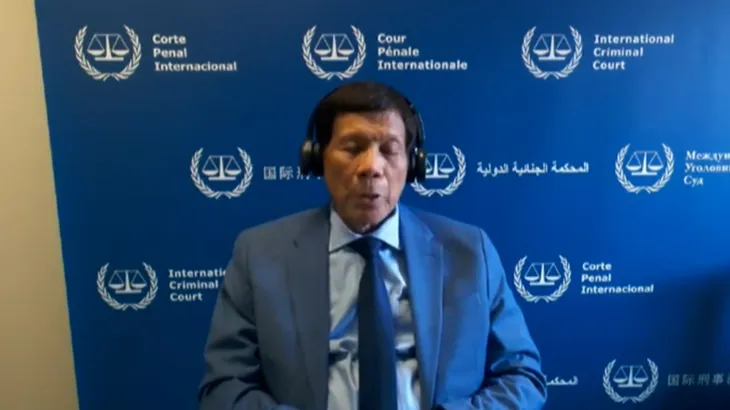

Proceedings against former president Rodrigo Duterte at the International Criminal Court are expected to move forward under a process that allows both sides sufficient preparation, an ICC spokesperson said, as reported by The Philippine STAR.

Speaking to the publication, ICC spokesperson Oriane Maillet emphasized that the court’s procedures are designed to handle complex cases involving extensive evidence. “The trials at the ICC can be complex, (it) may take a little bit longer than at national level because of the type of crimes that require a large amount of evidence to be presented in court, and some of the challenges that can be met during the proceedings,” she said.
Maillet added that fairness and due process remain central to the court’s mandate. “But we are committed to holding a fair and independent trial, impartial trial, where the defense will have enough time to prepare for its case and where the rights of the victims will be upheld,” she said.
The case progressed after ICC Pre-Trial Chamber I confirmed the charges of crimes against humanity on April 23, leading to the formation of Trial Chamber III, which is set to convene its initial status conference on May 27. The schedule for the trial proper will be determined by the judges based on submissions from both parties.
“I cannot speculate at this stage. It will be a decision by the judges to set the date for this trial,” Maillet said, noting that several matters still need to be addressed before proceedings begin. “There are many issues that need to be resolved before being able to start the trial. And really, they’ll have to see what is best for the parties to be ready for the trial. And it will really depend on the circumstances of the case, so let’s wait and see,” she added.

The chamber handling the case includes judges Joanna Korner, Keebong Paek, and Nicolas Guillou, who were appointed based on their qualifications and experience in international proceedings.
Maillet said the trial will generally be accessible to the public through online streaming, although certain portions may be restricted if sensitive information or witness protection concerns arise. “The judges may decide to hold certain hearings in closed session. If they feel some information needs to be protected – certain sensitive evidence, confidential evidence – or, if there’s a need to protect the witnesses or the victims, some sessions may be held in closed sessions. But the principle is that it is a public trial,” she said.
She also outlined how the proceedings typically begin, with opening statements followed by the prosecution’s presentation of evidence. “Now, what can we expect? On the first days of the trial, you usually have opening statements by the parties and participants, and then the prosecution will start presenting its case. The prosecution has to prove the guilt of the accused beyond reasonable doubt, so it’s quite a high threshold. To do so, they will present evidence. It can be material evidence, it can be photos, videos, witnesses,” she said.
While the accused is generally expected to attend, the final determination rests with the judges. During earlier hearings, Duterte’s legal team raised concerns over his health, prompting adjustments such as scheduled breaks; he later chose not to appear in those proceedings.
