



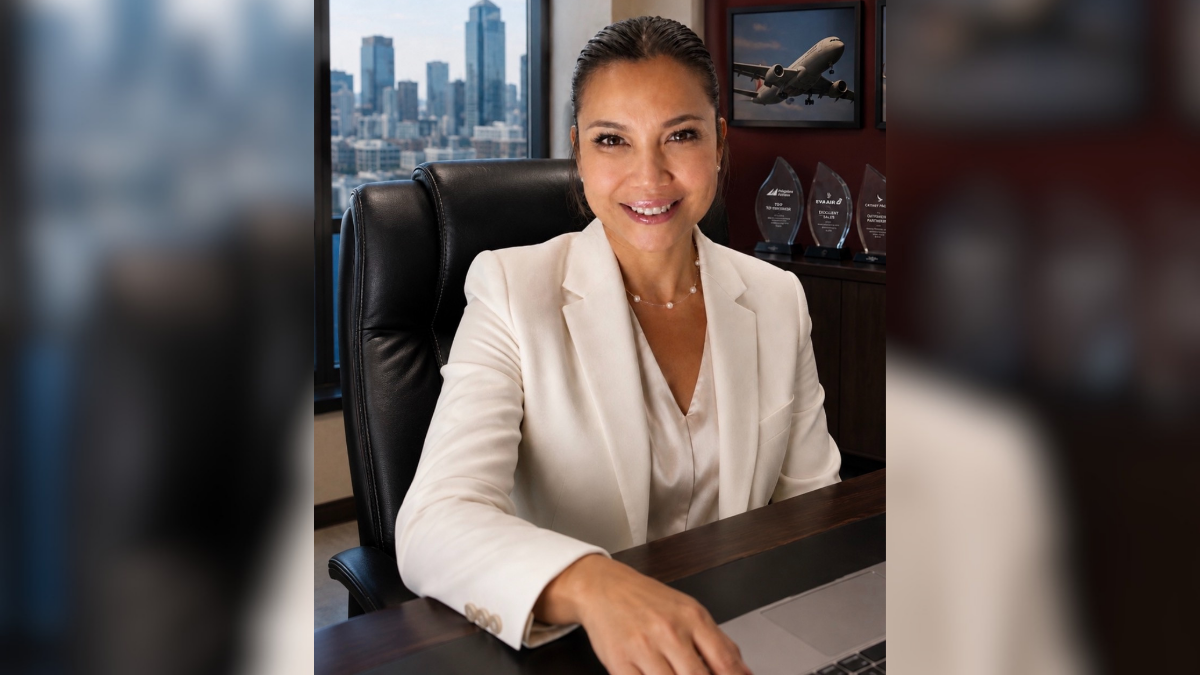

Overseas, the person who books your flight home is usually a stranger you’ll never meet. But the industry that moves millions of Filipinos across oceans every year still runs, at its core, on something older than any booking engine — the instinct to take care of people. Joanna Delos Reyes has spent more than two decades proving that point, first from a reservations desk in Manila and now as Director of Sales – Asia Accounts at Sky Bird Travel & Tours in the United States.

Her office today deals in Asia market development, international airline partnerships, and sales targets. But ask her what the work is actually about, and she circles back to the same idea every time.
“At the end of the day, it is still a people business,” she shares with TGFM. “Behind every airline ticket is a person traveling for a reason.”
That conviction did not come from a corporate training manual. It came from a career that began at Philippine Airlines, survived a cross-continental gamble, and was ultimately reshaped by thirteen days she spent praying in a hospital corridor.
Starting over at thirty thousand feet
Before America, there was PAL. Joanna spent six years there in Reservations, Sales and Marketing, absorbing the discipline of an industry that runs on precision and the softer art of making travelers feel looked after. “Those years gave me a strong foundation in the airline industry,” she recalls, “but more importantly, they taught me the value of service, relationships and taking care of people.”
Then, on December 30, 2000, she boarded a plane of her own and arrived in the United States with the ambition shared by generations of Filipinos before her.
“Like many Filipinos, I came to America in search of what we often call ‘greener pastures,'” she says. She knew what the phrase really cost. Leaving meant surrendering everything familiar — family, friends, a professional network built over years, the simple comfort of knowing how things worked. “I knew there would be sacrifices, but I also knew that opportunities do not always come to you. Sometimes you have to be brave enough to go after them.”
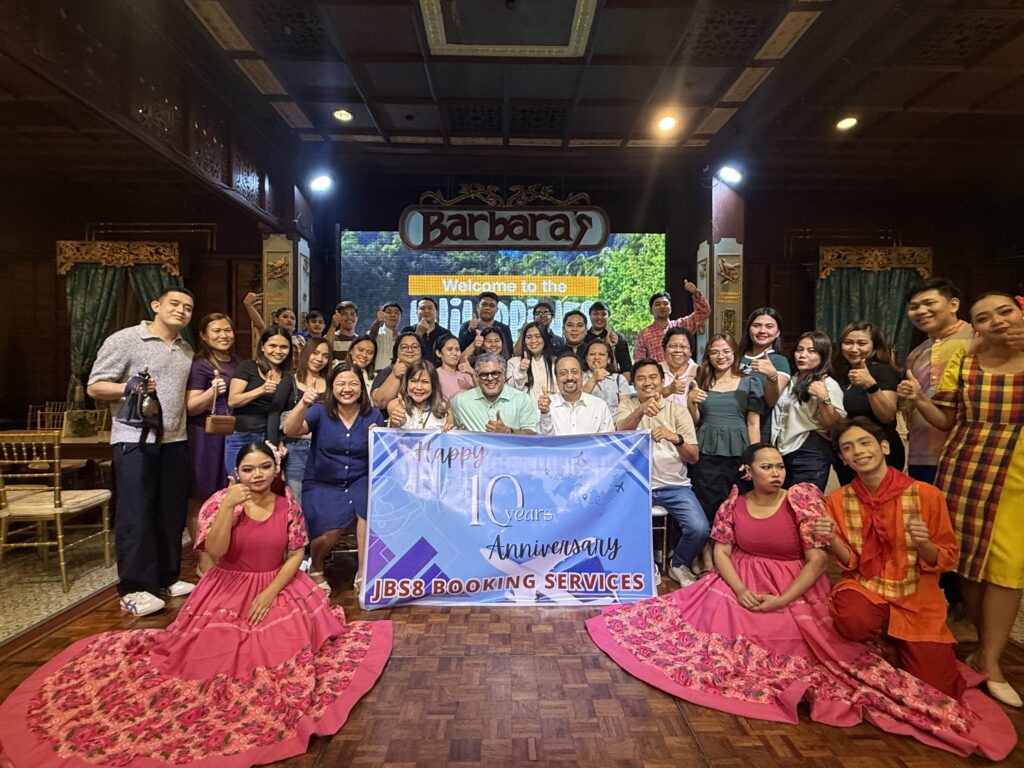
Bravery, it turned out, was only the entry fee. Her first job in America was with another travel consolidator, a modest restart for someone who had already built a name in Manila. The real climb came later, after she joined Sky Bird Travel & Tours — the move she now calls a major turning point in her professional journey.
What she doesn’t dress up is how hard the early years actually were. For a stretch, she held down two jobs at once. Her husband had decided to step away from work temporarily to focus on nursing school, and the bills did not pause to accommodate the plan. So she worked her regular hours at Sky Bird, then clocked in at Banana Republic.
“We had responsibilities and bills to pay, and we knew that his education was an investment in our family’s future,” she explains. “So we did what many Filipino families do — we made sacrifices for each other.”
There is no self-pity in how she tells it, and no embarrassment either. “I never thought I was above doing whatever honest work was necessary to help my family,” she says. Those were tiring days, stitched together from one shift and then another, held in place by a shared goal and a marriage that started in college and had already learned how to carry weight.
When someone finally sees you
The retail shifts eventually ended, but not because the sacrifices stopped mattering. They ended because someone at Sky Bird was paying attention.
Management noticed the dedication and the potential, and offered her the chance to supervise the company’s Manila team. For Joanna, the promotion landed as two things at once — a genuine career milestone, and, at that precise moment in her family’s life, a financial lifeline.
“That promotion was not only a career milestone,” she says. “At that particular time in our lives, it was also a tremendous financial blessing for my family.”
She has never forgotten the shape of that gesture: an employer choosing to believe in her before the title existed to justify it. And it rewired how she thinks about her own role now. The most telling part of her leadership philosophy is not something she accomplished but something she tries to pass along.
“Because someone once did that for me, I try to do the same today for the people I lead,” she says of her LAX and Manila teams. “When I see potential in someone, I want to encourage it. I want them to know that their current position does not have to define how far they can go.”
It is a neat inversion of the usual sales-leader story. Ask most executives about their proudest moments and you’ll hear about numbers. Ask her, and she talks about watching people grow past the roles they were hired into. “I believe leadership is not only about what you accomplish yourself,” she says. “It is also about how many people you help rise with you.”
That belief plays out in the parts of the job she describes with the most energy. She loves building relationships with travel partners — many of them entrepreneurs who clawed their way to stability — and finding ways to help their businesses succeed. And she takes particular satisfaction in the moment a team member finds their footing. “When I see someone on my LAX or Manila team develop confidence, learn new skills, take on bigger responsibilities and eventually become a leader, that makes me very proud.”

Working overseas, she’ll tell you, gave her more than a salary. It gave her cultural range, relationships with major international airlines, cities she never expected to see, and a harder-won trio: independence, adaptability and resilience. But the benefit she names first is quieter than any of those.
“Perhaps one of the greatest benefits is perspective,” she says. “Living abroad makes you appreciate both the opportunities of your adopted country and the beauty of your own.” Then the line that reframes the whole “greener pastures” premise: “The longer I have lived in America, the more I appreciate being Filipino.”
Thirteen days
For most of her career, the hardest chapter would have been the two-job years. Then the pandemic arrived and rearranged the scale of everything.
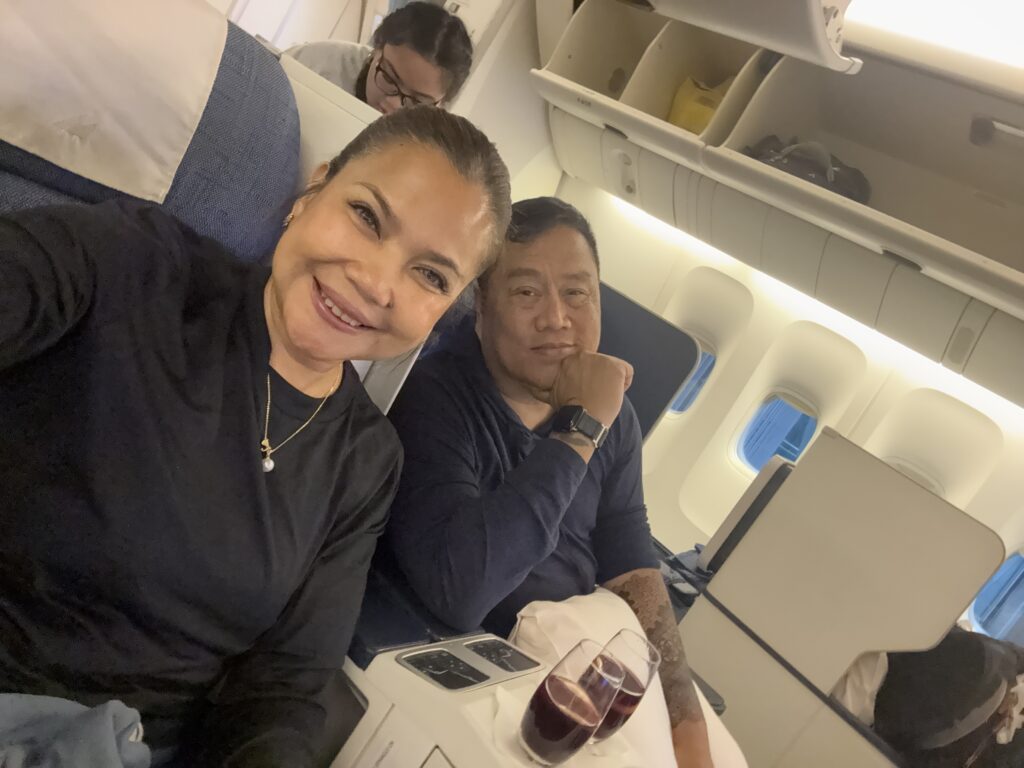
Her husband — the college sweetheart, the one whose nursing degree those Banana Republic shifts had helped pay for — was working as a dialysis nurse when he contracted COVID. His condition deteriorated fast. He was intubated for thirteen days.
She does not reach for polish when she describes what those days were like. “The doctors would talk to me about how slim his chances of survival were,” she says. “Hearing that about the person who has been beside you since college — the person with whom you have built your life and raised your family — is something very difficult to put into words.”
So she did the only thing left to do. She, her family and her friends prayed, and kept praying, through the stretches when there was nothing else to hold. “There were moments when all I could hold on to was my faith,” she says.
He survived.
The woman who tells that story now is not the same one who went into the hospital. The experience, she says plainly, changed her deeply — and it recalibrated what she counts as important. “It reminded me that careers, titles, sales numbers and achievements are important, but they are not everything. Family is everything. Faith is everything. Life itself is a gift.”
She refuses to keep that part of the story private, even in a professional profile that could easily have stayed on the safe ground of career milestones. “I will never stop sharing that part of our story because I experienced personally how faith can sustain you when circumstances seem impossible,” she says. “God can truly move mountains and listens to our prayers.” Every day she and her husband have now, she treats as something not to be taken for granted.
Carrying the country with her
That survival seems to have sharpened rather than dimmed her sense of purpose — including a purpose that reaches back across the Pacific. Increasingly, she has used her position to point the world toward the Philippines.

One recent collaboration stands out. Working with the Philippine Department of Tourism Los Angeles, she helped promote Zamboanga and met the city’s mayor, Khymer Adan T. Olaso, as part of an effort to sell the destination not only to balikbayans and Filipino-Americans but to non-Filipino travelers as well.
“Moments like that remind me that my career is not simply about selling travel,” she says. “It is also about using the opportunities I have been given to help connect people to the Philippines and show the world what our country has to offer.” Whether she is backing Filipino travel professionals, working with airlines that serve the Philippines, or promoting destinations like Zamboanga, she feels part of her work always circles back home. “I want people to know that the Philippines has so much more to discover.”
When she looks ahead, the picture gets deliberately smaller. She is too active and sociable, she jokes, to imagine retirement as sitting still — but she is ready for a slower chapter. After years of deadlines, early mornings, airline negotiations and sales goals, she’d like to take her own sweet time, ideally without another target hanging over her. She wants to be more involved in her church, to teach or work with children, and above all to have more time with her family — with the husband who has been beside her since college, and with her son, whose own family she hopes to one day help welcome as a grandmother.
“My future goal is really very simple,” she says. “Less rushing. Less stress. More family. More faith. More giving back. And more time to appreciate everything we worked so hard for.”
Her advice to fellow Filipinos abroad carries the weight of someone who has tested it. Never forget why you started. Don’t measure your journey against anyone else’s. Work hard, stay humble, protect your reputation, and when you finally reach a position to help someone else, do it. Balance your generosity toward loved ones with securing your own future — a distinctly Filipino tension she knows well. And hold on to faith when life turns impossible, because she has needed hers.
Most of all, she says, refuse to shrink your identity to fit a new country. “Never be ashamed of being Filipino. Carry our values with you wherever you go.” Success abroad, in her telling, isn’t a reason to leave that identity behind — it’s a platform to broadcast it.
The word she keeps returning to, when she surveys the whole arc, is gratitude — for Philippine Airlines and the foundation it gave her, for Sky Bird and the belief it extended before she’d earned the title, for the teams who remind her that leadership is never a solo act, and, above all else, for her family and her faith.
More than twenty-five years ago, she left Manila chasing greener pastures and had no idea where the journey would lead. One thing, she says, never shifted: “I may have built my career in America, but I have always carried the Philippines with me.”
