



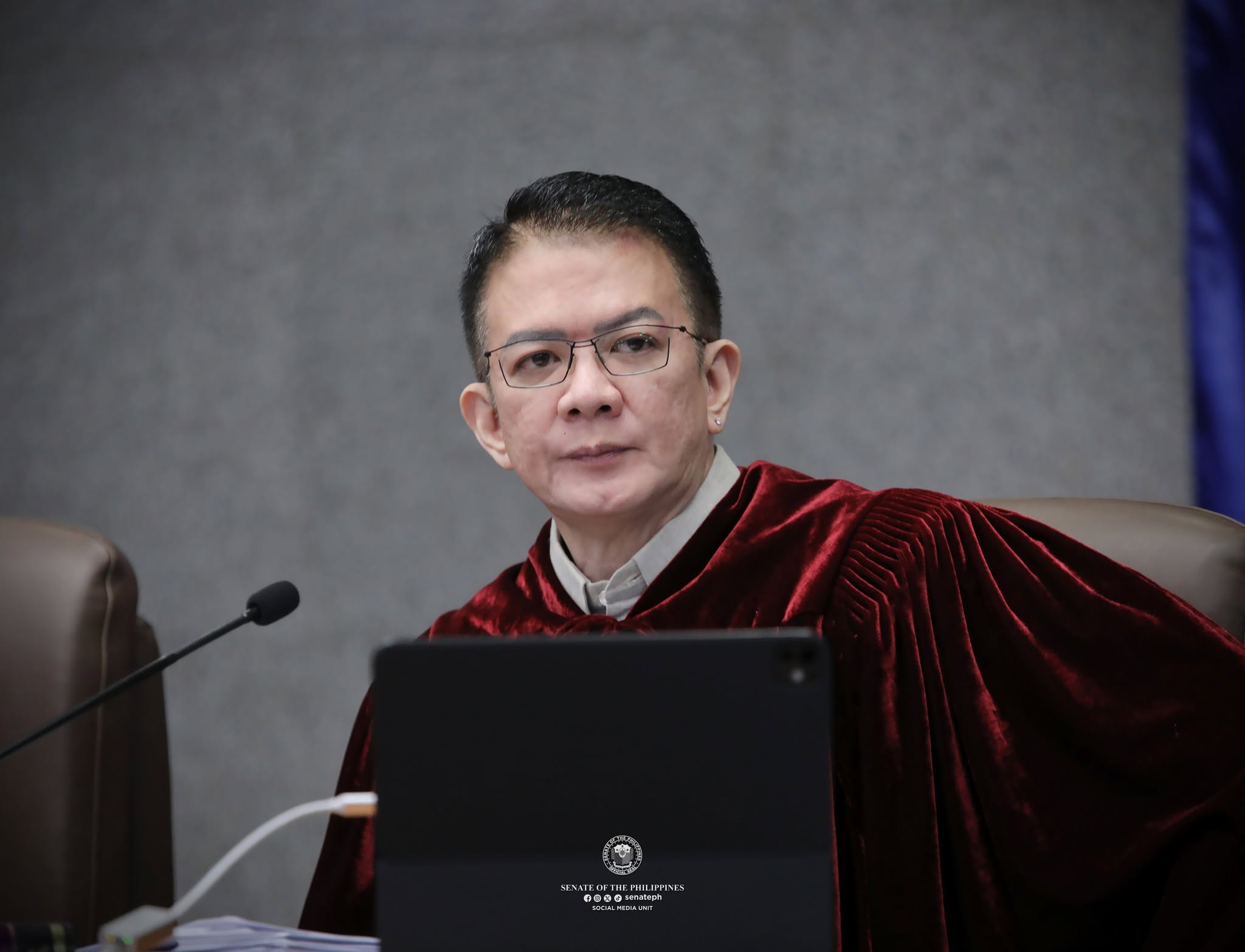

The question of who must ultimately establish the case against Vice President Sara Duterte drew a firm clarification from the man presiding over her impeachment trial, who told the Senate court that the obligation resting on the prosecution cannot be transferred to the defense no matter how the proceedings unfold.

That distinction surfaced after Senator-Judge Alan Peter Cayetano interjected during discussion of the Vice President’s alleged misuse of confidential funds. Cayetano sought to pin down whether the arguments before the court hinged on a finding of irregularity or fraud, and whether any “presumption that shifts” was being invoked as the panel weighed the disputed spending.
Presiding Officer Francis “Chiz” Escudero responded by separating two legal concepts that have run through much of the trial. “The burden of proof still lies with the Prosecution but depending on how the issue is presented, the burden of evidence may shift, but the burden of proof never shifts,” he said.
The formulation echoes a position Escudero staked out at the opening of the trial in July, when he ruled that the House prosecution alone must establish its case and that this responsibility would stay with the prosecutors throughout. That the two burdens operate differently has since become a recurring point of contention. The prosecution has argued that once its evidence raises a credible question, the defense is obligated to respond, while Duterte’s counsel has maintained that the accusing side carries the entire load and that the Vice President is presumed innocent until it is met.

The confidential funds at the center of the exchange involve P612.5 million allocated to the Office of the Vice President and the Department of Education during Duterte’s tenure heading both offices. House prosecutors have built part of their case on testimony from state auditors, with Commission on Audit official Roderick Wamil telling the court that unliquidated confidential funds are treated as initial evidence of personal use. Following that testimony, the prosecution contended that the defense now bears the task of accounting for where the money went and identifying the recipients and activities the disbursements supposedly covered.
Duterte, who has denied misusing public money, is not attending the proceedings in person and is represented by her legal team, which has argued that the case rests on flawed interpretations of audit documents and points to an approval chain running through the Department of Budget and Management and the Office of the President.
Conviction in the trial requires the votes of at least two-thirds of the Senate, a threshold Escudero has affirmed stands at 16 senators, and removal from office could carry with it perpetual disqualification from holding public office.
