



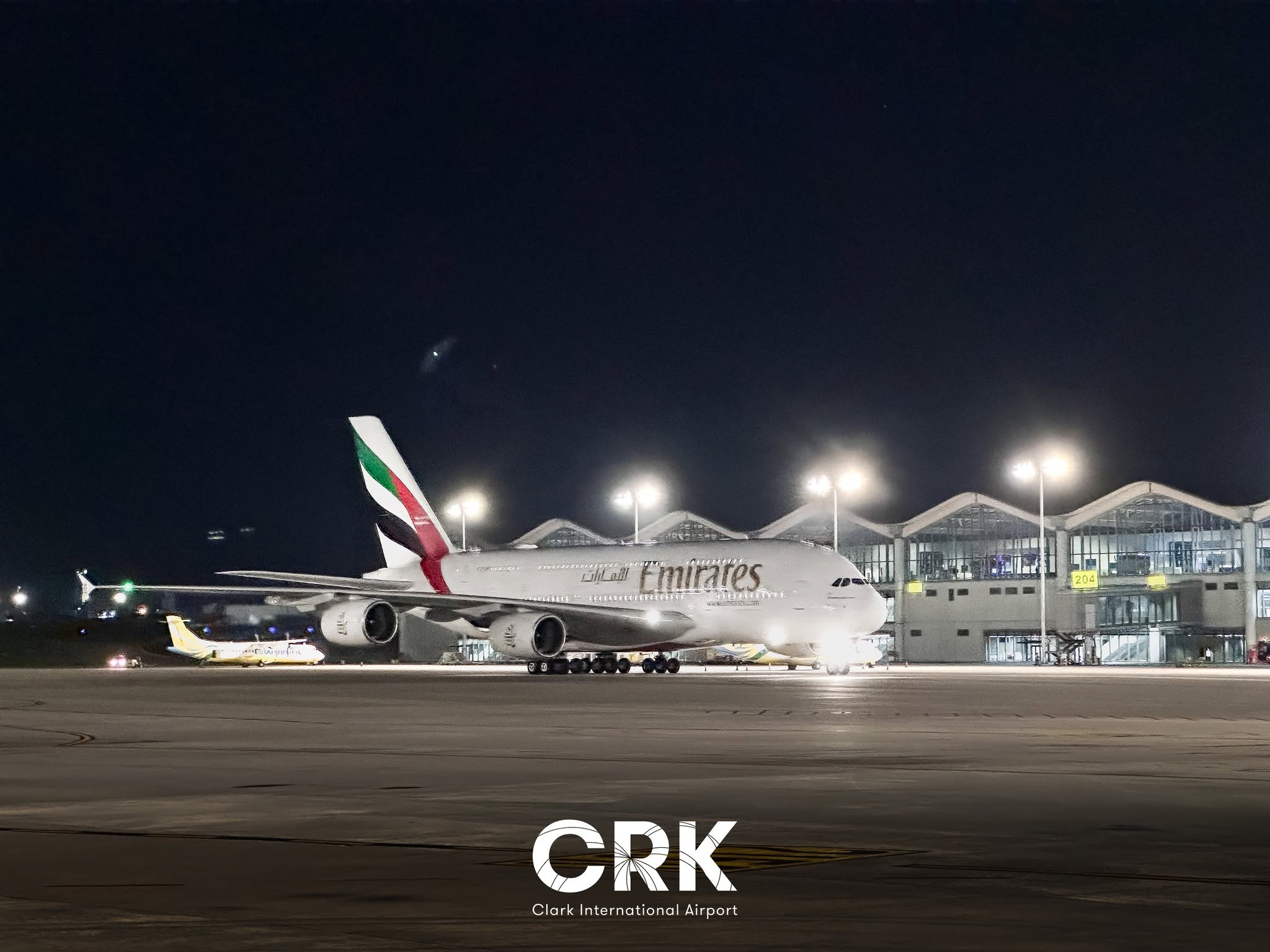

Clark International Airport has once more played host to the Airbus A380, the double-decker jet that ranks as the largest passenger aircraft in commercial service, with an Emirates superjumbo touching down at the Pampanga hub roughly six years after the type first visited the airport.

The airport, which goes by the code CRK, framed the landing as proof that its facilities can service an aircraft of the A380’s scale. That is not a trivial claim. The jet stretches nearly 80 metres from wingtip to wingtip and carries passengers on two full decks, requiring runways of sufficient length, reinforced aprons and boarding infrastructure built for wide-body operations. Clark, according to airport officials, has all three.
Emirates has a long history at the gateway. The Dubai carrier launched its first Clark service in 2016 and has flown to the Philippines since 1990. Its earliest A380 appearance at CRK came in August 2020, when a special service from Dubai — the first commercial flight of the type to land at the Luzon-based airport — arrived to a water cannon salute carrying more than 400 travellers, according to Emirates. A scheduled A380 rotation followed in 2023.
For CRK, positioned as an alternative international entry point to the congested Ninoy Aquino International Airport in Manila, the ability to routinely welcome the world’s biggest airliner strengthens its pitch to carriers weighing where to add capacity. Airport managers cast the latest touchdown as a marker of readiness for heavier aircraft and for growth in the years ahead.

The timing arrives as Emirates leans harder into the A380 than almost any operator on the planet. The airline flies roughly half of the world’s remaining active superjumbos and, as its president Sir Tim Clark told Aviation Week in late 2025, intends to keep them aloft into the 2040s in the absence of any comparably sized replacement — a gap widened by repeated delays to Boeing’s 777X programme. Clark said the carrier expects to have about 110 of the aircraft flying by the end of 2026, up from the mid-90s it operated last year.
Emirates has spent 2026 pulling stored A380s back into service, some of them parked since the pandemic, and fitting refreshed cabins that add premium economy seating alongside its signature First and Business Class products. Simple Flying has reported the retrofit programme covers 60 aircraft and includes Starlink connectivity and 4K seatback screens, part of a bid to keep the ageing jet competitive against newer twin-engine models flown by rival airlines.
Introduced to the Emirates fleet in 2008, the A380 built a devoted following among Filipino flyers, many of whom routinely routed trips through Dubai specifically to experience the aircraft’s space and amenities.
