



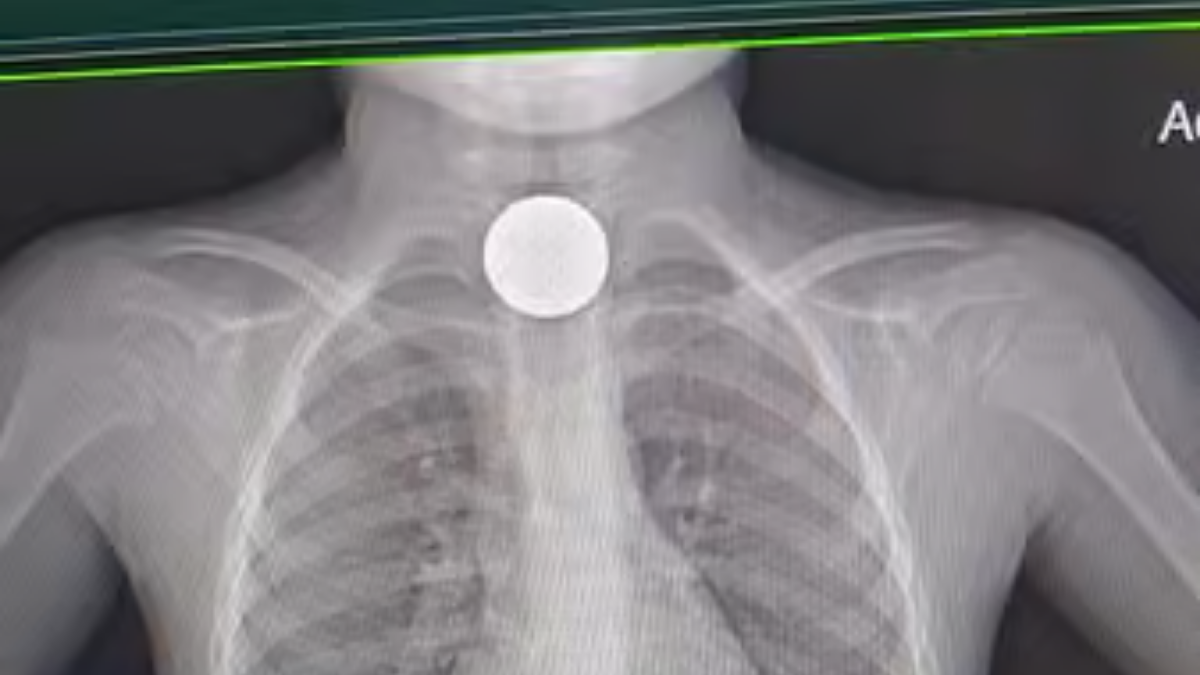

A four-year-old boy is recovering after doctors at a Dubai hospital extracted a coin lodged in his oesophagus during an emergency procedure that took just two minutes to complete.

Muhammad Shahzain Awan was rushed to Medcare Royal Speciality Hospital in Al Qusais after his parents noticed he was vomiting and struggling to breathe. The coin had become stuck in the upper oesophagus — a location where even minor movement carries the risk of serious complications.
“He was vomiting and choking, and we didn’t understand what was wrong at first. It was a very frightening moment for us, and we rushed him to the hospital as quickly as we could,” the boy’s mother told Khaleej Times. “We are relieved and grateful to the medical team for acting so quickly.”
Physicians performed an emergency endoscopic procedure, using a minimally invasive approach to retrieve the object. The child was stabilised shortly after and later discharged following a period of observation.

Dr Prithvi Priyadarshini, specialist gastroenterologist at the hospital who attended to the case, described the difficulty of performing the procedure on a young patient. “The procedure was complex and delicate, especially since the patient was a four-year-old child. Children typically have narrower passages, making it challenging to use endoscopy equipment and accessories,” she said.
Dr Priyadarshini also warned that such incidents occur more frequently than parents tend to assume. “Foreign body ingestion is something we see more often than people realise, and it can escalate very quickly. In young children, the airway and food passage are very small, so even a minor blockage can lead to serious consequences. In this case, timely intervention made all the difference.”
Children under four are considered particularly at risk because of their tendency to put objects in their mouths. Medical experts note that coins are the most frequently swallowed non-food items among toddlers, with estimates suggesting nearly one in five children between one and three years old may ingest a non-food object at some point. Food-related choking is also a significant concern — items such as grapes, nuts, hard candy, and raw vegetables account for more than half of choking incidents in young children.
Doctors advised parents to keep small objects out of children’s reach, supervise meals, ensure children eat in an upright position, and cut food into appropriately small pieces before serving.
