



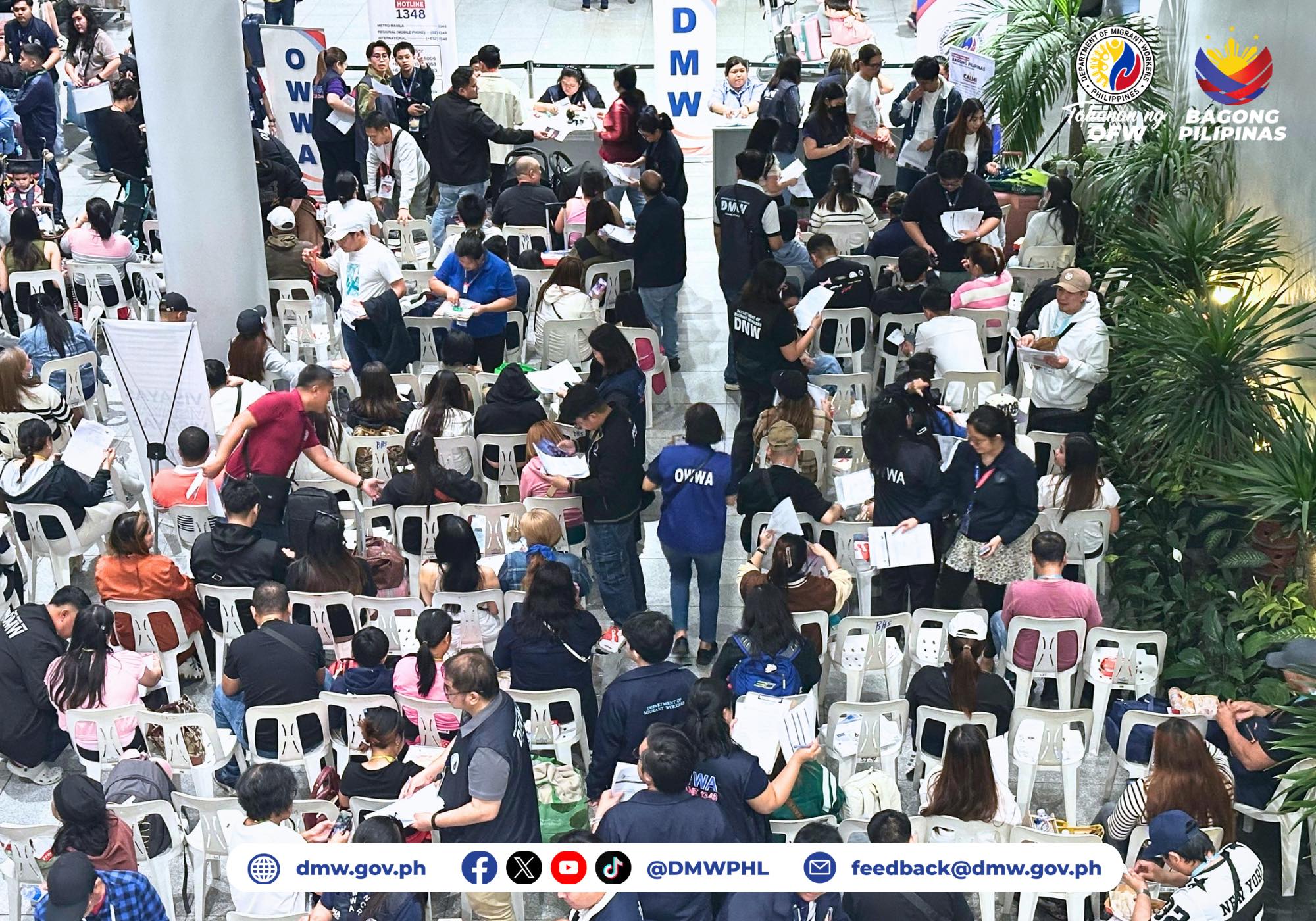

More than 30,000 overseas Filipino workers across 10 Middle Eastern countries are now accessing a range of government services as the Department of Migrant Workers moves to accelerate its crisis response following ongoing regional instability.

DMW Assistant Secretary Jun Rasul said many workers have suffered either permanent or temporary job loss, income reductions from shortened work schedules, or broader employment disruptions tied to the conflict. To account for those varied circumstances, the department has streamlined documentation requirements, including the acceptance of self-declarations from affected workers.
“And then to make it easier, we allow ‘sariling salaysay,’ self-declaration on the part of the affected OFW that he has lost his job or has been given pay cuts due to limited working hours, reduced working hours, and so on and so forth,” Rasul said.
Filipino community organizations may also certify that members have experienced reduced working hours, providing an alternative route for workers who lack employer documentation. Rasul cited sales staff at Dubai Duty Free as an example of those now qualifying under the guidelines.
“In the case, for example, in Dubai duty-free, we heard that most of the sales ladies there are allowed to report twice a week na lang because of reduction in the number of tourists coming in, so meron pong schedule sila to report, so nababawasan po ang kanilang sweldo. So the reason of that, the department has decided to grant financial assistance to them, the amount of USD200 coming from the action fund,” he said.
Applicants are required to submit a request for assistance form, a valid passport copy, and proof of overseas employment — such as a contract, visa, or labor card. Documentation of income disruption, whether an employer certification, reduced pay slips, a termination notice, or visa cancellation, must also be included.

Migrant Workers Secretary Hans Leo Cacdac said the program is now fully funded following a budget replenishment from the Department of Budget and Management, authorized by President Ferdinand R. Marcos Jr.
“Of this amount of PHP800 million, there will be allocations for financial assistance on-site, financial assistance here in our country for those who have returned, and there will be allocation also for transport, for airfare, air transport. In a nutshell, our financial assistance guidelines will pertain to those whose work has been affected by the crisis,” Cacdac said at a media briefing Friday.
“Lalarga tayo (All systems go) in terms of further distribution of our financial assistance of USD200 per worker affected by the crisis.”
As of Friday, 4,502 OFWs have received the USD200 cash assistance, with 6,605 Filipinos repatriated from the region — 5,023 of them workers and 1,343 their dependents. The government shouldered the cost of 6,366 of those repatriations.
The assistance program covers OFWs in Bahrain, Iran, Israel, Jordan, Saudi Arabia, Kuwait, Lebanon, Oman, Qatar, and the United Arab Emirates.
