



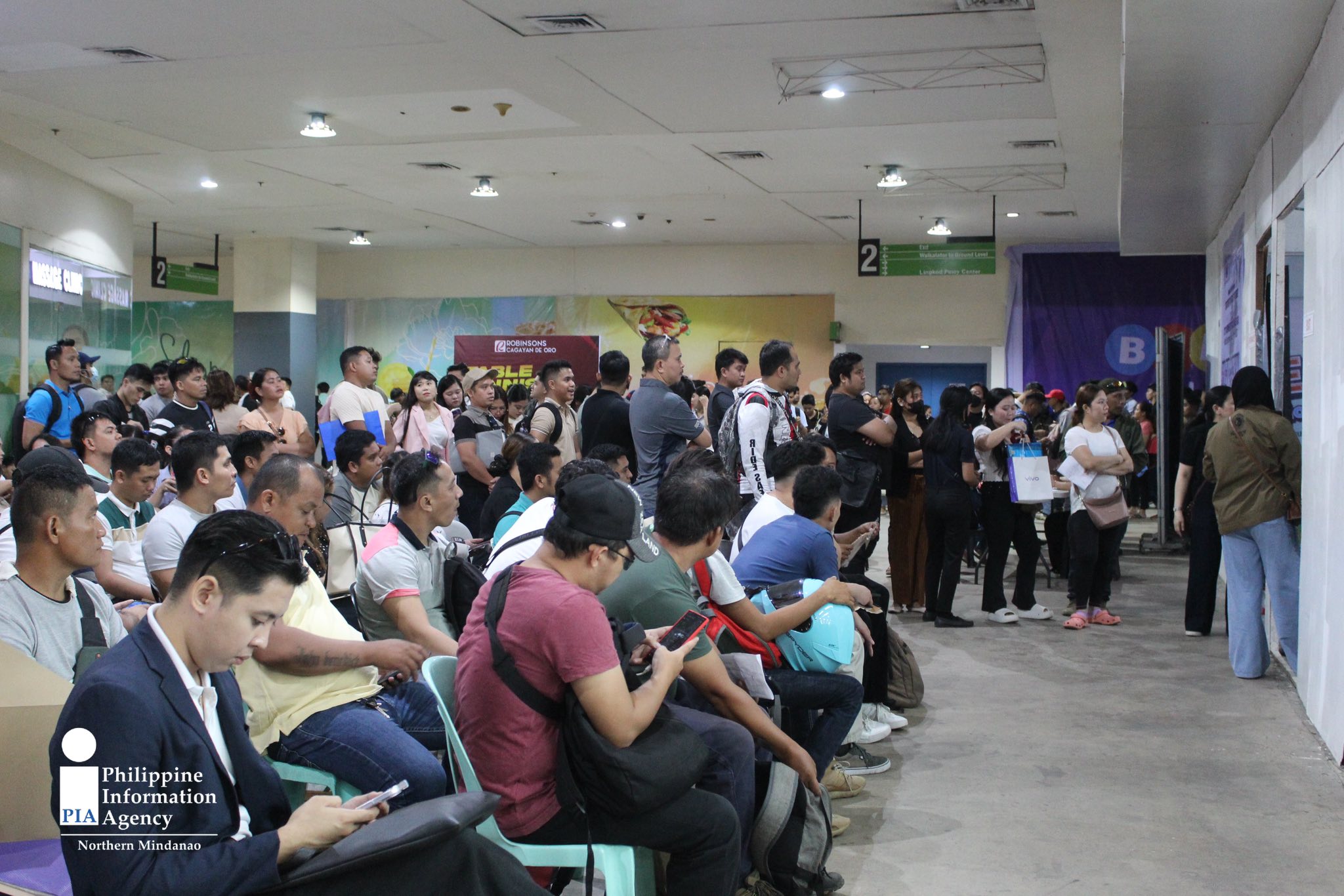

Thousands of Filipinos who left jobs abroad amid overseas conflicts are being steered toward local employment, retraining and small business support under a government program that the Department of Migrant Workers (DMW) says is gaining momentum.

At a Monday press briefing held at the agency’s headquarters in Mandaluyong City, DMW officials laid out how the National Reintegration Network (NRN) has scaled up its assistance, with particular attention to the large number of workers displaced by hostilities in the Middle East, the Philippine News Agency reported.
Assistant Secretary Kiko de Guzman traced the program’s reach back to April, when President Ferdinand R. Marcos Jr. opened the NRN caravan. Since then, he said, the department has fanned out to nearly every region to account for workers who have come home.
“Nakapagtala na po tayo ng mahigit 4,000 na former OFWs at mahigit 700 na recently repatriated OFWs that have been provided with frontline services and that have been assisted sa kanila pong reintegration needs kabilang na po diyan ang mga kaalaman, kabuhayan, and kalinga programs po natin (We have already recorded more than 4,000 former OFWs and over 700 recently repatriated OFWs who have been provided with frontline services and assisted with their reintegration needs, including knowledge, livelihood and care programs),” de Guzman said.
A whole-of-government safety net
The NRN functions as an inter-agency effort, pulling together the DMW and 15 other government bodies to guarantee that workers arriving home are met with immediate livelihood, job and psychosocial support instead of being left to fend for themselves. Much of that support is delivered through regional caravans that link returnees to public services, hiring assistance, financial aid and training.
Undersecretary Felicitas Bay said interest has been strong, with more than 2,000 returning workers signing up for various offerings.
“Doon sa ating livelihood, ang nag-signify sa amin sa livelihood ay 1,500 more or less. Sa (For the livelihood, around 1,500 signified interest. For) local employment, more than 600. For redeployment, it’s 1,300 more or less,” she said.
Many still want to return abroad
Not everyone, Bay noted, intends to stay. Some repatriated workers are waiting out the situation overseas because their employers never terminated their contracts, while others are pursuing fresh postings in different countries through state-brokered hiring arrangements.
She pointed to the aftermath of the 2023 and 2024 Israel-Hamas fighting as an example, recalling how some who came home from Israel later sought placements elsewhere.

“Banggitin ko lang siguro noong (Let me also mention, in) 2023 and 2024, I guess you’re all aware of the Israel-Hamas conflict. So in that conflict, some of the repatriates from Israel, they applied with our government-to-government Placement Bureau for Croatia, 17 hotel workers and some caregivers,” she said.
One caregiver, she added, used a TESDA voucher handed out on arrival to switch careers entirely.
“So, there’s life after any conflict or hostility. There’s life after repatriation,” Bay said.
Building skills for what comes next
Retraining has emerged as a central pillar of the effort. Migrant Workers Secretary Hans Leo Cacdac said the department has broadened its course offerings, including in caregiving and emergency health services. De Guzman said artificial intelligence training has also been added to the menu.
“Expanded program po ito, i-offer sa iba’t ibang regions sa Pilipinas para sa ating mga OFWs (This is an expanded program that we will offer to our OFWs from different regions nationwide) because we believe our OFWs need to be future-ready,” de Guzman said.
The agency is also working with licensed recruiters and employers to carve out new openings for displaced workers. Tied to the June 12 Independence Day commemoration, the DMW is preparing a job fair expected to draw 10 to 12 agencies and list upward of 4,000 vacancies spread across the Asia Pacific, Europe and the Americas.
Undersecretary Darlene Pajarito said domestic placement is taking on a bigger role alongside redeployment abroad. She cited a case in Region 9, where the regional office helped 142 teachers who had once worked overseas in low-skilled jobs move into licensed teaching posts at home.
“So sometimes it’s just closing the gap, within our country, there are opportunities, it’s just that there’s a gap in the connection. So as much as possible, as part of our integration strategy is to close that gap as well and help them find work in our home country,” she said.
For Pajarito, the point of the network is to function as continuous, full-cycle support — one that stays with workers well past the moment they touch back down on Philippine soil.
