



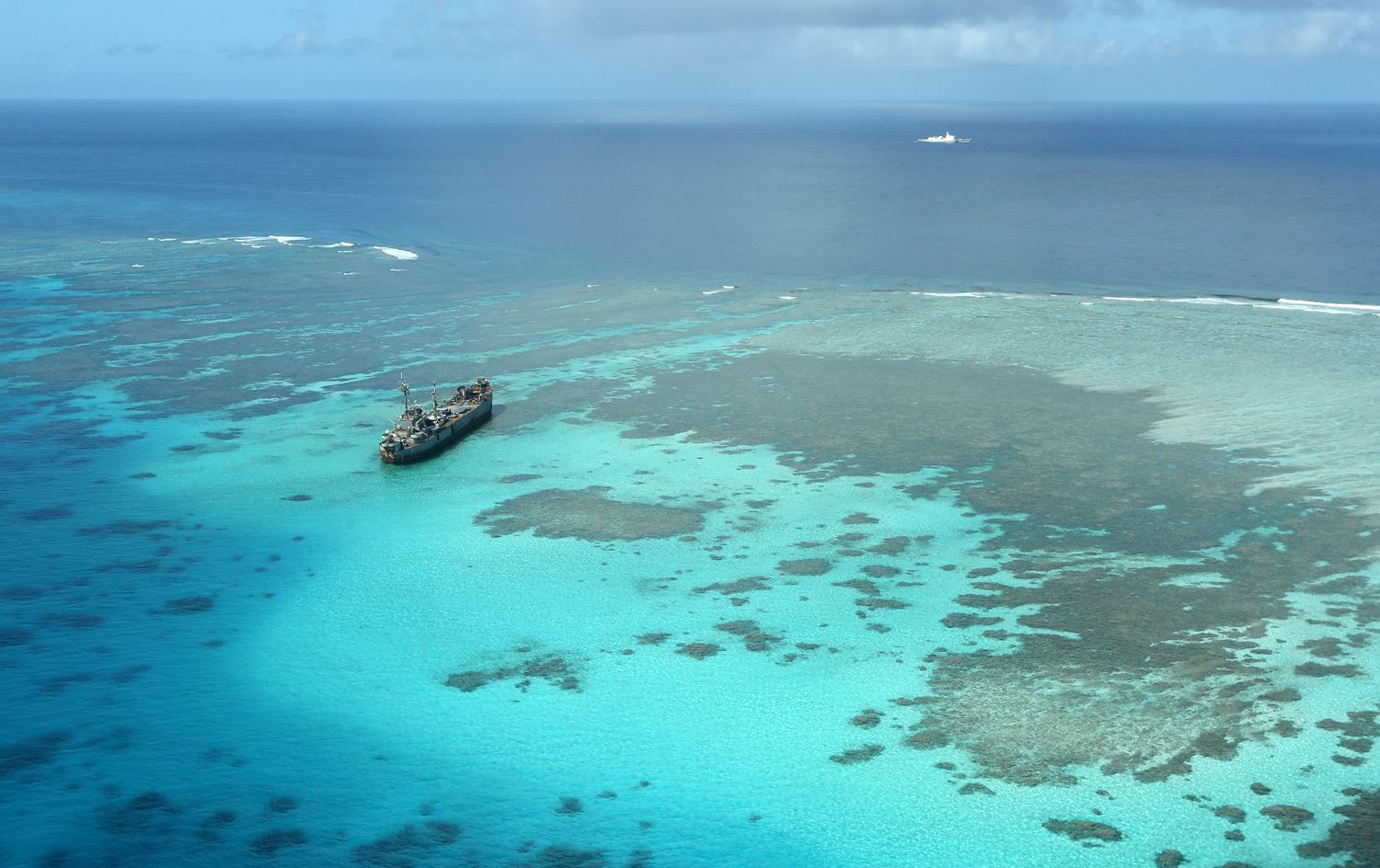

Any structure built on Ayungin Shoal can only be authorized by the Philippines, and Filipino ships need clearance from no one to reach it, the Department of Foreign Affairs declared in a statement issued from Manila on July 23, 2026.

“As a low-tide elevation, Ayungin generates no maritime entitlement of its own and cannot be claimed by any other state. The Philippines alone holds the sovereign right to authorize any structure there, and Philippine vessels do not require permission to sail to Ayungin,” the department said.
The shoal falls inside the country’s exclusive economic zone and continental shelf under the United Nations Convention on the Law of the Sea, a reading affirmed by the 2016 Arbitral Award, according to the DFA. Philstar reported that Ayungin lies 105 nautical miles off Palawan, comfortably inside the 200-nautical-mile zone the treaty grants coastal states.
A substantial portion of the statement targeted what the department called repeated efforts to distort both the shoal’s legal character and the Provisional Understanding covering rotation and resupply, or RORE, missions to the BRP Sierra Madre. That arrangement, the DFA said, exists solely as a framework of principles meant to prevent misreading and miscalculation while the Philippines delivers daily necessities to the grounded warship.
Nothing in the understanding functions as permission granted by or sought from a foreign government, the department added, and it confers no foreign jurisdiction over Philippine waters. It was accepted on the explicit condition that neither side’s national position would be weakened.
The DFA further stated the arrangement contains no requirement for the Philippines to request clearance for RORE missions and no provision permitting boarding or inspection of Philippine vessels. Sovereignty, sovereign rights and jurisdiction were never conceded, it said.

The statement landed three days after a confrontation at the shoal that the Armed Forces of the Philippines described as an assault by China Coast Guard personnel. Manila Bulletin reported that the encounter began at roughly 9:15 a.m. on July 20 when an eight-man rigid hull inflatable boat launched from a China Coast Guard vessel bearing bow number 21560 closed to within 20 to 30 meters of the Sierra Madre, prompting Navy crews to deploy rubber boats. Two sailors were injured after being struck with a wooden baton.
Beijing’s account placed blame on the Filipino side. The AFP and the Philippine Coast Guard rejected that version, telling Manila Bulletin that China circulated only partial video footage of the encounter.
President Ferdinand Marcos Jr. condemned the incident and summoned Chinese Ambassador Jing Quan to Malacañang on July 21 for a meeting that ran one hour and 20 minutes. Palace press officer Claire Castro said afterward that Marcos is seeking a “reset” of ties with Beijing. Officials told Philstar the meeting had been scheduled before the clash occurred, and Jing characterized the exchange as constructive.
Washington entered the picture on the evening of July 23, when Marcos and US President Donald Trump spoke by phone. Acting presidential spokesperson Dave Gomez said Trump committed to raising Philippine concerns with Chinese President Xi Jinping at their next meeting, which Rappler reported is expected during Xi’s US visit in September. The call followed Secretary of State Marco Rubio’s July 22 courtesy call at Malacañang, where Marcos briefed him on developments at sea.
The DFA closed its position by stating that rotation and resupply runs will continue, along with routine shipboard work aboard the Sierra Madre, describing both as ordinary government functions carried out within Philippine jurisdiction for as long as national interest requires. Its legal footing, the department said, rests on UNCLOS and the Arbitral Tribunal’s findings and is not open to negotiation.
