



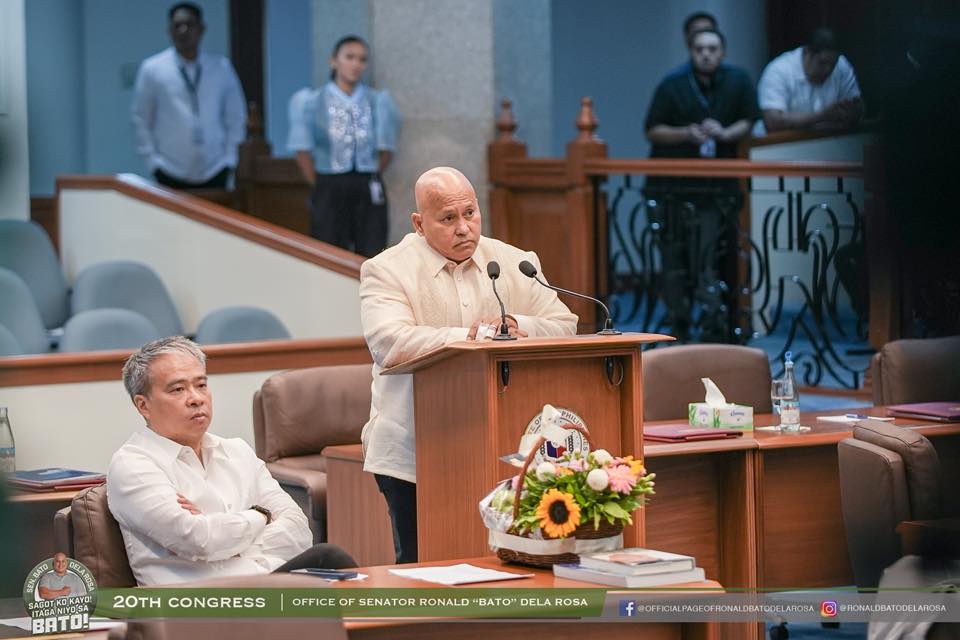

A constitutional argument is at the heart of Sen. Ronald dela Rosa’s latest legal move before the Supreme Court: that no Filipino citizen may be seized on Philippine soil based on a foreign or international warrant unless that process is first made enforceable under domestic law.

Through his counsel Israelito Torreon, the senator filed a 117-page reply with the High Court on May 18, pressing anew for a temporary restraining order against all attempts to arrest and surrender him in connection with the International Criminal Court warrant issued against him. The filing came days after what his camp described as an armed attempt by National Bureau of Investigation agents and former senator Antonio Trillanes IV to serve the sealed ICC warrant on May 11, an incident that ended with Dela Rosa retreating into the Senate Session Hall.
The reply names an extensive list of government entities — including the Department of Justice, the Department of the Interior and Local Government, the NBI, the Philippine National Police, and the Philippine Center on Transnational Crime — along with Trillanes, as parties that should be restrained from acting on the ICC warrant. Dela Rosa also asked the Court to bar these parties from entering or returning to the Senate to enforce any arrest order against a sitting senator without a valid Philippine court-issued warrant.
His legal team also raised the issue of legislative function, urging the Court to prevent any interference with Dela Rosa’s right to attend Senate sessions, cast his vote, and participate in legislative deliberations.
The reply argues that the government has not identified any provision of Philippine law that authorizes the executive branch to arrest, detain, or facilitate the surrender of a Filipino citizen based solely on an ICC warrant — without a domestic court order, without extradition proceedings under Philippine statute, and after the country’s withdrawal from the Rome Statute took effect on March 17, 2019.
“Petitioner does not ask this Honorable Court to acquit him. He asks only that before any Filipino citizen is seized on Philippine soil pursuant to a foreign or international process, that process must first be made enforceable under Philippine law and subjected to prior Philippine judicial determination. This is the minimum that Article III, Section 2 of the Constitution has always required,” the reply read.

Dela Rosa’s camp stressed that the petition is not an attempt to escape legal accountability, but a demand that constitutional safeguards be applied before any arrest is carried out. The filing also warns of what his legal team calls an irreversible consequence: once transferred to ICC custody in The Hague, any subsequent ruling by Philippine courts would arrive too late to matter.
“If petitioner is arrested and physically transferred to the custody of the International Criminal Court, he will be placed beyond the immediate and effective reach of Philippine judicial process. At that point, any subsequent ruling, however correct, will be reduced to an after-the-fact declaration. The status quo ante will have been destroyed. The jurisdiction of this Honorable Court will have been defeated not by law, not by another court, not by Congress – but by executive speed,” Dela Rosa pleaded.
A May 13 shooting incident inside the Senate building, which occurred two days after the confrontation with NBI agents, added urgency to the legal filings. Dela Rosa also asked the Court to issue a Writ of Preliminary Injunction in addition to the TRO.
Amid the legal standoff, the De La Salle University committee on national issues and concerns issued a statement calling on the public to critically examine leaders who, in its view, treat their positions as protection against accountability.
“Our faith impels us to confront injustice and to stand with those who suffer most from wanton abuse of power. Let us resist the temptation to treat these events as mere spectacle. We must go beyond outrage and passive spectatorship. Our vigilance must become sustained pressure on those who have the power to protect public funds, uphold accountability and advance the reforms our people urgently need,” it said.
