



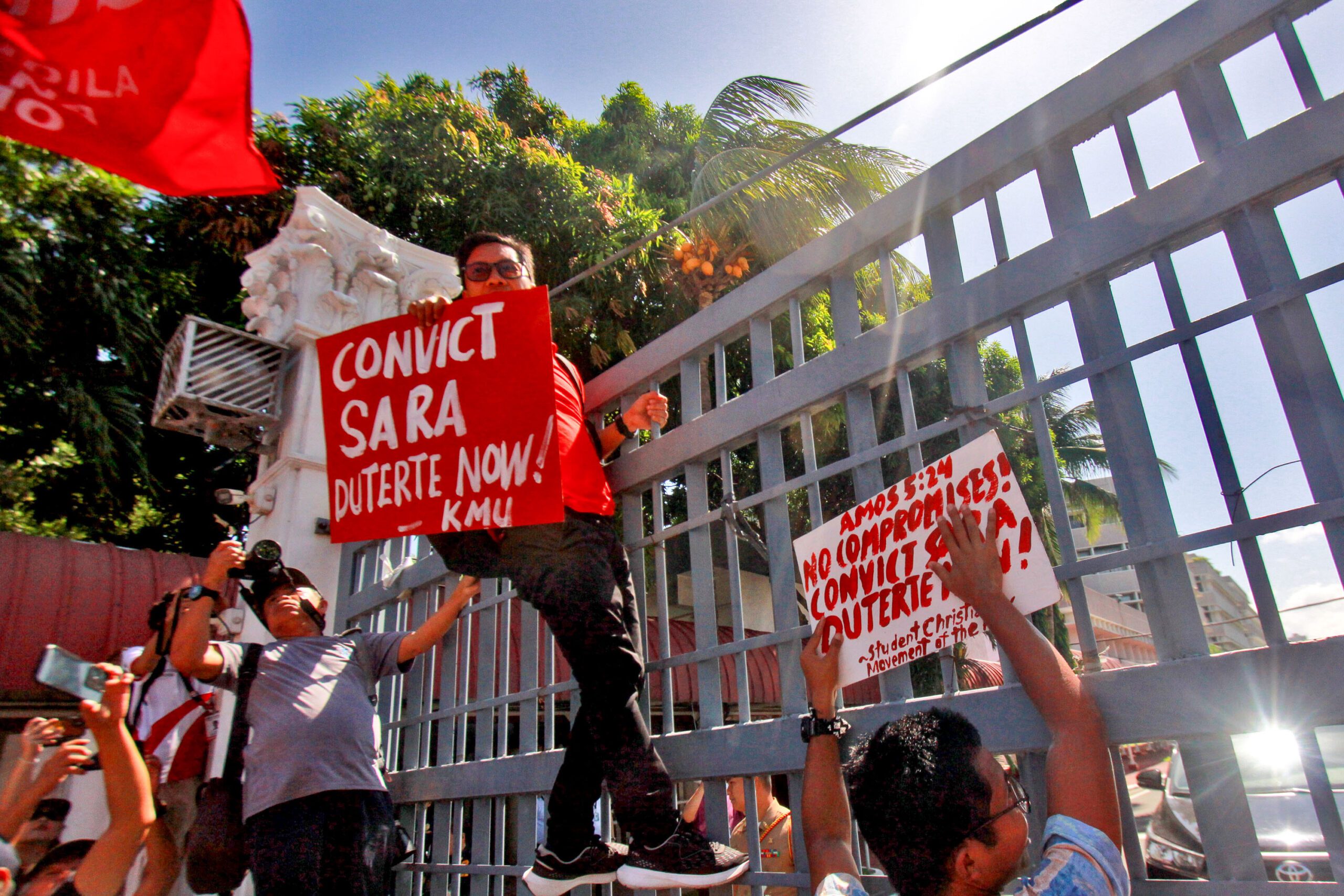

Filipino prosecutors handling the impeachment case against Vice President Sara Duterte say they may rest their argument on a single article rather than all four, depending on how strongly their evidence lands once the Senate trial begins on July 6.

Rep. Joel Chua, who represents Manila’s third district, made the point as the House panel finalizes its pre-trial brief. He explained that securing a guilty verdict does not hinge on proving every charge. “Depending on our assessment, if after one, two, or three articles we believe our evidence is already strong, we may no longer need to present all four articles,” he said. Should the first article alone prove decisive, Chua noted, the panel could simply move for a vote: “If we believe that the evidence under the first article alone is already strong enough and that conviction can be secured based on that, we may no longer continue with the remaining articles and allow the senators to vote on that article.”
Chua was equally firm that the chamber lacks any power to throw out the case outright. Once the articles reach the Senate, he argued, trying them becomes a constitutional obligation. “The only reason or the only way for this case to be dismissed is if the Senate has already rendered a decision and the Vice President is either acquitted or convicted,” he said.
The prosecutors spoke at the June 13 launch of “Bantay Impeachment,” a campaign assembled by roughly 120 civic organizations, academic figures and faith-based groups at Claret School in Quezon City. The coalition framed its purpose around four goals: explaining how impeachment works, tying the constitutional questions to the daily struggles of Filipinos, pressing senator-judges toward a fair and open trial, and pushing back against false information circulating online.
France Castro, a Makabayan lawmaker and convenor of Tama Na, Kilusang Bayan Kontra Kurakot, called on citizens to keep a close eye on the trial, describing impeachment as a tool of accountability rather than a partisan fight. The coalition’s joint statement spelled out the stakes: “When public funds are misused and public trust is betrayed, it is ordinary citizens who suffer the consequences through inadequate social services, poor governance and deepening corruption.” Organizers said their effort exists to “bridge the gap between the legal proceedings inside the impeachment court and the everyday struggles of ordinary Filipinos.”

To do that, the network laid out a plan built on grassroots teaching, monitoring of the proceedings, coordinated messaging and turning citizens out into the streets. Planned activities include neighborhood forums, campus talks, daily explainers on the trial and fact-checking work, capped by mobilization for rallies on July 6 when the trial opens. Chua and fellow House prosecutors Rep. Terry Ridon and Rep. Renee Co, the panel’s spokesperson, joined Castro at the event and voiced backing for the campaign.
Ridon used the gathering to defend the prosecution’s intention to bring forward fresh evidence concerning properties he said Duterte left out of her statements of assets, liabilities and net worth between 2007 and 2024. He maintained the move is within bounds. “Nothing prevents the prosecution panel from laying down new evidence up until pre-trial proceedings. By next week, these will be disclosed with particularity in our pre-trial brief,” he said, adding that additional evidence could still surface after pre-trial so long as it bears on the case.
A separate complication drew Chua’s attention: the standing of Sen. Jinggoy Estrada, arrested June 1 on non-bailable plunder charges by order of the Sandiganbayan. Offering what he called a personal view, Chua suggested the senator “temporarily cannot function” as a judge, leaving his role uncertain. He questioned how a compromised participant could properly weigh testimony. “How can he assess whether the witness that will be called by both the prosecution and the defense is telling a lie or telling the truth?” he asked. “How can he observe the manner or conduct of the witness, the way he or she will answer all the questions that will be asked of him?” Co shared the unease, saying Filipinos are entitled to “quality participation” from senator-judges, particularly their physical presence in the courtroom.
Estrada has brushed aside those doubts as hasty, pointing out that his suspension is still before the courts. “The issue is far from settled,” he said, calling it “premature” to write him out of the trial. This marks his second turn as a senator-judge; he voted to convict former chief justice Renato Corona in 2012 and had already sworn his oath in Duterte’s case before his arrest interrupted his participation.
