



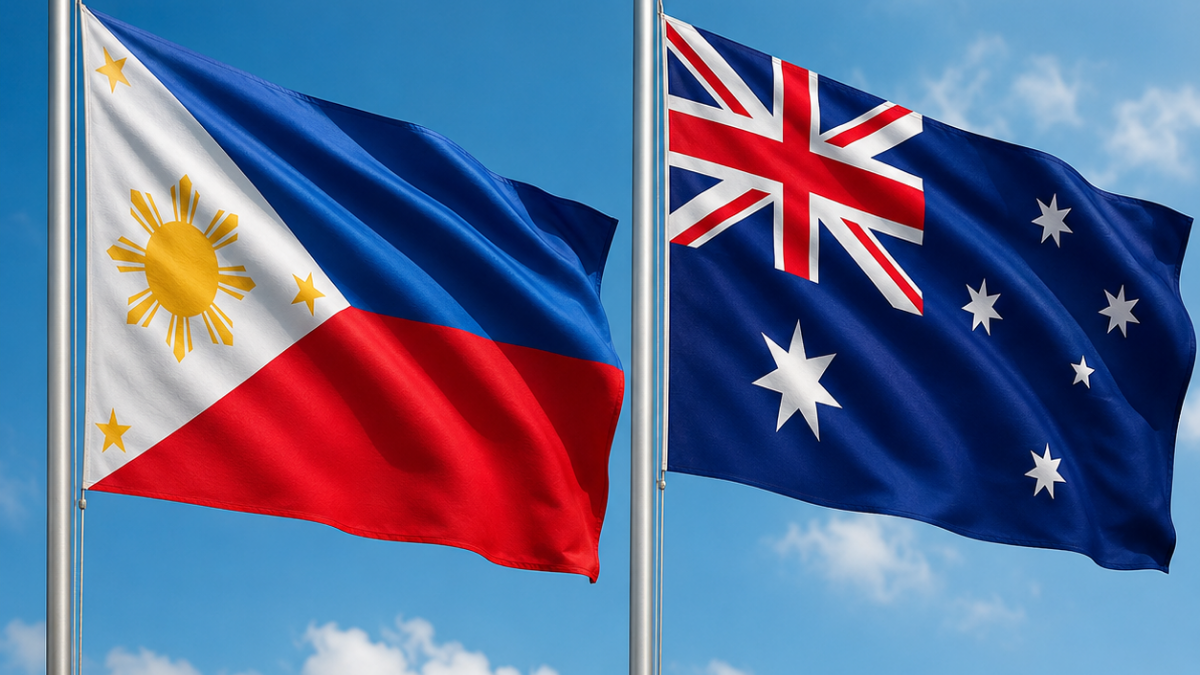

Manila will receive nearly P1.2 billion in fresh Australian maritime support, Canberra’s top diplomat said Thursday, July 23, with a portion of the money earmarked for advanced drone systems intended for the Philippine Coast Guard.

The commitment was unveiled by Foreign Minister Penny Wong during an address at De La Salle University in Manila. A P770-million allocation, equivalent to A$18 million and spread across four years, effectively doubles what Australia currently provides the Philippines under bilateral maritime programs. Separately, P427 million (A$10 million) has been set aside for drone technology and the training of Filipino operators.
Both allocations draw from a decade-long Australian initiative valued at P6.8 billion (A$160 million) that services maritime partnerships throughout Southeast Asia. That broader effort funds work on maritime domain awareness, reforms in governance, and protection of the marine environment.
Regional security cooperation also figures into a separate five-year commitment worth P470 million (A$11 million), which extends the ASEAN-Australia Political Security Partnership. Wong said the renewed phase would enable joint work on regional security concerns, among them talks on building an early warning mechanism designed to keep crises from escalating into open conflict.
Much of her speech centered on Chinese activity in contested waters. She raised the recent Chinese launch of a nuclear-capable missile from a submarine in the South China Sea — a weapon whose flight path crossed Philippine territory before it came down near Pacific island states.
“It comes in the context of a rapid military build-up of China’s nuclear arsenal, without the transparency or reassurance the region expects,” she said. “This is why Australia has described the test as provocative and destabilising.”
Notification of the launch was insufficient, Wong argued, both for the Philippines beneath the missile’s trajectory and for Pacific nations near its point of impact. She invoked the Hague Code of Conduct on ballistic missile activities, a framework with 145 subscribing states including Australia and the United States, as the standard against which such transparency should be measured.

On the conduct of Chinese vessels, Wong indicated Canberra intends to keep pressing the issue.
“Australia, with others, will continue to register our concerns about Chinese vessels engaging in destabilising and dangerous conduct in the South China Sea, including towards Philippine, Vietnamese, Malaysian, and Indonesian vessels,” she said.
Wong’s remarks fell on the 10th anniversary of the arbitral tribunal’s 2016 South China Sea decision, which she characterized as unanimous, clear, and binding. Australia has urged compliance from both Manila and Beijing since the award was handed down.
“The erosion of collective rights under international law does not benefit stability. It does not reinforce sovereignty. And it does not strengthen our shared resilience,” Wong said.
Trade and energy featured in the address as well. With Middle East hostilities sustaining upward pressure on regional energy costs, Wong noted Australia accounts for a third of Philippine liquefied natural gas requirements, half of the country’s wheat purchases, and close to a fifth of its beef supply.
Her trip coincides with the Philippines’ turn as ASEAN chair and the 80th year of diplomatic ties between the two governments, which in 2023 upgraded their relationship to a strategic partnership — the highest tier of bilateral engagement available between states.
