



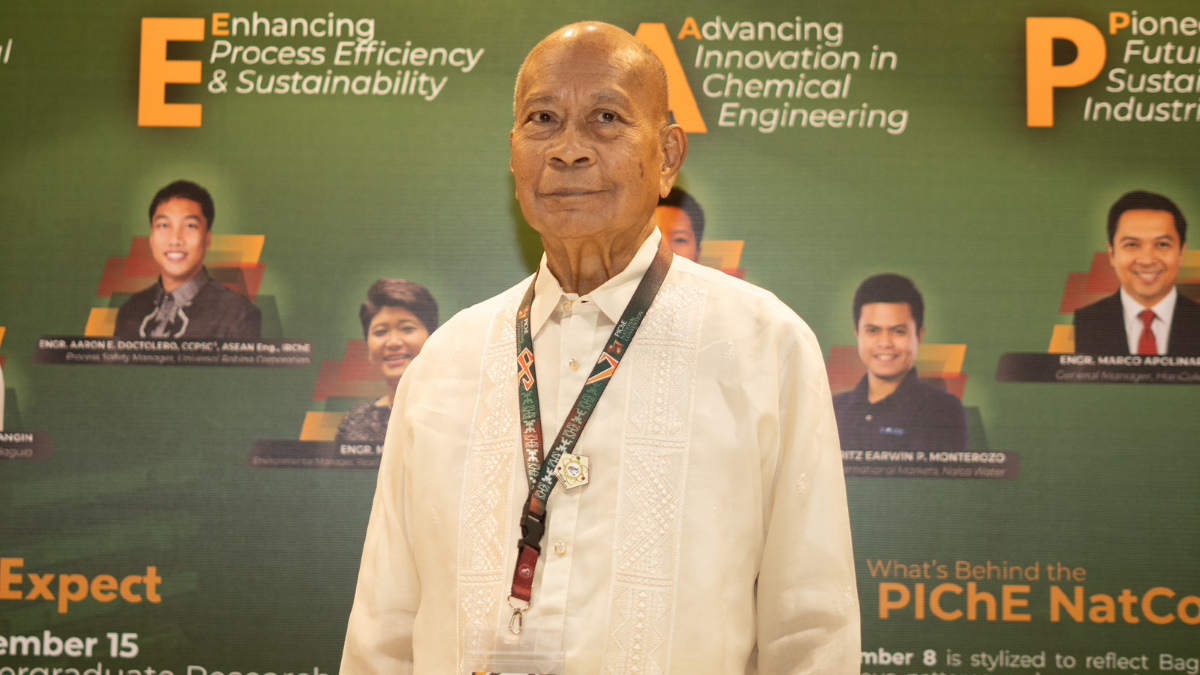

At 80, Romeo Apolega is no ordinary laundryman. He teaches chemistry to fellow laundry professionals; he writes papers on the effects of water quality in laundry; and he rarely forgets to bring his phenolphthalein test to check for laundry detergent residues on linens and see how laundry processes can improve.

For 53 years, Apolega—a chemical engineer—has married his field with an industry often treated by the world as routine, invisible work. At one point, he was running one of the Philippines’ largest industrial laundry operations, processing 150,000 kilos of linen daily. He formulated detergents and cleaning solutions for institutions and households, and he mentored thousands of laundry and housekeeping leaders over the last decades, so much so that he is called “Doctor Laundry” in the industry.
That lifelong contribution has now earned national recognition. The Philippine Institute of Chemical Engineers (PIChE) recently named Apolega one of its 2026 Outstanding Chemical Engineers during its national convention in Baguio City. He received the honor under the Industry category.
For laundry veterans, the recognition comes as little surprise. But the award also brings overdue attention to an underemphasized sector like laundry.
“A laundry facility is a plant, and good manufacturing processes are essential even in an industry like laundry that many people still look down on as sweatshop businesses,” Apolega said.
A career built on a second chance
Apolega’s career did not begin with an immediate professional breakthrough. A graduate of the University of Santo Tomas, he initially failed the Chemical Engineer Licensure Examination. He took work as a cashier supervisor at The Plaza in Makati before returning to the board examination with renewed resolve.
On his second attempt in 1973, he passed.
That moment opened the door to a career in laundry, sanitation, and cleaning. Apolega joined BASF Philippines, where he gained an early opportunity to travel to the United States and train in modern laundry techniques.
By the 1980s, he had become the national sales head of Diversey. In that role, he supported some of the Philippines’ largest hotels with their laundry and cleaning requirements. He later established his own chemical production company, First Clean Systems, and introduced WIN detergent to supermarket shelves. The venture showed another side of his engineering background: the ability to translate formulation knowledge into products used by households and businesses.
Bringing engineering to industrial laundry
In the early 2000s, Apolega led operations and business development at Kalinisan Steam Laundry, then the country’s largest steam laundry operation. The facility processed close to 100,000 to 150,000 kilos of linens each day, serving the scale and reliability requirements of institutional clients.

For Apolega, a facility of that size could not rely on intuition alone. Laundry operations require controlled processes, quality management, safety practices, productivity standards, proper chemical use, cost discipline, and an understanding of the equipment and materials moving through the plant.
His approach helped frame industrial laundry as a manufacturing operation rather than merely a back-of-house service. This perspective has become increasingly relevant as the industry changes. Over the last two decades, outsourcing and urbanization have reshaped how both households and companies manage laundry.
As cities grow, many residents increasingly see laundry as a time-consuming household task and choose to have their clothes washed elsewhere. Hotels, meanwhile, have increasingly outsourced laundry operations and repurposed laundry space for other revenue-generating uses, such as cafés and other guest-facing concepts. The Philippine hotel sector requires as much as 1.6 million kilos of linens processed daily, assuming full occupancy, according to Is It Clean?, a laundry consultancy and training academy founded by Apolega.
These changes have created growing demand for capable commercial and industrial laundries that can deliver quality, consistency, and scale.
Teaching the science behind clean
Until his retirement, Apolega continued to contribute as operations consultant for La Balina Steam Laundry in Cavite and Laguna, two large facilities serving the CALABARZON region.
Retirement has not ended Apolega’s work in the industry. He continues to lecture on laundry science, sharing the chemical engineering principles and operational practices that shaped his career. He was also named by his alma mater, UST, as an outstanding alumnus, and was recognized by the Professional Regulatory Board of Chemical Engineering with the “Service Award”, an honor given to Filipino engineers.
Together with business partner Paolo Abellanosa, Apolega founded Is It Clean? to professionalize the laundry sector by teaching the science behind the work. The initiative’s programs go beyond washing and drying, covering basic chemistry, operational management, quality management, accounting, and other disciplines that help laundry professionals build safer, more efficient, and more sustainable operations.
Since 2024, Is It Clean has held 50 masterclasses in 20 cities nationwide, training more than 2,000 executive housekeepers, hospital laundry managers, and laundry business owners.
The effort speaks directly to the gap Apolega has spent decades addressing. Laundry is essential to hotels, hospitals, restaurants, households, and many other parts of daily life. Yet the people responsible for those operations have not always had accessible professional training that combines science with business management.
At 80, the Doctor of Laundry remains one of the industry’s most persistent teachers, showing that the path to a better laundry sector begins with knowledge, discipline, and respect for the people behind every clean linen.
