



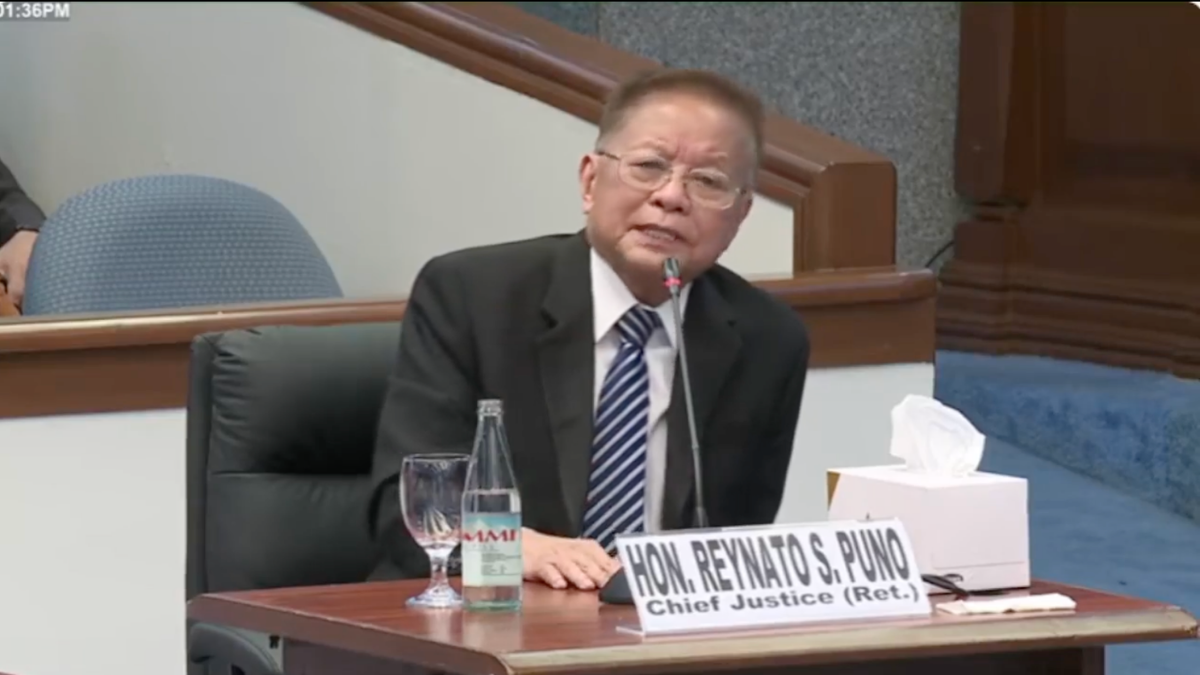

The Senate sitting as an impeachment court holds judicial authority that stands apart from the Supreme Court, former Chief Justice Reynato Puno told senators Wednesday, arguing that the Constitution nowhere grants the High Court any role in supervising how impeachment proceedings are run.

Puno appeared at the impeachment trial of Vice President Sara Duterte as an amicus curiae, one of several legal experts asked to weigh in on how many votes are required to remove an official from office.
His central point drew a sharp line between the senator-judges and members of the ordinary judiciary. “The impeachment court is not under the SC. The senator-judges are not like the judges of the regular courts of law who are all under the supervision of the SC,” he said, adding: “It is for this reason, your honors, that the Senate impeachment court was granted judicial power.”
To support that reading, Puno pointed to the constitutional text placing impeachment entirely in the Senate’s hands. Article XI, Section VI provides that the chamber alone may try and decide such cases. “Please note the use of the word sole, which means the only body that can try and decide all cases involving impeachment,” he said. In his view, that authority carries with it a narrower one: “The sole power to try and decide necessarily includes the lesser power to promulgate the rules that will govern the trial and decision of impeachment cases.”

The former magistrate located the source of this power outside Article VIII, the section defining what the Supreme Court itself may do. He walked through a series of things the article does not authorize the Court to touch. “Nowhere does it explicitly appear in Article [VIII] that the SC can review the rules of the Senate impeachment court. Nowhere does it appear in Article [VIII] that the SC can review how the Senate should conduct its trial,” he said. He continued: “Nowhere does it appear in Article [VIII] that the SC can review the evidence of the parties given in the impeachment court. Nowhere does it appear in Article [VIII] that the SC can review how the Senate impeachment court should decide impeachment cases.”
On the question that brought him before the chamber — the number of votes needed to convict — Puno left the matter with the senators themselves, saying it falls to them to determine whether that figure should be altered. The Constitution sets the bar at a two-thirds concurrence of all Senate members for any conviction to stand. “In general, all these questions are to be resolved alone by the Senate impeachment court because it is the sole judge to try and decide impeachment cases,” he said.
Puno also laid out the competing methods courts use to read the charter. One school insists on fidelity to the plain text, captured in the maxim verba legis non est recedendum — that there can be no departure from the words of the law. The other, he explained, takes a holistic view, reading a disputed clause alongside related provisions to uncover the framers’ intent and the purpose the people meant it to serve.
