



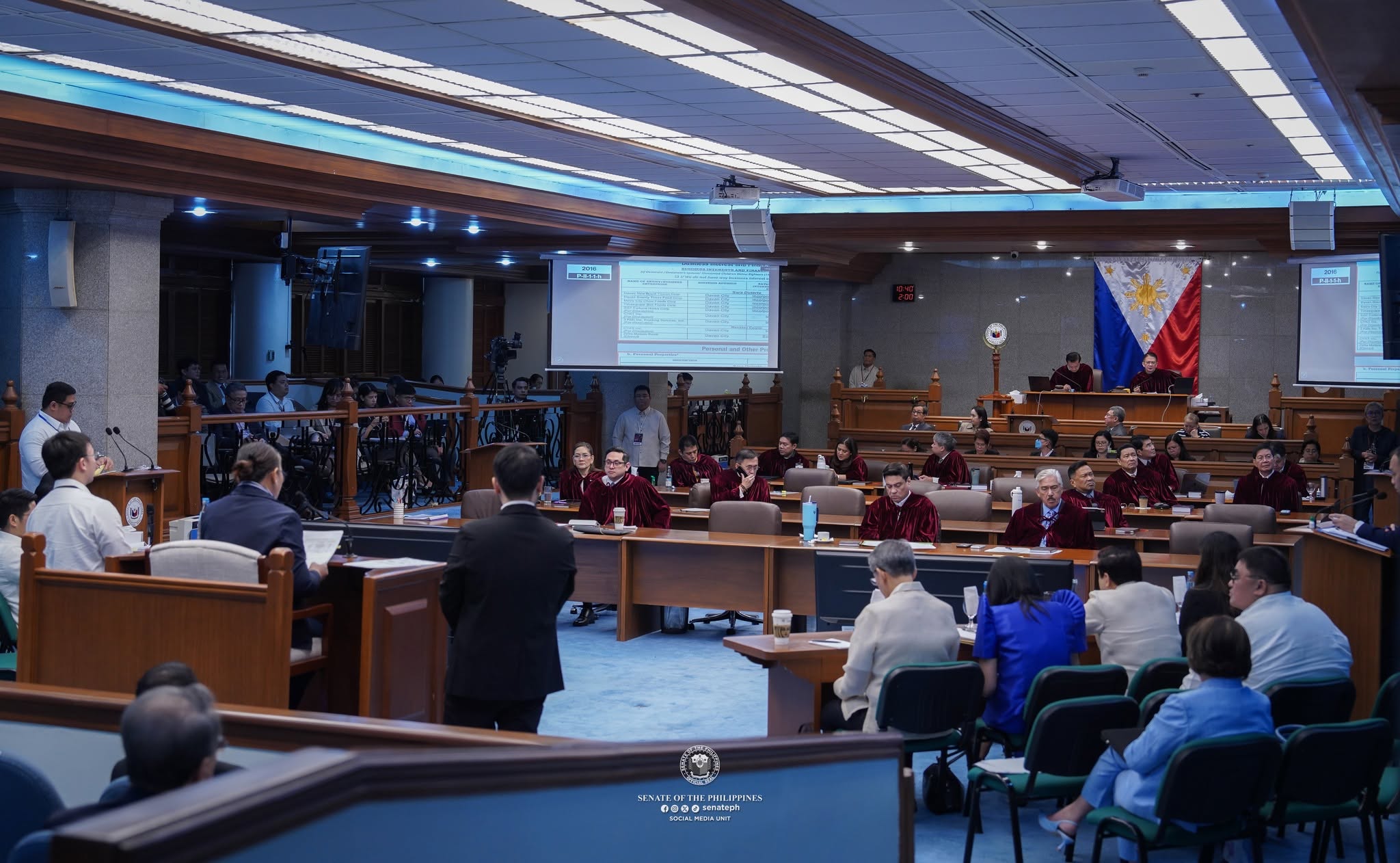

Three former chief justices of the Supreme Court told the Senate impeachment court on Wednesday that the two-thirds bar for removing an impeachable official should be measured against only those senator-judges taking an active role in Vice President Sara Duterte’s trial — a reading that could lower the number of votes required for conviction.

Artemio Panganiban, Hilario Davide, and Reynato Puno laid out that shared position on the trial’s 26th day, when the Senate sitting as an impeachment court invited legal scholars to weigh in as amici curiae on the exact threshold the Constitution demands for a guilty verdict.
Central to their argument is arithmetic tied to the chamber’s current makeup. Of the 24 senator-judges, four are unavailable — held on plunder charges or out of public view.
Panganiban framed the duty in terms of engagement with the case itself. “Active participation and independent evaluation of the evidence are essential to discharge the Senate’s and the Senator’s constitutional responsibility,” he said. He went on: “As the elected representatives of the Filipino people, the Senate’s mandate demands a commonsensical interpretation of the Constitution. Meaningful adjudication requires active participation in the search for truth and fairness. It is only in this manner that a verdict that is fair to the parties, fair to the Senators, and ultimately fair to our sovereign people.”
Davide, whose written statement was delivered aloud by Clerk of Court Renato Bantug, tied the count to eligibility. Those who wrote the 1987 charter, he argued, never meant for senators sidelined by physical incapacity, criminal exposure, or flight from legal trouble to figure into the two-thirds calculation. He pointed to jurisprudence barring officials from serving or practicing their profession while detained and facing prosecution. “Clearly then, the basis of computing the two thirds must be the number of senators who are qualified to vote, not the 24 in the present Senate,” he said, adding that “all those disqualified by reason of causes earlier mentioned should not be included.”

Puno rejected a plain-text approach altogether. Article XI, Section 3.6 speaks of the “concurrence of two-thirds of all the Members of the Senate,” and he stressed that the provision names no fixed figure at all. “I respectfully submit however that it is inappropriate to give Article XI Section 3.6 a standalone literal reading. If we give this kind of reading to Article XI Section 3.6, the threshold of 16 senators to convict will be fixed and immutable. However, if that is the intent, Article XI Section 3.6 should have simply stated that the number of votes to convict is 16, period,” he said. The framers instead chose a fraction, he noted, which by design shifts with circumstance: “By using two-thirds, the number of votes to convict will have to move depending on certain factors. A strict, standalone, literal interpretation of Article XI Section 3.6 may result in absurdities and may result in injustices which will defeat the purpose of the Constitution.”
What Puno urged in its place was a reading that accounts for context, weighing the voting clause alongside the rest of the charter “in order to give life to its purpose.” Such a method, he said, would let senators judge for themselves whether colleagues who have died, resigned, been expelled, or been sidelined by plunder charges or preventive suspension still belong in the denominator when two-thirds is worked out. He cautioned that the Constitution’s terms “should not be interpreted narrowly or pedantically for the prescriptions therein are not mathematical formulas.”
Not every expert agreed. Adolfo Azcuna, a former associate justice who helped draft the 1987 Constitution, held that 16 votes remain the fixed requirement, pegged to the Senate’s full membership. In his telling, a senator-judge’s absence from the proceedings does not strip away the power to vote on the verdict: “Whether or not a senator-judge who did not attend or substantially participate in the impeachment proceedings asked among others profound questions to and observed the demeanor of witnesses may nevertheless validly cast a vote on the final question in an impeachment trial,” he said. How to handle such situations, he added, falls to the chamber itself — “This is an internal mother for the Senate to decide, according to a rule it may adapt on this basis” — since the matter is internal to the Senate.
Azcuna cast the supermajority language as deliberate rather than incidental. Far from a drafting quirk or mere technicality, he said, the requirement exists to keep impeachment from hardening into a “routine weapon of partisan competition.”
