



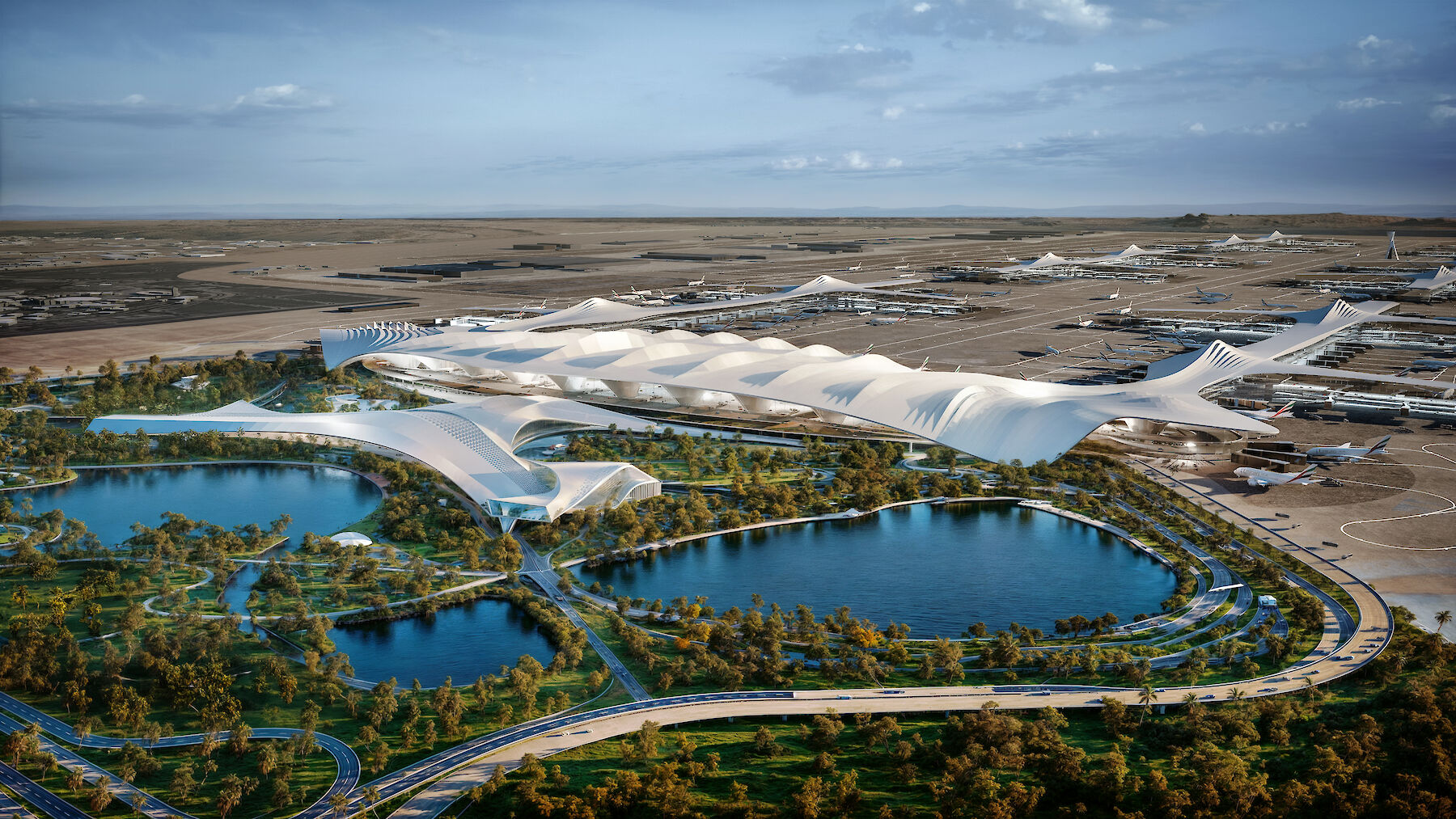

Passengers moving through the future Al Maktoum International Airport (DWC) will eventually rely on an internal transit line stretching roughly 50 kilometres, a scale that Mitsubishi Heavy Industries (MHI) says no other airport has attempted for this class of system.

The automated people mover (APM) will link nine stations and put 165 driverless vehicles into service across the airport campus, according to MHI. Its purpose is straightforward: cut down the time travelers spend crossing an increasingly vast facility and keep operations running smoothly as traffic climbs toward the airport’s target of 260 million passengers a year.
To grasp how far this outstrips existing setups, MHI points to the current benchmark. Dallas Fort Worth International Airport’s Skylink runs about 8 kilometres, meaning the Dubai line will measure more than six times longer. Atlanta’s Hartsfield–Jackson operates the busiest such system anywhere, moving close to 91 million riders each year, though on a far shorter route.
The order comes from Dubai Aviation City Corporation (DACC), a government body, which handed the work to a consortium of three firms. Alongside MHI sits its Dubai arm, MHI Mobility Engineering Services (MHI-MESC), and India’s Larsen & Toubro (L&T). MHI and MHI-MESC are steering the vehicle design, procurement and testing, the signalling technology and the broader task of stitching every component together. L&T takes on the design, procurement, testing and physical construction of the remaining subsystems.
MHI is no stranger to Dubai’s rail ambitions, having led the consortium that delivered the Dubai Metro back in 2011. The company expects the people mover to be finished by December 2031, leaving a window before the enlarged airport is slated to welcome its first passengers in 2032.

The line functions purely inside the airport grounds and should not be confused with the separate rail schemes meant to tie DWC into the wider city. On that front, Dubai’s Roads and Transport Authority continues advancing a 55-kilometre Airport Express Line intended to join Dubai International Airport (DXB) in Garhoud with Al Maktoum. Six groups submitted bids last week to study and design that route, according to MEED. The planned alignment would run through Al-Jaddaf and Al-Khail Road with a fresh station at Jumeirah Village Circle, plus two spur lines — one heading toward the Al-Fardan Exchange metro station at Emirates Golf Club, the other toward Business Bay.
Dubai Airports chief executive Paul Griffiths has previously singled out three surface links he considers central to how travelers will reach DWC: the Etihad Rail high-speed line, the Airport Express and the Dubai Metro’s Gold Line. He described the Gold Line as especially valuable for daily commuters and framed the Airport Express as a fast connection between Dubai’s main population hubs and the airport.
Griffiths has also spoken about the design philosophy driving the second phase, telling Gulf News the emphasis falls squarely on technology and passenger comfort. “We have to have the latest technology, the best design, because we are determined to create an airport experience like none other that will be far and away the most advanced and the most friendly and convenient for our customers.”
He has signaled a willingness to hold off on certain choices to capture whatever advances arrive nearest to completion. “We will be putting in all sorts of new technology and probably making some of those decisions quite late in the day to allow the latest techniques and developments to be adopted for the longer term,” he said, casting an airport’s fundamental job as the meeting point between ground travel and air travel.
