



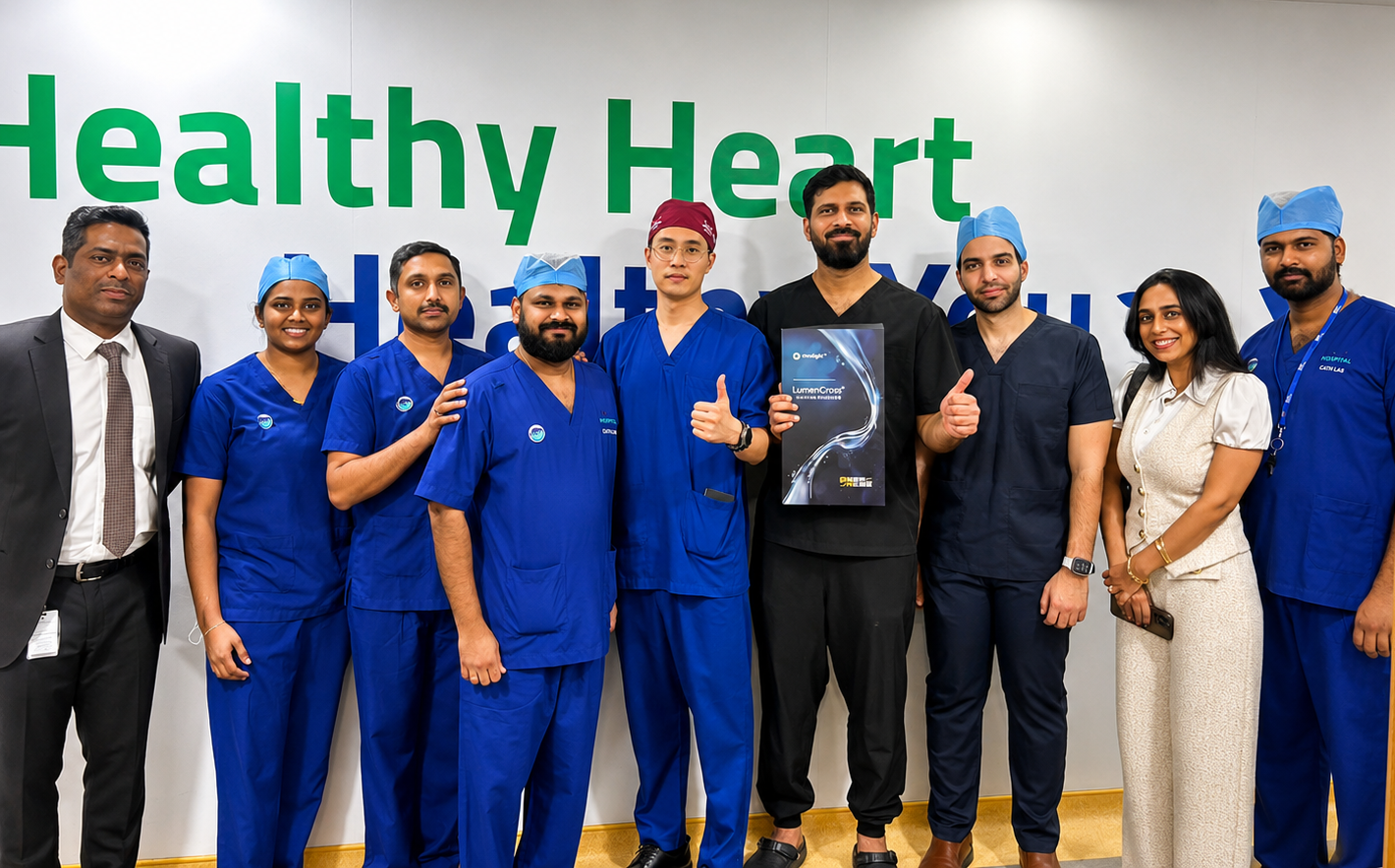

A 52-year-old Dubai resident living with type 2 diabetes, hypertension and elevated cholesterol arrived with escalating chest pain on June 2, 2026. Clinicians identified Acute Coronary Syndrome (ACS-NSTEMI), a condition demanding immediate intervention, and imaging exposed a difficult problem: severe narrowing where the left anterior descending artery meets one of its branches, plus further disease further down the vessel.

What made his case notable extended beyond the anatomy. Doctors at Aster Hospital Mankhool treated him using the Cornaris P80/P80-E Optical Coherence Tomography platform from Vivolight — the first application of the system anywhere in the Gulf. He left the hospital a day after the procedure in stable condition and has reported no return of symptoms.
Rather than the vessel outlines produced by standard X-ray angiography, the OCT platform sends near-infrared light through the artery to build cross-sectional pictures of the vessel wall itself. Physicians can then judge where a blockage sits, what it is made of, how tight it is, how much calcium has accumulated, and what all of that means for blood flow — findings gathered in one pass.
Speed is a defining feature. Super-Fast Mode covers 40 mm of artery in a single second. High-Definition Mode reads 55 mm in 2.75 seconds. Full View Mode extends to 80 mm in 2 seconds. Clinicians select the mode according to what a given case requires.
Dr. Naveed Ahmed, Head of Cardiac Services, Aster Hospitals & Clinics, UAE, said: “This technology allows us to see the heart artery in a completely new way. Instead of relying only on traditional images, we can now understand the structure and composition of the blockage, assess the surrounding artery environment in greater detail, and perform functional assessment of the treated vessel. This enables greater precision during complex procedures and helps us make more informed clinical decisions to achieve better patient outcomes.”
Guided by the OCT images, the team combined a drug-eluting stent with a drug-coated balloon and addressed the distal lesion separately. Blood flow returned to normal. Ahmed described the approach as one that lets his team refine each phase of treatment.
Deployment occurs during Percutaneous Coronary Intervention, the catheter-based technique that clears blocked arteries with balloons and stents and avoids opening the chest.

The stakes across the region are considerable. Roughly 40 percent of deaths in the UAE trace back to cardiovascular disease, with GCC figures ranging between 33 and 38 percent, making it a persistent driver of chronic disease mortality.
Published research comparing OCT-guided procedures against angiography-guided ones has recorded cardiac mortality falling by 39 to 46 percent and stent-related complications dropping by 48 to 64 percent.
Dr. Sherbaz Bichu, CEO – Aster Hospitals & Clinics, UAE, Oman & Bahrain, said: “At Aster Hospital, we are proud to be the first in the Gulf to introduce this next-generation heart imaging technology. Our patients deserve access to advanced diagnostic tools that enable our clinical teams to make more precise and informed treatment decisions.”
Bichu added that the capability strengthens the hospital’s handling of complicated cardiac cases and reflects a broader push to bring internationally validated tools into routine care.
Vivolight’s system consolidates several diagnostic functions into one unit and is already installed in over 300 Chinese hospitals. It has since reached the United States, where regulators cleared it, along with Indonesia, Chile, Armenia, Hong Kong and Macao.
Aster Hospital Mankhool holds the number four position in the UAE on Newsweek’s World’s Best Hospitals 2026 list.
