




Some Filipinos grew up watching Ang TV. Others spent their childhood summers eating dirty ice cream on the street. For an entire generation, another constant in the background of their lives was this: Jinggoy Estrada had a case.

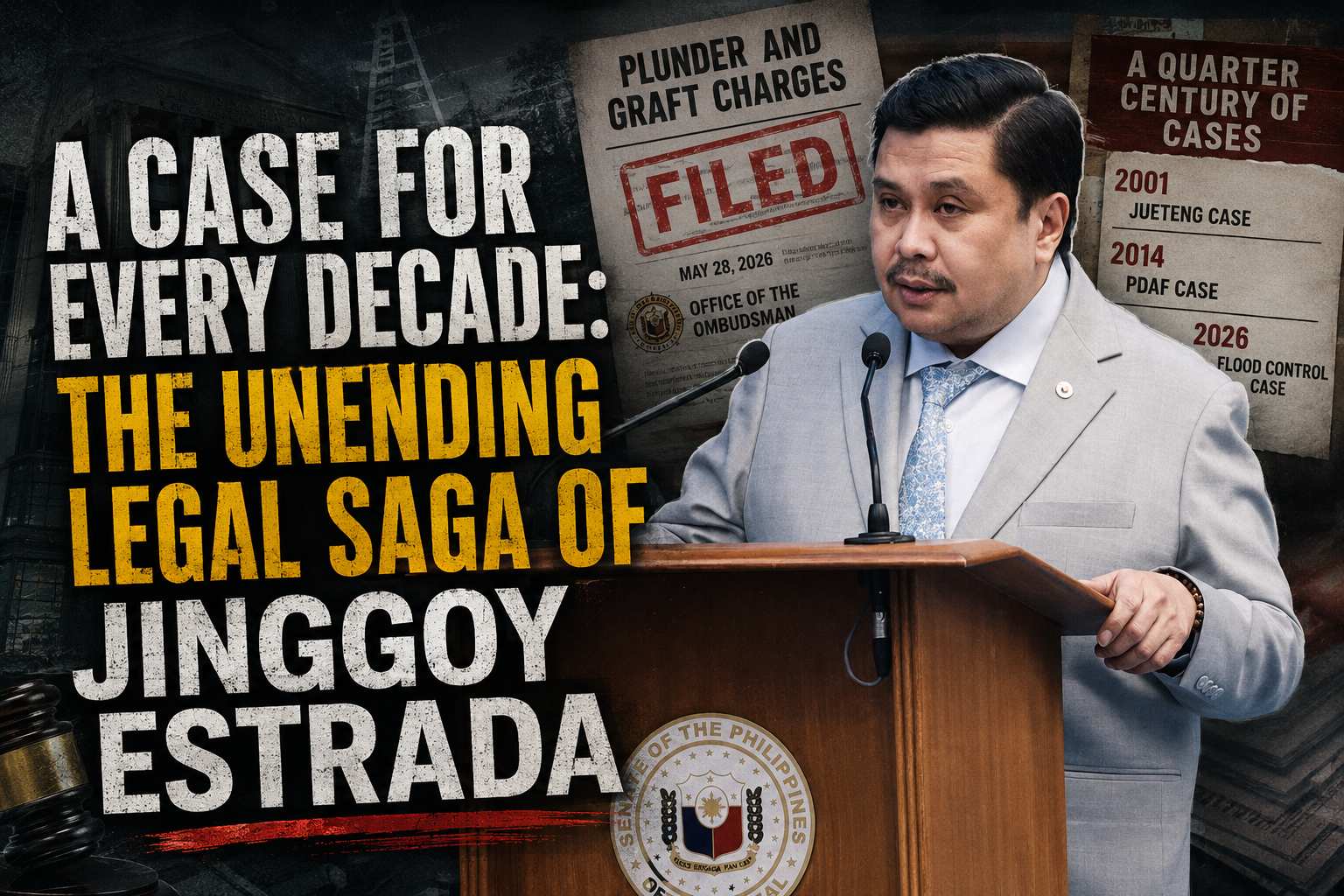
That bitter observation has been making rounds on Filipino social media in the past 24 hours, after the Office of the Ombudsman formally filed new plunder and graft charges against Senator Jose “Jinggoy” P. Ejercito Estrada Jr. on May 28, 2026 — his third plunder case in 25 years. The reaction online was less shock than exhausted recognition. “Nung bata pa ako, may kaso na si Jinggoy,” one widely shared post read. “Ngayon, 30s na ako. May bago na namang kaso.” The joke practically writes itself. But behind the dark humor is a serious question that Philippine democracy has yet to satisfactorily answer: why do voters keep returning this man to office?
The latest charges stem from an alleged ₱573 million in kickbacks “systematically delivered” to Estrada through an intricate mechanism involving illegal budgetary insertions and project allocations within the Department of Public Works and Highways infrastructure portfolio for fiscal year 2025. Former DPWH Secretary Manuel Bonoan was charged alongside him, as were DPWH National Capital Region officials — district engineers Manny Bulusan and Arturo Gonzalez Jr. and assistant district engineer Denryl Caesar Cortuna.
The Office of the Ombudsman recommended no bail for Estrada and his co-accused, and said it would pursue hold departure orders against all respondents to preserve the integrity of the case in court. The case will be raffled to a Sandiganbayan division, which will determine whether there is probable cause. If it finds there is, it will issue an arrest warrant against the senator. For a sitting legislator, the implications are staggering. Plunder is a non-bailable offense, meaning Estrada could be detained, just as his friend former senator Bong Revilla was.
Interior Secretary Juanito Victor “Jonvic” Remulla has already discussed the senator’s options with him amid the expected issuance of a warrant. “Talked to him already. I gave him options, and he said he will think about it,” Remulla said, declining to disclose what those options were.
Estrada, for his part, has pushed back. He cited the Senate Legislative Budget Research and Monitoring Office’s finding that there is no record of him making insertions in the 2025 national budget, and said he was not given the opportunity to properly study the resolutions of the Department of Justice and the Ombudsman before the case was filed — calling the supposed oversight a “serious implication” on his right to due process. The Ombudsman, however, addressed this directly, noting that the LBRMO certification does not fully capture the entire budgetary process, as insertions could be done through a “layered method.”
The question of how the flood control scandal came to implicate Estrada traces back to September 2025, when former DPWH engineer Brice Hernandez first linked the senator to the scandal, alleging that Estrada received 30 percent in kickbacks from flood control projects. Estrada denied the accusation and later sued Hernandez for perjury.
But this is far from the first time the senator has found himself at the defense table.
Estrada’s legal troubles date back to 2001, when he was still mayor of San Juan City. He and his father, former President Joseph Ejercito Estrada, were charged with plunder involving jueteng money, with the elder Estrada ultimately convicted in September 2007 before being pardoned by then-President Gloria Macapagal-Arroyo a month later. The younger Estrada walked free — acquitted due to the insufficiency of the testimony of then-star witness Chavit Singson.
Round two came in 2014. Estrada and businesswoman Janet Lim-Napoles were charged with plunder over an alleged misuse of ₱200 million in Priority Development Assistance Fund allocations. He was arrested and detained at the Philippine National Police Custodial Center in June 2014 and was suspended by the Senate in September 2014 for 90 days. He was eventually released on bail in September 2017, but his legal exposure in that case dragged on for years. In January 2024, the Sandiganbayan acquitted him of plunder but convicted him of one count of direct bribery and two counts of indirect bribery. He was later fully acquitted after the court’s Special Fifth Division granted his motion for reconsideration in August 2024. His graft cases from the same scandal, however, remain pending. The Supreme Court, in October 2025, rejected his petition to have them dismissed, ruling that graft charges are not “deemed absorbed” by his plunder acquittal.

In total, Estrada has now been hit with plunder charges three times across three different scandals — jueteng, pork barrel, and flood control — spanning a quarter century.
And yet, he keeps winning.
Despite his pending cases, Estrada won a Senate seat in the 2022 elections, placing 12th. He did so running under the UniTeam slate of then-presidential candidate Ferdinand Marcos Jr. and Sara Duterte — the most dominant political alliance of that cycle. In May 2024, his fellow senators elected him Senate President Pro Tempore once again.
The reasons for his sustained electoral viability are neither mysterious nor flattering to the system that enables them. Estrada has genuinely authored legislation — he principally authored 20 laws, including the Domestic Workers Act or Batas Kasambahay, the Philippine Green Jobs Act, and a measure strengthening conciliation-mediation as a mode of dispute settlement for labor cases. His supporters point to this record, and to the deep wells of loyalty that come with the Estrada name in urban poor communities, where his father’s populist legacy remains a powerful currency.
One letter to the editor published in the Inquirer framed it bluntly: “Senator Estrada received his mandate from the electorate twice — from the last elections, he received an overwhelming 18 million votes from the Filipinos.” The writer added that supporters of both Jinggoy and his father “come from the ranks of the masses and the poor,” and that Estrada as a lawmaker has pushed for legislation aimed at improving their lot.
That argument cuts both ways. The same masses who have consistently returned Estrada to the Senate are also the communities most directly harmed by corruption in public infrastructure — the very kind of corruption he now stands accused of perpetrating through flood control projects. The irony is not lost on those Filipinos now venting online.
The social media generation that grew up alongside Jinggoy Estrada’s cases is now old enough to vote, old enough to be taxpayers, and old enough to be directly affected by deficient flood infrastructure in a country that ranks among the world’s most disaster-prone. They are not laughing because it is funny. They are laughing because the alternative — confronting the full weight of what 25 years of this represents — is simply too exhausting.
An arrest warrant has yet to be issued. Estrada says he will exhaust all legal remedies. He has said this before.
He usually has.
