



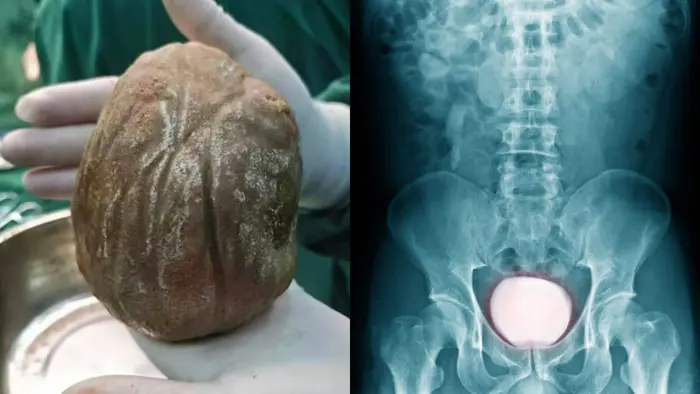

A 56-year-old farmer from Guangdong province in southern China put off seeking medical care for three years while suffering from increasingly debilitating urinary symptoms — a decision that nearly cost him his kidney function.

According to the South China Morning Post, Chen, who has not been further identified, was eventually brought to Xuwen Hospital, Affiliated Hospital of Guangdong Medical University, where imaging revealed a bladder stone measuring 10 centimetres by 13 centimetres. The mass, weighing 1.3 kilograms — roughly the size of two adult fists — was later described as the largest bladder stone on record in the Western Guangdong region.
By the time Chen sought treatment, the stone had grown large enough to fill nearly the entire bladder cavity. The prolonged obstruction had triggered bilateral hydronephrosis, a serious condition in which urine accumulates and causes both kidneys to swell, compounded by a severe urinary tract infection. His doctor warned that continued delay could have led to uraemia, a life-threatening buildup of waste products in the blood caused by kidney failure.
As a farmer reluctant to interrupt his work, Chen had been managing the pain on his own by purchasing over-the-counter medication. The symptoms had by then worsened to the point where he avoided long trips during daylight hours and struggled to sleep through the night.

Surgeons successfully removed the stone in a procedure planned specifically around the complexity of his case. Chen was reported to be recovering well as of May.
While Chen’s attending physician did not disclose the specific cause of his stone, urologist Wang Guangchun of Shanghai Tenth People’s Hospital explained to the outlet that bladder stones typically develop when urine is retained in the bladder over time. Contributing factors include an enlarged prostate — more common in older men — as well as sedentary habits and low water intake. Wang urged anyone experiencing interrupted or painful urination to seek medical evaluation without delay.
Chen’s doctor recommended drinking sufficient water, voiding the bladder at regular intervals, and addressing underlying conditions such as prostate enlargement or urinary tract infections before they escalate.
