



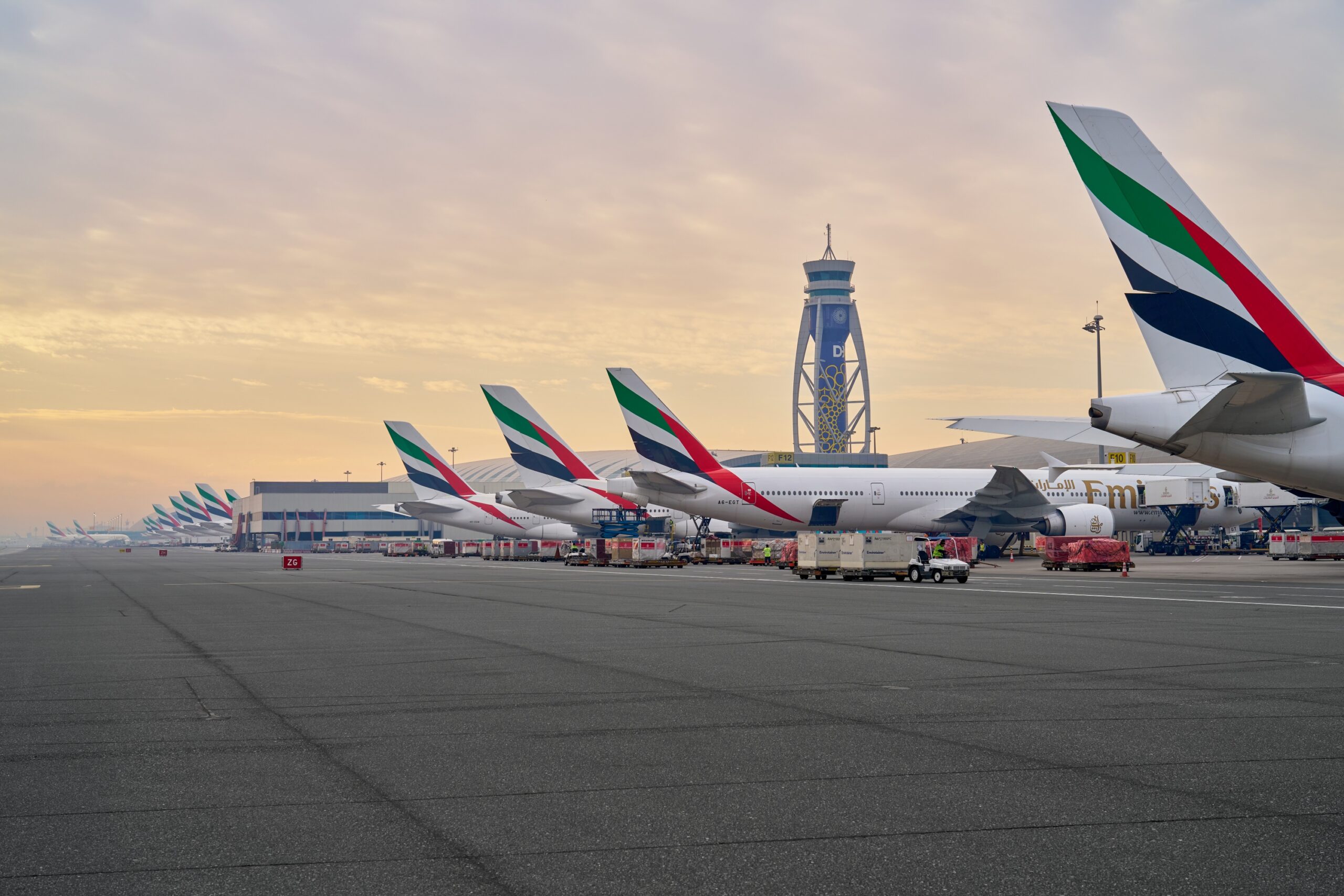

Dubai International Airport moved 6 million passengers and processed more than 213,000 tonnes of cargo between late February and the end of April, even as regional airspace disruptions sharply curtailed flight activity across one of the world’s busiest aviation corridors.

The disruptions, which began on February 28 and peaked through March, forced a sustained reconfiguration of schedules, ground handling, and passenger flows at DXB. Aircraft movements during this period totalled more than 32,000 — a fraction of normal capacity — yet the airport maintained continuous operations throughout.
With UAE airspace now fully restored, Dubai Airports has shifted to a recovery phase, progressively increasing daily flight movements as airline partners work to rebuild their schedules. Remaining constraints are tied not to UAE airspace but to the availability of regional routing options in neighbouring corridors, which authorities say are being actively coordinated.
Paul Griffiths, CEO of Dubai Airports, described the scale of what the hub navigated: “The extraordinary events of the past few weeks are unprecedented for any major airport hub such as DXB. International transfer traffic through the Middle East region accounts for a major share of the global air travel market, with 22.4 million annual passenger journeys flowing through DXB, representing one third of the transfer traffic across the region’s hubs. Maintaining the smooth operation of DXB is therefore critical to keep global journeys moving. Our focus has been on keeping operations safe and consistent for our customers through close coordination and rapid decision-making across the entire airport community and beyond, while ensuring the system remains ready to respond swiftly as conditions improve.”
Griffiths added that the crisis had practical benefits for the airport’s institutional readiness: “Our collective response to these challenges has sharpened our ability to adapt at pace. That readiness will enable us to accommodate returning demand as capacity is restored, reinforcing DXB’s role as a leading global hub, even as some regional routing constraints remain.”
The airport’s recovery is underpinned by the structural significance of the Middle East transfer market. Of an estimated 99.3 million passengers whose itineraries could route through the region, roughly 70% do so — and DXB alone handles 32% of that traffic. Analysts and airport officials expect transfer volumes to rebound faster than point-to-point traffic, given limited alternative routing options globally.

Home carriers Emirates and flydubai, alongside service partners and civil aviation control authorities, formed the operational backbone of the airport’s response under the oneDXB coordination framework.
First-quarter figures reflect the depth of the disruption. DXB welcomed 18.6 million guests between January and March 2026, a 20.6% decline year on year. March bore the heaviest impact, with passenger numbers falling 65.7% to 2.5 million. Cargo volumes for the quarter reached 399,600 tonnes, down 22.7%, while aircraft movements totalled 88,000 — a 20.8% drop from Q1 2025.
India retained its position as DXB’s largest country market with 2.5 million passengers in Q1, followed by Saudi Arabia at 1.3 million, the United Kingdom at 1.2 million, and Pakistan at 918,000. London was the busiest city route with 752,000 passengers, ahead of Mumbai at 520,000 and Jeddah at 505,000.
Baggage handling came under pressure during the period. The mishandled baggage rate rose to 3.5 per 1,000 passengers in Q1, compared with 1.95 per 1,000 in the same quarter last year — though still well below the current global industry benchmark of approximately 6.3 per 1,000 passengers.
Construction and planning work at Dubai World Central – Al Maktoum International (DWC) continues on its separate long-term expansion timeline, independent of the current recovery effort at DXB.
