



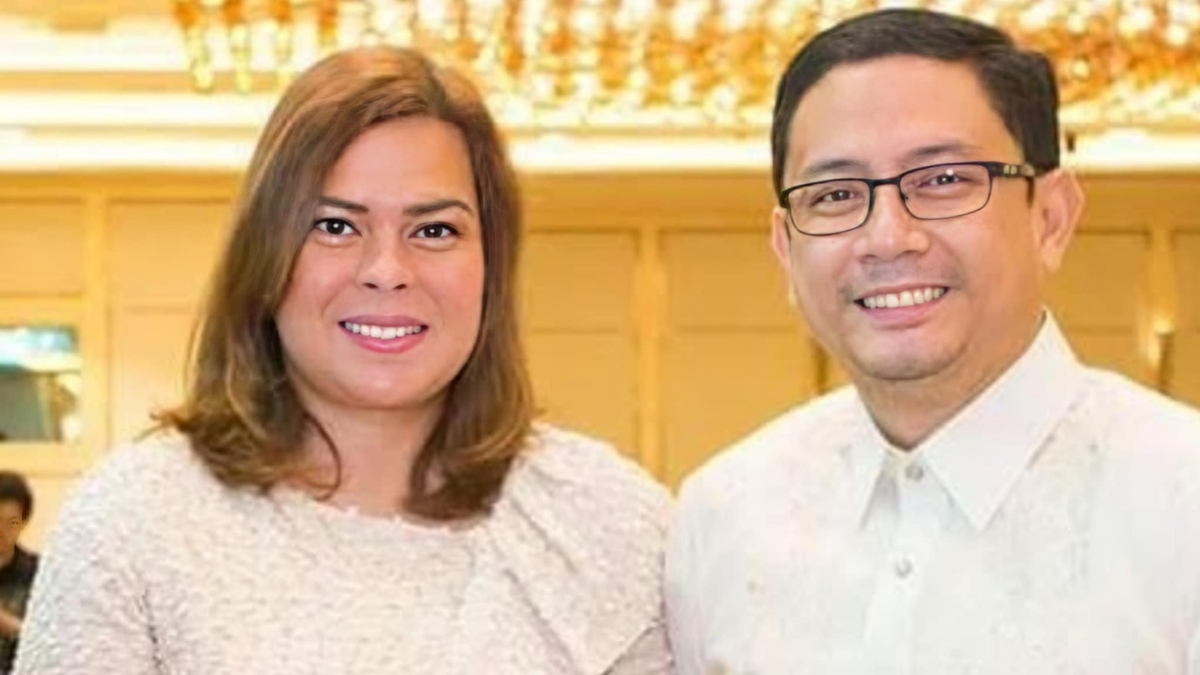

Manases Carpio, the husband of Vice President Sara Duterte, is taking legal action against top financial regulators and several House lawmakers, accusing them of conspiring to expose banking records that he says are shielded by law.

The complaint, to be filed Monday at the Quezon City Prosecutor’s Office, names Bangko Sentral ng Pilipinas Governor Eli Remolona Jr. and AMLC Executive Director Ronel Buenaventura, alongside House Committee on Justice Chair Gerville Luistro of Batangas and Representatives Percival Cendaña and Chel Diokno of Akbayan Party-List, and Leila De Lima of Mamamayang Liberal Party-List.
At the center of the dispute is the AMLC’s disclosure during a House clarificatory hearing on the vice president’s impeachment complaint — where it presented data on P6.77 billion in covered and suspicious transactions tied to Duterte and Carpio spanning nearly two decades. Of that figure, P4.425 billion flowed into their accounts, P1.554 billion flowed out, and P791 million remained categorized as “undetermined” due to limitations in the AMLC’s older system.
Carpio’s complaint charges that the respondents “connived to illegally disclose and divulge classified confidential banking records” protected under the Anti-Money Laundering Act, the Bank Secrecy Law, and the Data Privacy Act. It further alleges that “the AMLC and the House Committee on Justice leaked various private records of transactions, expanding to insurance payments, time deposits, investments and utility bill payments.”
Carpio described the disclosure as a tool for “black propaganda and political harassment rather than a legitimate regulatory action,” calling it “diabolical” and framing it as an attempt to destroy his wife’s reputation ahead of her announced 2028 presidential bid. “AMLA is being weaponized to the max even if illegal and contrary to law, for pure black propaganda with a view to the 2028 national election,” he said.

He also argued that bank secrecy protections carry no exceptions. “There is no exception. The prohibition is absolute. That is what Congress itself enacted to preserve full security against any disclosure of any information or record obtained by the AMLC,” Carpio said, adding that even media outfits risk criminal charges for publishing such records.
The named legislators pushed back. De Lima said in a statement Sunday that “as far as the House Committee on Justice is concerned, the proceedings cannot be considered violative of any law,” arguing that the Bank Secrecy Law’s prohibition applies only to bank officers and employees — not to Congress. “The fact that evidence of ill-gotten wealth was exposed in the course of the impeachment proceedings does not make such exposure criminal. It is a direct consequence of impeachment as an accountability mechanism,” she said.
Cendaña echoed that position, saying impeachment hearings are a recognized exception to bank secrecy and anti-money laundering rules. He also called on Duterte and her allies to redirect their energy toward appearing at the April 29 committee hearing instead. “May free will at maraming pera naman sila para magfile ng kaso, pero ang tanong ay may nilabag bang batas ang mga miyembro ng CoJ at AMLC? Wala,” he said. (They have the free will and the money to file cases, but the question is did the committee or the AMLC break any laws? None.)
House Committee on Public Accounts Chair Terry Ridon noted Sunday that the complaint, for all its legal arguments, does not dispute the AMLC’s figures. “In fact, the complaint itself effectively concedes the factual basis of the AMLC findings,” Ridon said, pointing out that Carpio never categorically denied the existence, accuracy, or scale of the transactions. “Once the scale of these transactions is no longer disputed, the issue becomes clearer — can these billions be reconciled with declared assets, net worth, and lawful income?” he asked.
Luistro, for her part, had maintained during the hearings that the committee was examining transaction patterns, not seeking account-specific details.
