




Airspace closures over parts of the Middle East are forcing Philippine authorities to reroute evacuation efforts through the United Arab Emirates, even as the number of overseas Filipino workers requesting repatriation continues to climb.

Migrant Workers Secretary Hans Leo Cacdac said at least 1,200 Filipinos have already asked to be brought home in the coming days, adding to the roughly 1,600 workers and dependents the Department of Migrant Workers has repatriated since early March.
“We have an increasing number… At least 1,200 [have asked] to be repatriated in the coming days,” Cacdac told reporters.
The Department of Foreign Affairs separately placed the total number of repatriation requests at 1,262, reflecting the scale of anxiety among Filipinos across the region as missile strikes, disrupted supply chains, and flight cancellations compound daily life.
Kuwait, Qatar, and Bahrain have become particularly difficult departure points. With flight options limited in those countries, authorities are leaning on the UAE — where air corridors remain more accessible — as the primary staging ground for chartered flights.
“The challenges continue with those with closed airspace — there’s Kuwait, Qatar and Bahrain,” Cacdac said. “The United Arab Emirates has more flights, so we could charter out there.”

Chartered flights from the UAE are to be deployed in sequence as part of a sustained government effort, officials said.
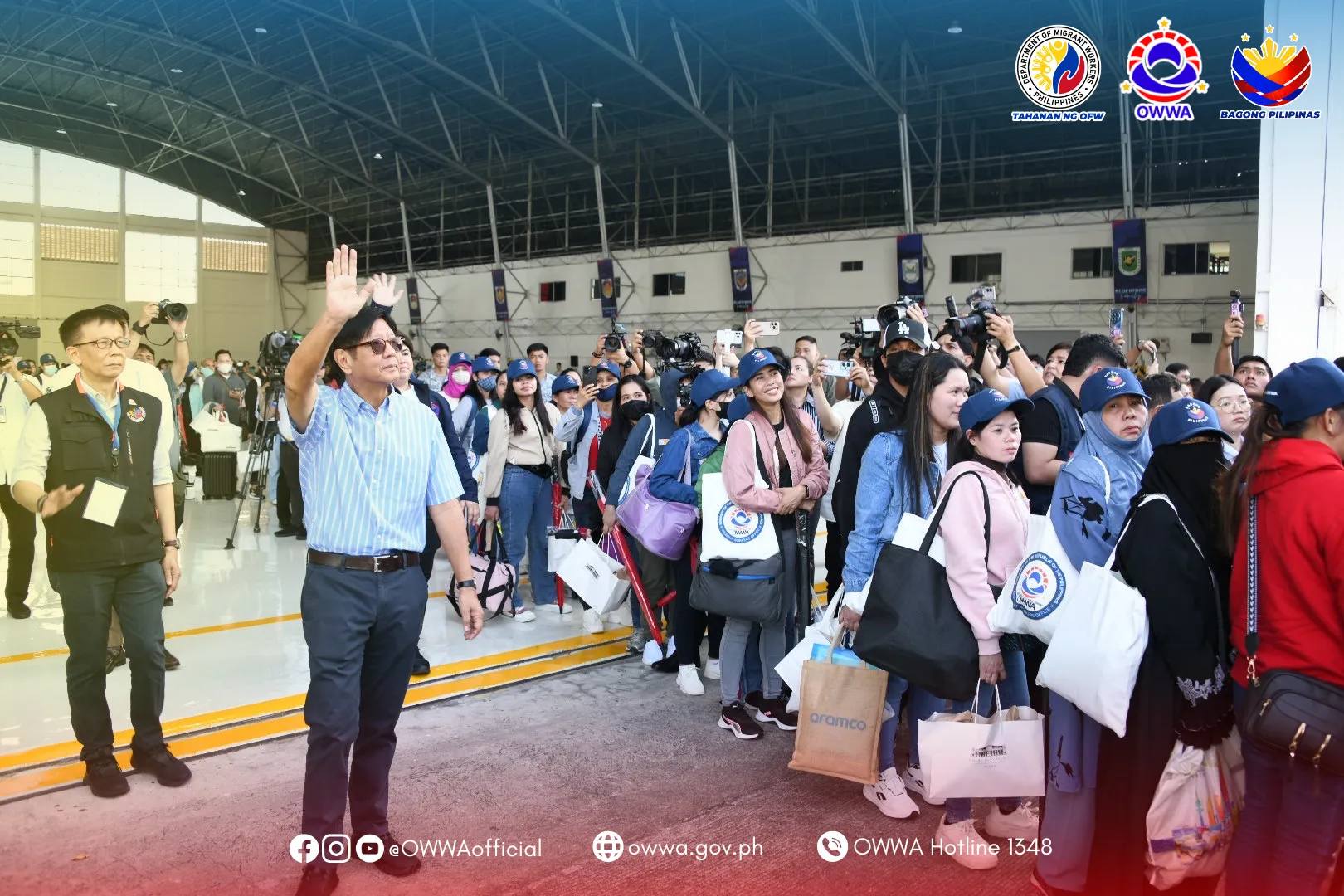
The operational difficulty was on display this week, when 343 Filipinos arrived at Villamor Air Base in Pasay City on Monday from Bahrain, Kuwait, Qatar, and Saudi Arabia. Among them, 234 came from the three Gulf states, while 109 flew in from Saudi Arabia. Those from Qatar, Kuwait, and Bahrain could not fly out directly — they had to travel overland for hours before reaching a viable exit point.
“It was a land-crossing effort, and it took on average about seven to eight hours to get to Riyadh,” Cacdac said.
President Ferdinand Marcos Jr. received the returning workers at Villamor, a gesture the administration has maintained throughout the crisis to underscore its attention to OFW welfare.
The repatriation effort is set against the backdrop of a Filipino workforce deeply embedded in the region. Government figures show approximately 2.4 million Filipinos are based across the Middle East, with the heaviest concentrations in the UAE and Saudi Arabia, followed by Qatar and Kuwait.
Despite the deteriorating situation, Manila has not yet imposed a deployment ban. Cacdac said such a move would be triggered by official travel alert thresholds that have not yet been reached, though advisories and safety protocols have already been issued by Philippine embassies and the DFA.
