



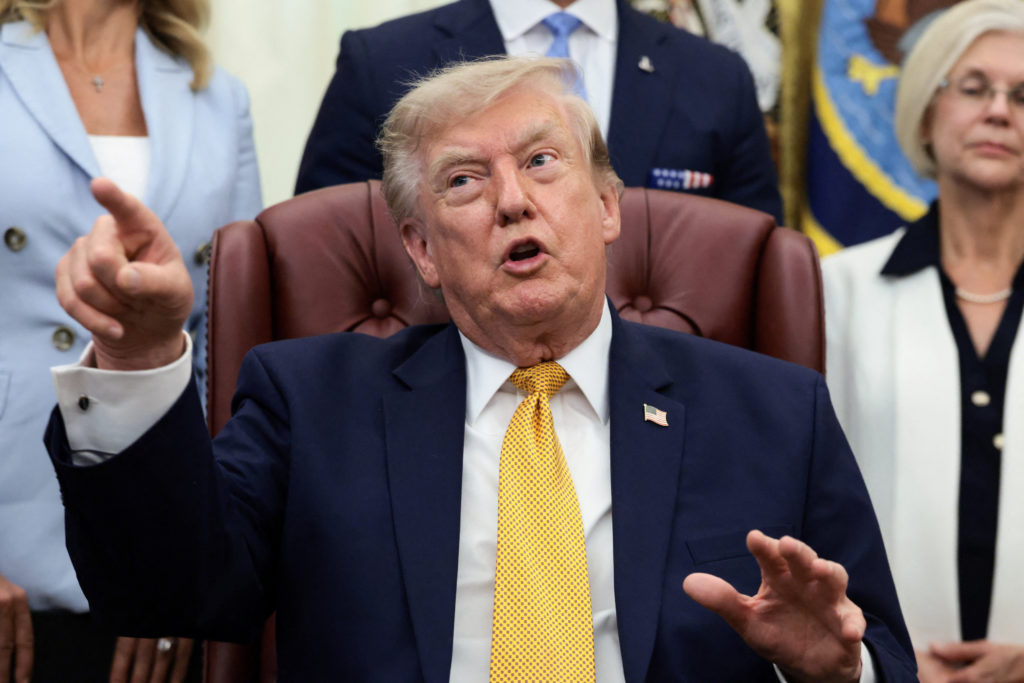

President Donald Trump moved Thursday to restrict who qualifies for automatic US citizenship at birth, signing a pair of executive orders that revive one of his most contested immigration goals after the Supreme Court blocked his earlier push. Rather than banning the practice outright across broad categories of immigrants, the new directives take a narrower route, and the White House is betting that distinction keeps them clear of the court’s June 30 decision.

A central target is what the administration labels “birth tourism,” the arrival of pregnant foreign nationals who deliver in the United States so their children gain citizenship. “That practice of birth tourism is, as of the signing of this order, hereby banned,” White House aide Stephen Miller told those gathered for the Oval Office signing.
The administration’s legal theory rests on reinterpreting the historical exceptions to citizenship at birth and widening the pool of people who fall outside the guarantee. Officials contend this approach sits beyond the reach of the justices’ ruling, which had voided Trump’s first order for sweeping too broadly across immigrants living in the country illegally or on temporary status.
Trump made no secret of his frustration with the bench. He branded the 6-3 decision a “very unfortunate decision,” and argued that commercial operations had sprung up around the practice. “That’s not the way it’s supposed to work. It’s a disgrace. They’re buying their way in, and we’re not going to let it happen,” he said. He also disputed the modern application of the 14th Amendment, saying, “This was done for a different reason. This was done right after the Civil War. This was for the babies of slaves, and what’s happening now?”

The scope of the orders reaches past birth tourism. They curtail citizenship claims for children of foreign government workers stationed in the US and for children of individuals deemed alien enemies. Depending on whether Congress passes proposed legislation ending automatic citizenship in US territories, people born there could be affected as well.
Reliable numbers are hard to come by. No official count exists for foreigners who travel specifically to give birth and secure citizenship, nor for any taxpayer cost. The Center for Immigration Studies, which favors reduced immigration levels, estimated in a 2020 analysis that 20,000 to 25,000 mothers came to the US for birth tourism during a one-year stretch spanning 2016 to 2017 — a figure set against the roughly 3.6 million births recorded nationwide in 2025.
Legal pushback appears certain. Analysts said the practical effect remains murky in light of the court’s decision, and advocacy groups framed the move as an end-run around the justices. The ACLU forecast defeat in the courts. Deborah Fleischaker, a former Biden administration official now with UnidosUS, a Hispanic civil rights and advocacy organization, said the orders amount to an effort to sidestep a ruling that established birthright citizenship as a constitutional guarantee standing for more than 150 years. Zain Lakhani of the Women’s Refugee Commission warned that pregnant women seeking lawful entry could see their rights violated “in one of the most vulnerable moments of their lives,” and urged officials to craft guidelines that respect the court’s decision.
Trump’s initial order, signed his first day in office in 2025, had instructed federal agencies to withhold recognition of citizenship from children born in the US when neither parent held citizenship or a green card. Courts have long read the 14th Amendment’s Citizenship Clause — “All persons born or naturalized in the United States, and subject to the jurisdiction thereof, are citizens of the United States and of the state wherein they reside” — as covering nearly all babies born on American soil, sparing only narrow cases such as the children of diplomats or an occupying enemy force. Writing for the majority, Chief Justice John Roberts traced that promise to the amendment’s framers, describing citizenship as “the right to have rights – to freely participate in our political community. We keep that promise today,” he wrote.
