



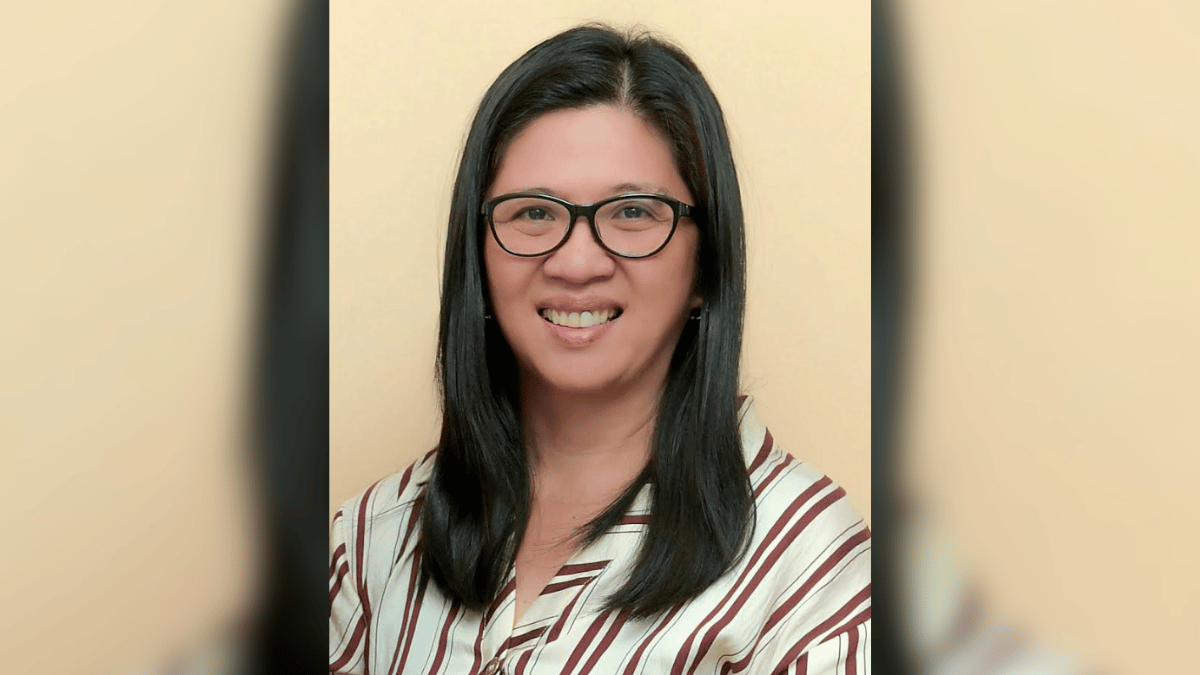

There are mentors you remember because of what they taught you. Others stay with you because of the way they influenced the way you think.

For those of us who encountered Dr. Gracila V. Ucag-Decena, PhD, MAN, RN, during our nursing education in the Philippines, she was part of a familiar world: lecture rooms, clinical discussions, assessments, and the demanding process of learning how to think and act like a nurse. It is easy, then, to imagine that the work of a nurse educator happens within familiar surroundings, among colleagues who share the same professional language and students who come from roughly the same educational system.
Dr. Ucag-Decena’s career has taken her somewhere quite different.
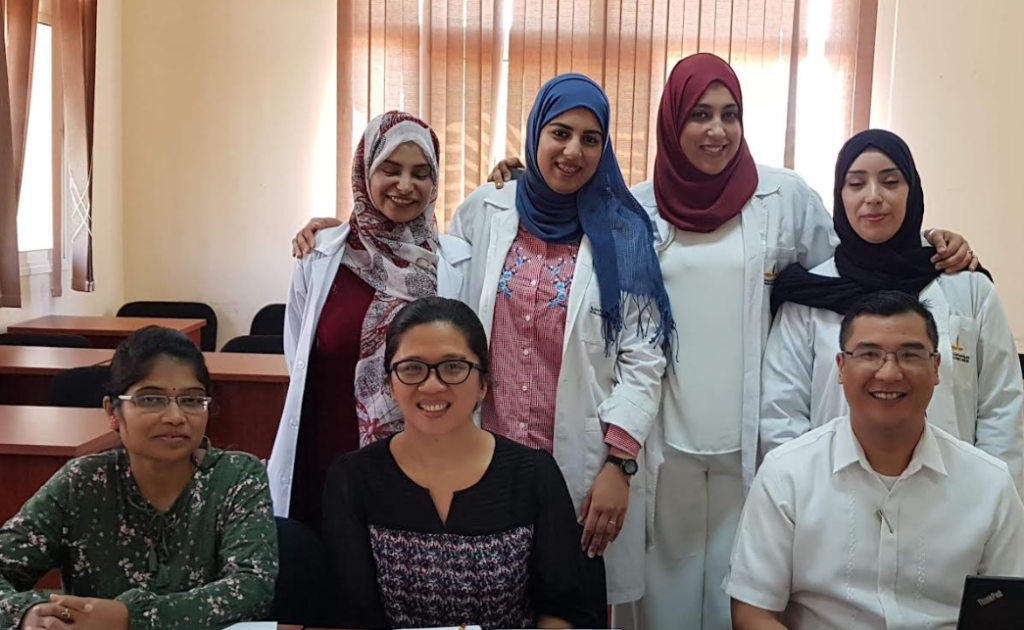
Today, she is working in Morocco, a country where the Filipino nursing community is relatively small and where the nursing students she teaches were educated within a French-based academic system. Rather than stepping into an established Filipino professional network, she entered an environment where she had to build her professional identity largely on her own.
For a Filipino nurse educator, that meant more than moving to another country.
It meant learning how to teach across a different educational culture, communicate across languages, and find common ground between different ways of understanding nursing. And perhaps most importantly, it meant discovering how far the lessons of Filipino nursing education could travel.
Choosing the Less Familiar Path
Before relocating to Morocco, Dr. Ucag-Decena had already established herself within Philippine higher education. With a Bachelor’s and Master’s degree in Nursing and a PhD in Educational Management, her career had developed around teaching, clinical education, curriculum design, and the preparation of future healthcare professionals.
Her move to Morocco was driven by both professional opportunity and personal transition. But there was another attraction: the unfamiliarity itself.
The Philippines has long been one of the world’s major sources of internationally mobile nurses. Countries such as the United States, Canada, the United Kingdom, Australia, and the Middle East have well-established Filipino healthcare communities, complete with professional networks and familiar pathways for newcomers.
Morocco presented a different proposition.
“There was a unique avenue for institutional contribution,” she explained, describing the decision to work in a setting where the Filipino nursing diaspora remains relatively small. Instead of entering a well-worn migration pathway, she was stepping into what she describes as an emerging educational context, one where she could test her ability to adapt as an educator while contributing to the institution itself.
It was, in many ways, a blank page. And blank pages can be intimidating. They can also be where something new begins.
Teaching Across Two Educational Worlds
One of the most significant challenges was not nursing itself. It was language and educational culture.
Her students were licensed Moroccan nurses whose foundational clinical education had been shaped by a French-based academic curriculum. Dr. Ucag-Decena, meanwhile, came from the Philippine nursing education system, where instruction and professional practice have developed within a predominantly English-speaking framework. Her classes were conducted in English, but simply speaking the same instructional language did not mean everyone was starting from the same place. The concepts, terminology, expectations, and approaches to learning could differ. For an educator, that distinction matters.
A teaching strategy that works perfectly in one classroom may fall flat in another. A familiar way of explaining a clinical concept may not immediately translate to students who were trained within a different academic tradition. Dr. Ucag-Decena therefore had to adapt not only what she taught, but how she taught it.
Technology became part of that process. So did non-verbal communication, visual and multimodal instruction, and her own effort to acquire relevant linguistic skills. But adaptation was not simply about overcoming a language barrier. It was about learning to meet students where they were.
From Knowing the Answer to Learning How to Think
One of the most interesting aspects of Dr. Ucag-Decena’s teaching philosophy is her emphasis on moving students beyond memorization. Nursing education has always required students to absorb an enormous amount of information. Anatomy, pharmacology, pathophysiology, procedures, assessments, medications, precautions, protocols. The list can seem endless.
But knowing information is not the same as knowing what to do with it.
A nurse may remember a clinical guideline and still face a patient whose presentation does not fit neatly into a textbook example. That is where clinical judgment begins. Dr. Ucag-Decena has worked to encourage a shift from traditional instructor-centered learning toward more active, student-centered approaches. Through structured assessment tools and evidence-based teaching strategies, she seeks to develop critical thinking and clinical judgment rather than relying primarily on rote learning. Her experiences abroad reinforced something she had already understood as an educator: there is no single formula for teaching nurses.
“Nursing pedagogy cannot be monolithic,” she explained.
The principle is deceptively simple. Good teaching requires flexibility. Students think differently. Cultures shape learning differently. Educational systems develop different expectations. Even something as fundamental as the relationship between teacher and student can vary considerably between countries.
An effective educator has to notice those differences without losing sight of the standards nursing demands.
A Filipino Approach to Nursing Education
Despite adapting to a new educational environment, Dr. Ucag-Decena has not left her Filipino nursing education background behind.
If anything, working abroad has made her more conscious of what it has given her. She describes Philippine nursing education as shaped by rigorous clinical standards and a holistic approach to patient care. These values have influenced the way she teaches and the way she relates to students.

There is also something distinctly Filipino in the relational dimension of her approach.
In the Philippines, educators often occupy a role that extends beyond delivering academic content. Teachers become mentors, advisers, sometimes even figures students turn to when the pressures of nursing school become difficult to navigate. Bringing that relational approach into another cultural environment requires sensitivity. In Morocco, she encountered institutional hierarchies and communication patterns that differed from those she had known in the Philippines. She had to learn how to maintain a supportive mentoring style while respecting local expectations around faculty-student relationships.
That balance became another form of teaching. It required knowing when to adapt and when to hold firm.
Being Filipino Where Filipinos Are Few
There is a particular kind of visibility that comes with being a Filipino healthcare professional in a country where Filipino nurses are already well established. There are others who have walked the same path. There are Filipino colleagues nearby. There are familiar stories, networks, and communities.
Dr. Ucag-Decena experienced something different.
The Filipino presence within higher education was not as established, meaning she had to demonstrate the value of Filipino nursing educators through her work rather than relying on an existing professional community.
That can be a demanding position. But it can also be liberating. Without an established template to follow, there is room to create one. Dr. Ucag-Decena sees Filipino nurse educators as bringing a combination of clinical rigor, professional ethics, holistic care, and patient-centered advocacy to global nursing education. For her, the contribution of Filipino nurses abroad should not be limited to filling healthcare workforce shortages.
We can also influence how healthcare professionals are educated. That distinction is important. A nurse who moves abroad contributes through patient care. A nurse educator can potentially influence hundreds or thousands of future nurses through the students they teach.
The ripple travels further.
Finding Opportunity at the Edges
Her experience has also shaped the work she now does beyond the classroom.
As Co-Director and Manager at Explorem Formation Center, she is involved in language training, international mobility initiatives, and recruitment for global healthcare partners. The work sits at an interesting intersection of nursing, education, and international mobility. It reflects something that has been present throughout her career: an interest in helping healthcare professionals cross boundaries, whether those boundaries are academic, cultural, linguistic, or geographic.
Her message to Filipino nurses and educators considering less traditional destinations is therefore not simply to “be brave” and go somewhere unfamiliar.
It is more strategic than that. Look at unfamiliarity as an opportunity.
Traditional migration destinations already have established systems, professional networks, and Filipino communities. Those pathways can offer valuable support, but they also mean entering an ecosystem that others have already built. Less familiar destinations can offer something else: the chance to become one of the people who builds what comes next.
For educators especially, that can mean introducing new teaching approaches, developing institutional partnerships, strengthening nursing education, and establishing a Filipino professional presence where very little existed before.
The Teacher Goes Somewhere New
There is something fitting about Dr. Ucag-Decena’s journey.
A nurse educator spends much of her career asking students to step beyond what they already know. Learn something difficult. Think differently. Question assumptions. Adapt when circumstances change. Develop confidence in unfamiliar situations. Her own career has required her to do precisely that.
From the perspective of a former student, there is also something quietly remarkable about seeing a familiar educator take those same principles into a completely different setting. The classroom may have changed. The country has changed. The students have changed. But the essential work remains.
Teach. Adapt. Mentor. Challenge. Empower.
And then, eventually, let the students carry what they have learned somewhere beyond the classroom. Perhaps that is the most fitting measure of an educator’s influence. Not how many lectures they delivered, but how far their teaching travels after the lecture ends.
Dr. Ucag-Decena’s story suggests that Filipino nursing education does not have to remain confined to the places where Filipino nurses are already numerous. There are classrooms, institutions, and healthcare systems beyond the familiar migration corridors where Filipino educators can contribute, collaborate, and establish something new.
Her career in Morocco is one example of what that can look like. It is also a reminder that professional influence does not always begin where the Filipino community is strongest. Sometimes, it begins where there are very few of us.
And sometimes, the most meaningful legacy of a Filipino nurse educator is not simply the students she teaches, but the new ground she makes possible for those who will come after her.”
