



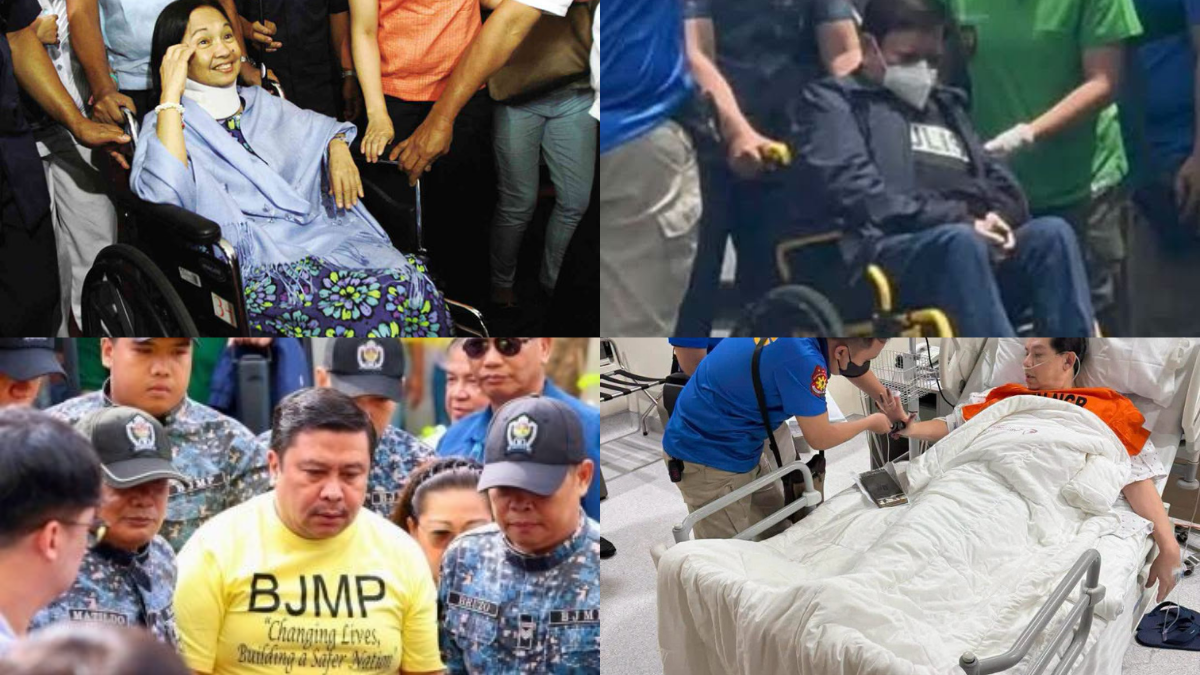

There is a rhythm to Philippine corruption cases that Filipinos have watched play out for the better part of three decades. A high-profile official is charged. An anti-graft court issues an arrest warrant. And then, almost on cue, the accused is rushed to a hospital — chest pains, hypertension, a bad back, a suddenly discovered tumor, and, in the most famous instance, a neck brace.

Senator Panfilo “Ping” Lacson put words to the pattern in July 2026, and his phrasing has since become a kind of national shorthand. “When a warrant of arrest is out and the person has high standing in society, they suddenly become ill, and all the medical complications come out,” he said. “There’s pneumonia, high blood pressure, high cholesterol — everything hurts. Suddenly there’s a neck brace, and then their back hurts.” On social media, he was blunter still: “Bawal magkasakit. Mahal ang gamot” — a wry warning that getting sick is a luxury, since medicine is expensive.
Whether these hospitalizations reflect genuine illness, tactical delay, or a bid to trade a detention cell for a private suite is rarely settled in any single case. Many of the officials involved had medically documented conditions. But the timing — ailments surfacing alongside the warrant — has fueled a public suspicion that hospital confinement has become the elite detainee’s escape hatch. Here are the names that recur whenever the pattern is discussed.
Joseph “Erap” Estrada — the template (2001)
The playbook arguably begins with a president. Ousted in the 2001 EDSA II uprising, Joseph Estrada was arrested that April on plunder charges and, after three days in a Camp Crame cell, was taken with his son Jinggoy to the Veterans Memorial Medical Center (VMMC) in Quezon City on April 28, 2001, ostensibly for a full medical checkup. The anti-graft court formally granted him hospital detention that June. VMMC’s 120-square-meter presidential suite became his home for years — the government at one point even discussed converting a hospital auditorium into a makeshift courtroom for his trial.
Estrada’s requests were not always granted: the Sandiganbayan denied a 2001 bail motion for lack of medical basis and rejected a 2002 request to transfer to San Juan Medical Center over rectal bleeding, ruling he had not shown VMMC could not treat him. He was at one point even allowed to fly to Hong Kong for knee surgery. Convicted of plunder in 2007, he was pardoned weeks later by his successor, Gloria Macapagal-Arroyo — a favor that would take on a striking symmetry years later.
Gloria Macapagal-Arroyo — the neck brace that launched a thousand jokes (2011–2012)
If Estrada set the template, Arroyo made it iconic. Barred from leaving the country in November 2011 to seek medical treatment abroad, she took up residence in a 16th-floor suite at St. Luke’s Medical Center in Taguig. On November 18, 2011, she was served an arrest warrant there for alleged electoral sabotage and booked the next day — photographed in a neck brace and hospital gown, an IV drip in her arm, as her mugshots were taken. She had been admitted months earlier for cervical spondylosis and underwent three operations on her cervical spine.
The government said at the time she could be trying to evade justice; her lawyers said she needed overseas care for a bone ailment. In October 2012 she was placed under hospital arrest a second time, over a P366-million plunder charge tied to the alleged misuse of Philippine Charity Sweepstakes Office funds, found to be suffering from dehydration and hypertension at VMMC — the same facility, and eventually the same suite, that had held Estrada. In a moment that captured the whole absurd cycle, Estrada, by then Manila mayor, visited her there in December 2013 to “return the favor.” Arroyo was ultimately acquitted by the Supreme Court in 2016. Her neck brace, however, entered the language — Lacson’s 2026 remark was a direct jab at it.
Juan Ponce Enrile — age and infirmity as a legal argument (2014)
The 2014 pork barrel scam, centered on businesswoman Janet Lim-Napoles and the misuse of lawmakers’ Priority Development Assistance Fund, put three senators in detention. The eldest, Juan Ponce Enrile — accused of receiving P172.8 million in kickbacks — was held not in a regular cell but at the Philippine National Police General Hospital in Camp Crame. State prosecutors opposed his hospital arrest in 2014, arguing there was no urgent reason for it and that it amounted to preferential treatment. His camp prevailed where it mattered most: in August 2015, the Supreme Court granted him bail, citing his advanced age and fragile health. Enrile has since died.
Ramon “Bong” Revilla Jr. — the mid-detention hospital dash (2014)
Enrile’s co-accused Bong Revilla, charged with plunder and 16 counts of graft over an alleged P224.5 million in kickbacks — the largest sum among the three — was detained at the PNP Custodial Center. In November 2014 he was rushed to the PNP General Hospital after vomiting and complaining of a severe headache and hypertension, then transferred by ambulance to St. Luke’s in Taguig, where the Sandiganbayan allowed him to remain pending a recommended biopsy. He was discharged and returned to custody days later. Acquitted of plunder in 2018, Revilla was back in jail by 2026 on graft and malversation charges tied to a Bulacan flood control project — this time detained at the New Quezon City Jail in Payatas.

Jinggoy Estrada — the case that cuts both ways
Few illustrate the pattern’s ambiguity better than Jinggoy Estrada, who has now faced plunder three times: the 2001 jueteng case alongside his father, the 2014 pork barrel scam, and the 2026 flood control cases. During his 2014–2017 detention he was diagnosed with “frozen shoulder” (calcific tendinitis) and later approved for hospital checkups — but the Sandiganbayan hedged those trips with eight strict conditions, including a single named hospital, fixed hours, no media, and escorts he had to pay for himself. His documented ailments over the years have run from heart to shoulders to knees.
Yet in the 2026 flood control cases, when illness might have offered a familiar exit, Estrada surrendered and declared he would not hide to evade the process — “I will not hide behind the institution to evade the process,” he said — and was detained at the regular Quezon City Jail in Payatas, not a hospital suite. He is the counter-example that proves the pattern is a choice, not an inevitability.
Martin Romualdez — booked in a hospital bed (2026)
The most recent and vivid entry belongs to former House Speaker and Leyte Representative Martin Romualdez. Hours after the Ombudsman filed plunder charges in September 2026, the Sandiganbayan’s Third Division issued his arrest warrant — and it was served, along with booking procedures, while he lay confined at Cardinal Santos Medical Center in San Juan. He then petitioned the court to extend his hospital confinement, arguing that the required care could not be safely delivered in a detention facility. The court’s clerk pushed back publicly: only the court, he said, can determine whether a medical condition affects a warrant’s implementation, and “until the Court orders otherwise, the warrant remains in force and must be implemented.”
Rodante Marcoleta and Manuel Bonoan — the 2026 flood control wave
The sprawling 2026 flood control corruption scandal produced two more textbook cases. Senator Rodante Marcoleta, 72 — charged with plunder over an undeclared P75 million in campaign donations — was rushed to the hospital after his arrest with chest pains and diagnosed with mild pneumonia, degenerative disc disease, and hypertension, landing at the PNP General Hospital. Former Public Works Secretary Manuel Bonoan, 80, charged with plunder over his alleged role in funding anomalous flood control projects, was granted hospital arrest by the Sandiganbayan’s Fifth Division on June 5, 2026, after suffering a heart attack that required two procedures; he too is confined at the PNP General Hospital, and has since turned state witness. It was this pair that prompted Lacson’s observation that “it’s as if their ailments all came out alongside the warrant of arrest.”
The one who was told no — Janet Lim-Napoles
Not everyone gets the suite. Janet Lim-Napoles, the alleged mastermind of the pork barrel scam and not an elected official, sought hospital arrest at St. Luke’s in late 2013, citing an ovarian tumor and severe abdominal pain. When she was brought to the PNP General Hospital for tests, doctors found no ovarian cyst and declared her condition not life-threatening — she could return to her cell. President Benigno Aquino III said at the time that any medical claim had to be verified and that the courts would decide. Her denied request stands as a reminder that the pattern depends heavily on which doctors, which court, and which patient.
A pattern, not a verdict
The recurrence is hard to miss. The same handful of venues — the PNP General Hospital in Camp Crame, St. Luke’s, VMMC, Cardinal Santos — reappear across two decades and administrations. The same conditions surface with the same timing. And the same public frustration returns each cycle: that for the powerful, a warrant is less a moment of reckoning than the cue for a wheelchair.
But two cautions are worth keeping. Most of these officials did have medically documented conditions, and courts have repeatedly refused hospital arrest when the evidence fell short — from Estrada in 2002 to Napoles in 2014 to the pointed reminders issued in Romualdez’s 2026 case. And Arroyo, the pattern’s most enduring symbol, was ultimately acquitted. The “evading arrest” framing is a well-founded and widely shared criticism, and the timing is genuinely striking. It is not, in most individual cases, an adjudicated fact. What is beyond dispute is that Filipinos have learned to expect the hospital bed the moment the warrant is signed — and that expectation, more than any single diagnosis, is what keeps the pattern in the headlines.
