



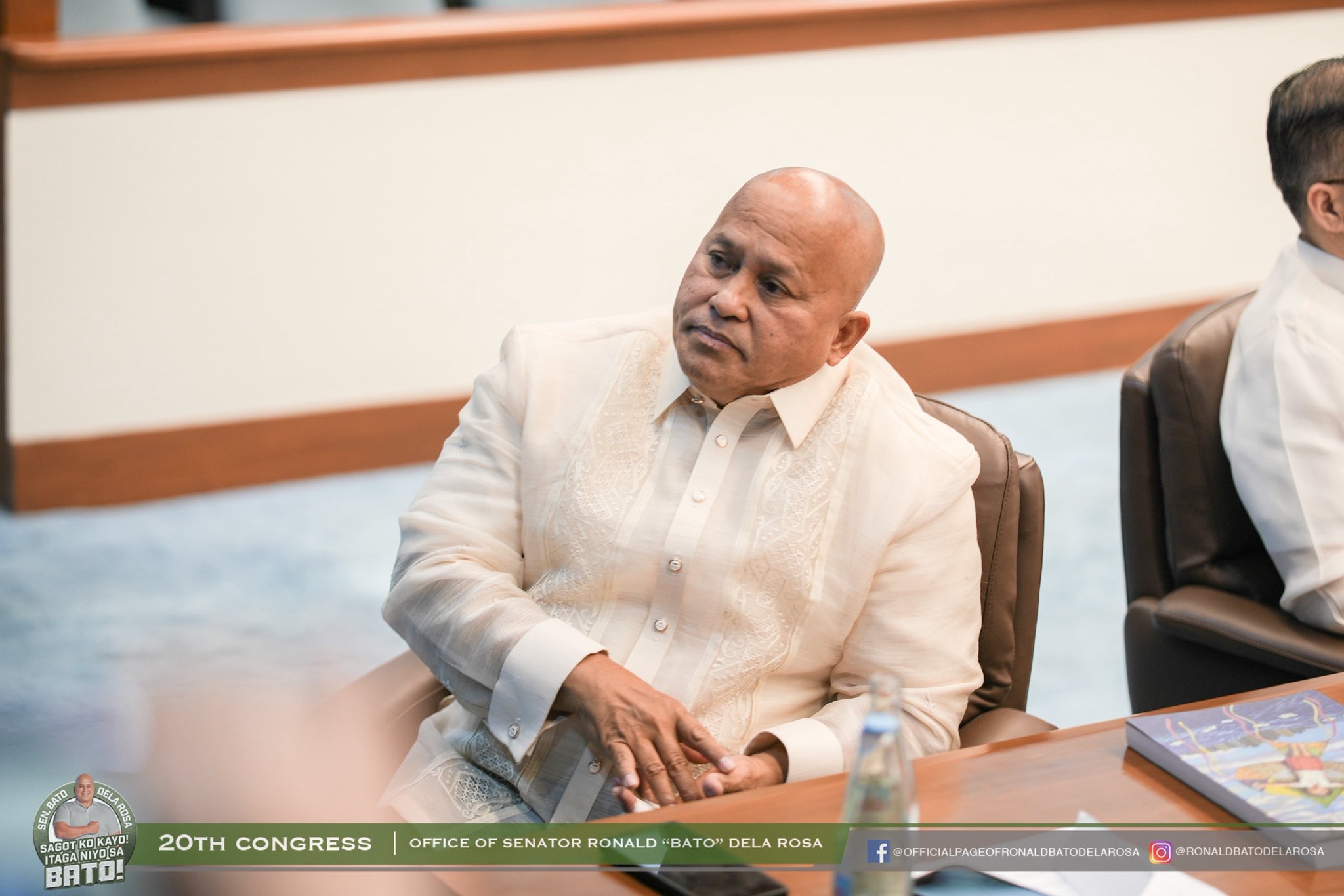

The Philippine government has formally asked the Supreme Court to dismiss Senator Ronald dela Rosa’s bid to block his arrest under an International Criminal Court warrant, arguing that the senator has forfeited his right to seek judicial relief by choosing to evade law enforcement.

Solicitor General Darlene Berberabe, in a filing dated May 16, described Dela Rosa as a fugitive who deliberately placed himself beyond the reach of lawful process — a characterization that, under the “fugitive disentitlement doctrine,” strips him of legal standing before the courts.
“Since a fugitive from justice has demonstrated disrespect for legal processes, he or she has no right to call upon the courts and the judicial system to adjudicate any of his or her claims,” the Office of the Solicitor General (OSG) said in its filing.
The ICC Pre-Trial Chamber unsealed an arrest warrant against Dela Rosa on May 11, 2026, charging him as an indirect co-perpetrator of crimes against humanity — specifically murder and attempted murder — committed in connection with the Philippines’ anti-drug campaign between November 1, 2011, and March 16, 2019. He served as chief of the Philippine National Police under former president Rodrigo Duterte, whom the ICC has separately charged and detained in The Hague.
The OSG reconstructed Dela Rosa’s movements as evidence of deliberate evasion. It said the senator had gone into hiding for six months after reports emerged that an ICC warrant might be issued. He resurfaced on May 11 — the same day the House of Representatives impeached Vice President Sara Duterte — to cast the deciding 13th vote that installed Senator Alan Peter Cayetano as Senate president. He then departed the Senate premises at around 2:30 a.m. on May 14, reportedly in the company of Senator Robinhood Padilla, shortly after the chamber placed him under what it called “protective custody.”
“The essence of being a fugitive from justice lies in the deliberate act of placing oneself beyond the reach of law enforcement,” the OSG said. “This essence is precisely reflected in Senator dela Rosa’s deliberate evasion of arrest.”
Dela Rosa had argued that arresting him solely on the basis of an ICC warrant would violate the Philippine Constitution’s requirement that a local court make an independent determination of probable cause. The OSG rejected that position, pointing to Section 17 of Republic Act 9851 — the Philippine Act on Crimes Against International Humanitarian Law — which it said allows authorities to surrender accused persons to an appropriate international court without a separate domestic warrant.

The OSG also dismissed Dela Rosa’s due process objection, noting that the Rome Statute contains its own judicial safeguards. Under Article 58 of the Rome Statute, an arrest warrant may only be issued after the Pre-Trial Chamber finds reasonable grounds to believe the individual committed a crime within the court’s jurisdiction.
“The issuance of the ICC warrant itself already presupposes judicial evaluation and independent determination by a competent tribunal, in compliance with the basic requirements of due process,” the government said.
On the question of parliamentary immunity, the OSG said the shield does not apply because the charges carry penalties far exceeding six years — the constitutional threshold below which sitting legislators are protected from arrest while Congress is in session. Crimes against humanity under RA 9851 carry a minimum of 14 years and up to life imprisonment. Section 9 of the same law explicitly provides that membership in a legislative body “shall in no case exempt a person from criminal responsibility” for such offenses.
Dela Rosa had also argued that the Philippines’ March 2019 withdrawal from the Rome Statute extinguished any obligation to cooperate with the ICC. The OSG countered by citing the Supreme Court’s 2021 ruling in Pangilinan v. Cayetano, which held that a withdrawing state remains bound by obligations arising from proceedings initiated before the withdrawal took effect. It further argued that the prohibition on crimes against humanity has reached the status of jus cogens — a peremptory norm of customary international law that no state may override — and that the Constitution’s incorporation clause makes such norms part of domestic law.
The OSG also pushed back on Dela Rosa’s request that the court apply extradition rules by analogy, calling it a “false equivalence.” ICC surrender and state-to-state extradition, it said, are governed by entirely different legal frameworks, institutional relationships, and domestic mechanisms.
The Department of Justice has said the ICC warrant will be served only after the Supreme Court rules on Dela Rosa’s petition — unless he attempts to leave the country, in which case he would be immediately detained. His current whereabouts remain unknown.
“The rule of law is not a convenience to be embraced in moments of protection but discarded in moments of accountability,” the OSG said.
