



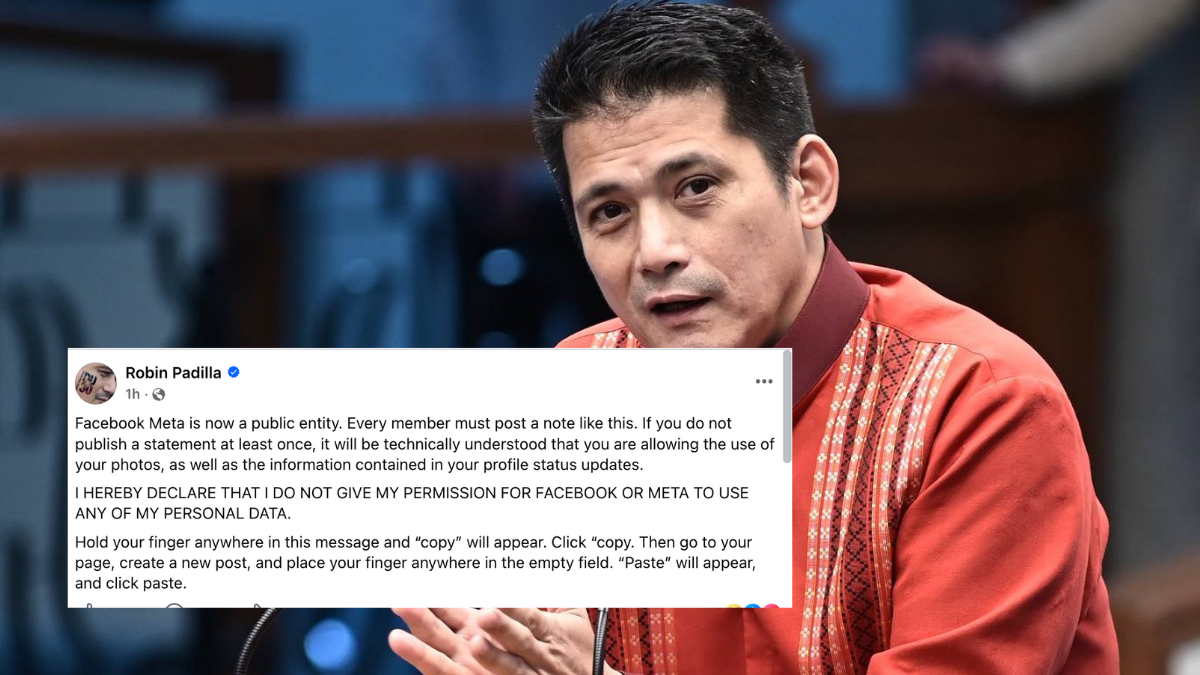

Senator Robin Padilla, one of the Philippines’ most prominent lawmakers and currently the country’s top-voted senator, became the subject of widespread ridicule online after sharing a long-debunked internet hoax on his official verified Facebook page — a copy-paste chain message falsely claiming that posting a personal declaration can legally prevent Meta from using your data.

The post, which appeared on Padilla’s verified account and quickly drew thousands of reactions and shares, read in part: “Facebook Meta is now a public entity. Every member must post a note like this. If you do not publish a statement at least once, it will be technically understood that you are allowing the use of your photos, as well as the information contained in your profile status updates.” It concluded with an all-caps declaration: “I HEREBY DECLARE THAT I DO NOT GIVE MY PERMISSION FOR FACEBOOK OR META TO USE ANY OF MY PERSONAL DATA.”
The post instructed followers to copy and paste the text to their own pages — the hallmark of a viral chain message.
A hoax as old as the internet
The message is not new. According to fact-checking website Snopes.com, this particular copy-paste chain message is “one of the oldest and more persistent rumors in internet history,” having circulated in various forms for well over a decade. Snopes has debunked multiple versions of this exact text, noting that copying and pasting such a declaration onto one’s profile “will not change anything about the fact that they already agreed to the company’s terms of service and privacy policy when they signed up for an account.”
In short: a Facebook post, no matter how boldly worded, carries no legal weight against Meta’s terms of service, which users agree to upon registration.
Filipinos react: Ridicule and disbelief

The comments section of Padilla’s post erupted with a mix of laughter, disbelief, and exasperation — particularly given that the senator sits on the Senate Committee on Public Information and Mass Media and has authored legislation related to social media regulation.
“Senador na naniniwala sa chain message hahahahahahahahahahahahaha,” (A senator who believes in a chain message) wrote verified personality Gabe Pineda, garnering over 100 reactions.
Others were blunter. “Wow, for a supposed ‘lawmaker’ you should be able to distinguish truth from hoax pero huh HAHAHAHAHA,” wrote one commenter. Another simply asked: “Where’s the brain?“
Several commenters called it an embarrassment to the office. “Just a reminder na senator to” (Just a reminder, this person is a senator), one user wrote, accompanied by laughing emojis. One commenter, Khel Pabilona, offered a more substantive rebuttal, pointing out that even if such a post were legitimate, it would be ineffective for public-profile users: “Kahit ipost po yang declaration of not giving permission to meta eh kung public naman po ang profile ng isang user sa Facebook eh makukuha pa rin po personal data na publicly available.” (Even if you post that declaration of not giving permission to Meta, if a user’s profile is public on Facebook, the publicly available personal data can still be accessed.)
The irony is hard to miss
The backlash carries a particular sting given the context. Senator Padilla has been publicly vocal about protecting Filipinos online — he has filed Senate Bill 601, which seeks to limit addictive social media features targeting children. He also chairs the Senate committee overseeing public information and media.
Padilla also previously warned the public about fake news and scam pages misusing his name, including a fraudulent scholarship scheme circulating on Facebook. In that instance, his office urged Filipinos to be “vigilant and critical” of dubious online posts.
