



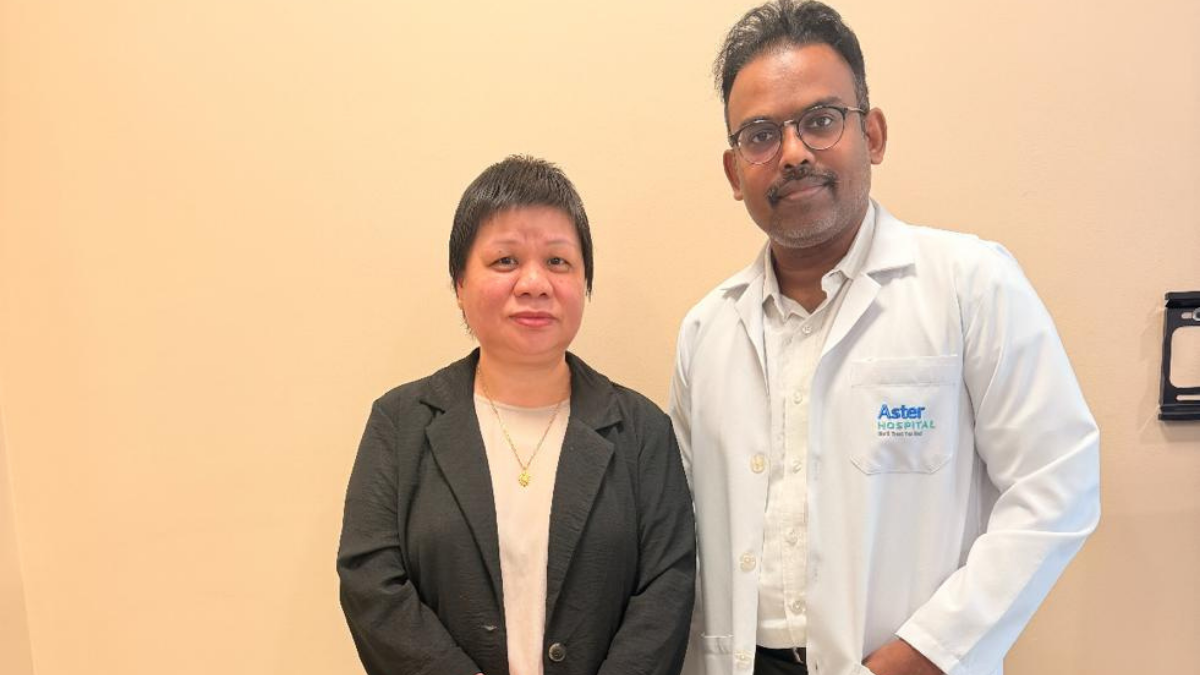

A Filipino logistics worker based in the UAE has made a complete recovery after undergoing emergency neurosurgery for a deep-seated brain tumor that threatened major blood vessels in her brain, doctors at Aster Hospital Al Qusais announced.

Eliza, 48, had spent nearly five months seeking answers for recurring headaches that came with nausea and vomiting. Early consultations pointed to migraine or vertigo — a misread of symptoms that delayed the identification of a more serious underlying condition. It was only after advanced imaging was ordered that an MRI revealed a parafalcine supratentorial meningioma, a roughly 3-centimeter tumor exerting significant pressure on surrounding brain structures.
While meningiomas rank among the most frequently occurring primary brain tumors, the parafalcine supratentorial variant accounts for only 5 to 11 percent of such cases. Their position deep within the brain makes surgical access especially difficult — a challenge compounded in Eliza’s case by the tumor’s proximity to the superior sagittal sinus, the major vein responsible for draining blood from the brain.
Specialist Neurosurgeon Dr. Chelladurai Pandian Hariharan led the seven-hour operation alongside Dr. Manish Srinivasa Murthy, Head of Department and Specialist in Anesthesiology and Medical Director at the hospital. The surgical team used a combination of intraoperative monitoring, microscope-assisted techniques, and ultrasound guidance. Surgeons accessed the tumor by opening the skull at the back of the head, partially resected the mass, then repaired the brain’s outer covering and reconstructed the skull using the patient’s own bone.
“This case was particularly complex because the tumor was located deep within the brain and involved the superior sagittal sinus, one of the major veins responsible for draining blood from the brain,” Dr. Chelladurai said. “Any surgical manipulation in this area carries risks such as significant bleeding, stroke, or brain swelling. With advanced neurosurgical techniques and continuous intraoperative monitoring, we were able to carefully remove the tumor while protecting critical brain structures. Early diagnosis and timely surgical intervention are crucial to preventing serious neurological complications.”

Dr. Manish described the procedure as requiring careful coordination across the medical team. “Managing tumors located near major venous structures requires meticulous planning and a multidisciplinary approach,” he said. “The use of modern surgical technologies such as neuromonitoring and microscope-assisted precision allowed us to perform the surgery safely while minimizing risks. This case demonstrates how coordinated care, from diagnosis through surgery and post-operative recovery, can significantly improve outcomes for patients with complex neurological conditions.”
Eliza spent three days under observation in the intensive care unit, where serial CT scans tracked her progress. She was subsequently moved to a general ward and discharged without any neurological deficits. Radiation therapy completed in July 2025 resulted in full resolution of the tumor.
“For months, I believed my headaches were just migraines, but Dr. Chelladurai was the first to identify the real problem,” Eliza said. “I am deeply grateful to him, Dr. Manish, and the entire medical team at Aster Hospital Al Qusais for saving my life. The care, reassurance, and professionalism I received throughout my treatment — from diagnosis to surgery and recovery — were truly exceptional. Today I am healthy, back at work, and able to spend time with my family because of their dedication.”
She has since returned to her logistics role and to her husband and two children in the UAE.
